Older adults prioritising fibre
For someone who eats ordinary textures, wholewheat pasta offers a way to consider fibre within a familiar meal. The NHS identifies wholewheat pasta as a wholegrain option for increasing fibre intake.


For an older adult who eats ordinary textures, wholewheat pasta is worth considering when fibre is the priority, but choose a type they will eat and plan the rest of the meal rather than relying on pasta alone. Compare jarred sauces by their stated serving as well as per 100g. If the person has a prescribed swallowing plan, select and prepare food to that individual plan instead of assuming standard pasta or a smooth sauce is suitable.
For someone who eats ordinary textures, wholewheat pasta offers a way to consider fibre within a familiar meal. The NHS identifies wholewheat pasta as a wholegrain option for increasing fibre intake.
For an older adult who prefers a familiar pasta dish, the choice also includes what protein food and vegetables they will eat with it. NHS Dumfries and Galloway discusses protein as part of eating well in later life.
When a person has a prescribed texture-modified diet, their individual plan determines whether and how pasta and sauce can be served. The International Dysphagia Diet Standardisation Initiative (IDDSI) calls for food to be tested under its intended serving conditions.
Start with any prescribed texture requirements; for ordinary-texture meals, weigh fibre, meal accompaniments and sauce labels against what the person will eat.
| Concern | What to check | Who this matters to |
|---|---|---|
| Fibre | Check for wholewheat pasta and compare fibre figures only when the labels use the same cooked or dry basis. | If I want more fibre in a pasta meal and ordinary textures are suitable, the pasta itself is a useful place to start; about 40% of consumers put this need first. |
| Meal composition | Read the stated protein serving value and plan a protein food the person will eat alongside the pasta. | When appetite is limited, I want the familiar pasta dish to include more than pasta and sauce; for about 30% of consumers, building the rest of the meal is the primary concern. |
| Prescribed texture | Check the individual IDDSI level and whether the prepared dish can be tested as required at serving conditions. | If I am shopping to a swallowing plan, I need the finished dish to meet that plan rather than relying on a packet description; this comes first for about 20% of consumers. |
| Sauce and preparation | Compare sauce salt per 100g and per stated serving, and check how many servings the jar contains. | On days when preparing a meal needs to be simpler, I want a convenient sauce without losing sight of its label; about 10% of consumers make this their main purchasing concern. |
A texture description on a packet does not establish that the finished meal meets an individual’s prescribed IDDSI level. Texture errors can carry choking or aspiration risks.
Follow the person’s current care plan and the required preparation and testing method. IDDSI specifies testing under intended serving conditions.
Wholewheat pasta can help with a fibre-led choice, but its flavour and texture may not appeal to everyone. The meal still needs to work for the person eating it.
Try it in a dish they accept, or choose a familiar pasta and consider other suitable foods in the meal.
Dolmio lists 1.4g protein per 112g serving for its Original Bolognese sauce and 1.6g for its Smooth Tomato Bolognese sauce. A sauce portion should not stand in for planning the meal’s protein food.
Choose an accompaniment the person can eat, taking account of any allergy, dietary or swallowing requirements.
A cooked serving and a dry-weight portion are different measurement bases, so their fibre or protein figures should not be treated as like-for-like.
Check the preparation state and serving size printed beside each value before comparing pasta labels.
Tesco Whole Wheat Fusilli is a wholewheat dried-pasta option for ordinary-texture meals.
M&S Wholewheat Penne is a dried-pasta option when the pack’s fibre information matters to the choice.
Barilla Whole Wheat Spaghetti provides an identified wholewheat spaghetti option.
Dolmio’s Original and Smooth Tomato Bolognese sauces are jarred accompaniments for pasta meals.
These Morrisons wholewheat fusilli listings are options for an older adult who eats ordinary pasta textures and wants a dried storecupboard staple. Check the pack and the planned meal before choosing between them.
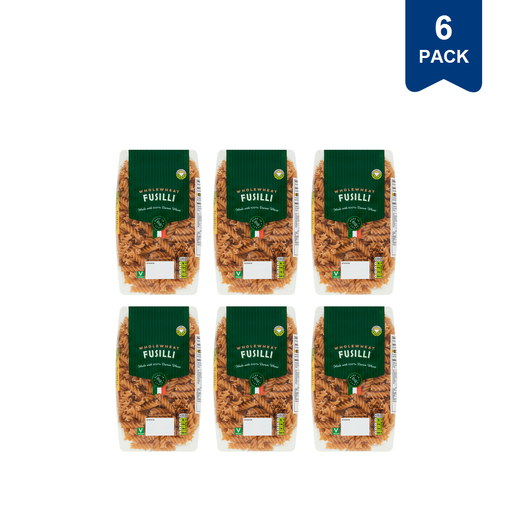 Image unavailable
Consider this dried wholewheat fusilli for an ordinary-texture meal where pasta is one part of the plate. The title says six 500g packs, but the accompanying gross-weight description says 500g; confirm the bundle quantity before ordering. Do not use the standard pasta description to judge suitability for a prescribed swallowing plan.
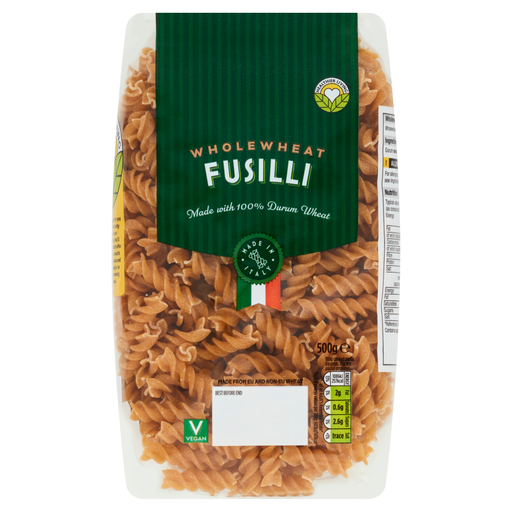 Image unavailable
This 500g dried wholewheat fusilli listing suits a plan for ordinary-texture pasta with separately chosen meal accompaniments. Check the pack’s nutrition basis before comparing its figures with another pasta, and follow an individual care plan if a modified texture is required.
No. It is an option when fibre is the priority and ordinary pasta textures are suitable, but the person’s preferences, meal accompaniments, allergies and any prescribed texture requirements also affect the choice.
Plan the pasta as the starchy base, then choose a protein food and vegetables the person will eat and can have under any dietary or swallowing plan. NHS Dumfries and Galloway’s older-adult guidance discusses the importance of protein-containing meals and snacks.
Use it only if the person’s individual swallowing plan permits the prepared dish and it meets the required texture tests under serving conditions. Neither soft-cooking instructions nor a smooth-labelled sauce establish that result; IDDSI places individual recommendations with the assessing clinician.
Read the salt value per 100g and per serving, then consider the amount of sauce used. Dolmio lists 0.75g salt per 112g serving for both its Original and Smooth Tomato Bolognese sauces; check the current jar when buying.
Follow the instructions on the pack. Tesco and Marks & Spencer specify a cool, dry place for their cited dried-pasta products; check the physical label for current storage instructions and ingredients.