Shoppers avoiding added sugars
You want to distinguish a no-added-sugar sauce from one with a lower total-sugars figure. The NHS notes that naturally occurring sugars still appear in the total-sugars value.


Choose a no-added-sugar sauce if avoiding added sugars is your priority; if you want to compare total sugars, use the per-100g figures on the exact sauce labels instead. A plain pasta salad gives you control over its ingredients, but whichever dish you prepare, check allergens and plan how cooked pasta will be cooled and kept chilled for the picnic.
You want to distinguish a no-added-sugar sauce from one with a lower total-sugars figure. The NHS notes that naturally occurring sugars still appear in the total-sugars value.
You need to compare sugars, salt, ingredients, allergens and the amount of sauce you will serve, rather than rely on one front-of-pack message.
You plan to prepare pasta before travelling and need to allow for cooling, refrigeration and transport of the finished dish.
A no-added-sugar claim and a total-sugars value answer different questions. Compare the exact sauce labels for the result you want, then consider how you will handle the prepared picnic dish.
| Concern | What to check | Who this matters to |
|---|---|---|
| Avoiding added sugars | Read the exact pack’s claim and ingredients, then check total sugars per 100g. No added sugar does not mean sugar-free. | If my priority is avoiding added sugars, I need to know what the sauce claim covers before choosing it. About 42% of consumers put that need first. |
| Comparing the whole label | Compare like-for-like sauces using sugars and salt per 100g; check ingredients, allergens and the amount your recipe uses. | When serving several people, I want the sauce quantity and ingredient list to work for the whole group, not just a favourable front-of-pack claim. For about 33% of consumers, that broader label comparison comes first. |
| Handling prepared pasta | Check storage instructions after opening and plan cooling, refrigeration and chilled transport for the cooked dish. | If I make pasta before leaving, I need to keep the finished dish appropriately chilled on the journey. Picnic handling is the primary concern for about 25% of consumers. |
According to the NHS, naturally occurring sugars are included in the total-sugars figure. A no-added-sugar claim therefore cannot tell you which sauce has the lower total.
Read the claim and compare total sugars per 100g on the exact packs.
The NHS explains that nutrition labels show values per 100g and may also show values per portion. The stated portion might not be the amount you put in your pasta dish.
Compare sauces on the same per-100g basis, then use the quantity planned for your recipe to assess the finished dish.
Storage instructions for an unopened sauce do not describe how to keep a prepared pasta dish. Cooked pasta and any chilled additions need their own cooling and storage plan.
Cool the prepared dish promptly, refrigerate it and arrange chilled transport where needed. Follow the storage instructions for its ingredients.
A sauce range to consider if avoiding added sugar is your main requirement.
A tomato-sauce range to compare by the ingredients and nutrition panel of each jar.
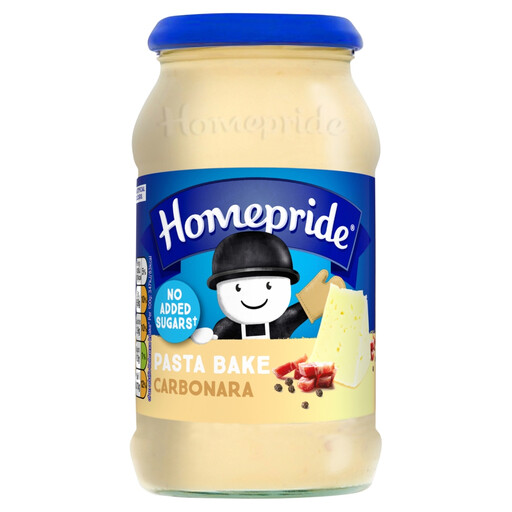
This selection is a no-added-sugar carbonara pasta-bake sauce for a cooked pasta dish. Consider its cooking directions and how you would cool and transport the finished dish before choosing it for a picnic.
 No image available
Consider this sauce if avoiding added sugar in a cooked pasta bake is your priority, rather than choosing a ready-to-eat pasta salad.
The 485g product is labelled no added sugar, which does not mean sugar-free. Its listing identifies bacon (pork), milk, barley, celery and egg; check the exact pack against your group’s needs. Follow its directions to cook the food fully and serve it piping hot. If preparing it ahead, plan cooling, refrigeration and transport for the finished dish.
No. A no-added-sugar claim concerns sugars or foods used for sweetening that have been added; it does not guarantee zero total sugars. The NHS explains that naturally occurring sugars are included in the total-sugars figure, so check the nutrition panel too.
Compare total sugars per 100g on the exact packs, then check salt, ingredients, allergens and how much sauce you will use. The NHS notes that labels may also give per-portion values, but your recipe may use a different amount.
Yes, if you can cool, refrigerate and transport the prepared dish appropriately. NHS food-safety guidance advises cooling cooked food as quickly as possible, ideally within 1 to 2 hours, before refrigerating it; follow any more restrictive instructions for the ingredients you use.