Shoppers avoiding added sugar
If you want a convenient tomato sauce without added sugar, check the ingredients as well as the total sugars shown per 100g. A no-added-sugar claim does not mean a sauce contains no sugars.


When choosing pasta sauce for a weight-management meal, compare total sugars, calories and salt per 100g rather than relying on a no-added-sugar or low-fat claim alone. If avoiding added sugar is your priority, check both the claim and the ingredients; whichever sauce you choose, consider how much sauce, pasta and other ingredients you plan to serve.
If you want a convenient tomato sauce without added sugar, check the ingredients as well as the total sugars shown per 100g. A no-added-sugar claim does not mean a sauce contains no sugars.
If you plan the amount of food on your plate, the sauce is only one consideration. The pasta portion and additions such as cheese, oil or mince also affect the meal you serve.
If you are willing to consider sauces with different claims, compare their sugars, calories and salt on the same per-100g basis before deciding how much to use.
Compare sauce figures per 100g before allowing for the amount you will serve. The NHS describes 5g of sugars or less per 100g as low for foods, and 0.3g of salt or less per 100g as low in salt.
| Concern | What to check | Who this matters to |
|---|---|---|
| Avoiding added sugar | Read the ingredients and the total “of which sugars” figure per 100g; a no-added-sugar claim does not replace either check. | When I want a ready-made sauce without added sugar, I still need to know how much total sugar it contains. About 42% of consumers put avoiding added sugar first. |
| Planning the whole meal | Compare sauce calories per 100g, then consider the sauce and pasta portions and any additions. | If I am planning a pasta meal, choosing the jar alone does not settle what will be on my plate. About 33% of consumers prioritise whole-meal portions and energy. |
| Balancing label figures | Put sugars, calories and salt side by side on a per-100g basis rather than choosing from one front-of-pack claim. | When several jars look suitable, I want to weigh their different label figures before choosing. About 25% of consumers put that comparison first. |
Tesco Groceries lists sugar among the ingredients of Dolmio Bolognese Low Fat sauce. Its low-fat positioning does not answer whether you want to avoid added sugar.
Decide which label figure or ingredient matters most to you, then check the ingredients and per-100g panel separately.
The NHS notes that a manufacturer’s serving size may differ from the amount you use. Pasta and added ingredients also contribute to the meal.
Compare jars per 100g first, then consider the amounts of sauce and pasta you intend to serve.
A lower sugars figure does not establish that a sauce is also low in salt. The NHS uses 0.3g of salt or less per 100g as its low-salt benchmark for foods.
Check salt beside sugars and calories, particularly when choosing between sauces with different claims.
Its Tomato & Basil No Added Sugar sauce is an option when avoiding added sugar is the main requirement.
Its no-added-sugar pasta sauce line and Bolognese Low Fat sauce serve different label priorities.
Its tomato sauces offer label figures to compare without assuming that a particular front-of-pack claim settles the choice.
Its 400g Arrabbiata is a tomato-and-chilli sauce for shoppers considering that flavour.
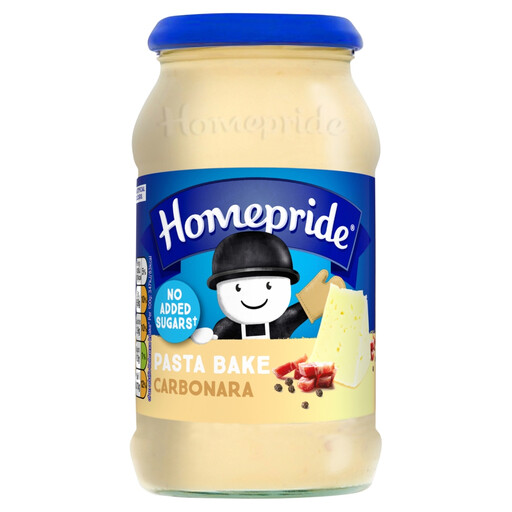
These selections include a no-added-sugar carbonara-style pasta-bake sauce and two tomato-based pasta sauces. Compare their labels for the meal you intend to make; the carbonara-style sauce is not interchangeable with a tomato sauce.
 No image available
Consider this for a pasta bake when avoiding added sugar matters more to you than choosing a tomato sauce. Its listing reports 1.1g sugars and 83kcal per 100g; compare the listed 5.7g fat and 0.6g salt per 100g as well. The listing identifies barley, celery, eggs and milk as allergens, so check the current pack before use.
 No image available
Consider this tomato-and-chilli sauce if you want to compare total sugars and calories per 100g. Its listing reports 4.2g sugars, 52kcal and 0.94g salt per 100g. If avoiding added sugar is essential, check the current pack’s ingredients and claims rather than relying on the total-sugars figure.
 No image available
Consider this tomato-and-cheese sauce if its flavour suits your meal and you want per-100g figures to compare. Its listing reports 4.7g sugars, 95kcal and 0.74g salt per 100g. Check the current pack before relying on a no-added-sugar claim: the listing also names apple juice concentrate among the ingredients.
No. Check total “of which sugars” on the nutrition panel as well as the no-added-sugar claim. For example, the Joybuy listing for Mutti Tomato & Basil No Added Sugar sauce gives 4.5g sugars per 100g.
Choose according to the figure that matters most to your meal plan, then check the others rather than treating one number as the whole answer. Compare sauces per 100g and consider the amount you will serve with the pasta and any additions.
No. Tesco Groceries lists sugar among the ingredients of Dolmio Bolognese Low Fat sauce. Read the ingredient list if avoiding added sugar is your priority, even when the front of the jar highlights fat.
Follow the storage instructions for the individual sauce. Marks & Spencer says to refrigerate its Tomato and Basil Pasta Sauce after opening and use it within 3 days, while the Joybuy listing for Mutti Tomato & Basil No Added Sugar says to refrigerate it and consume it within 5 days. Check the pack you buy rather than transferring one sauce’s period to another.