Lunch planners comparing sugar labels
If sugar is your main buying concern, you need to distinguish the claim on the front of a jar from the sugars figure in its nutrition information.


For an office pasta lunch, compare sugars per 100g rather than treating ‘no added sugar’ as ‘sugar-free’ or as a ‘reduced sugar’ claim. UK legislation requires a reduced-sugar claim to be based on at least 30% less sugar than a similar product. Among the two ready-to-use tomato sauces compared here, Sainsbury’s lists less sugar per 100g, while Tesco states a longer refrigerated use period after opening; choose according to the portions you will prepare and when you will use the jar.
If sugar is your main buying concern, you need to distinguish the claim on the front of a jar from the sugars figure in its nutrition information.
Jar size, portions and the instruction for using sauce after opening matter when one pack needs to cover more than one lunch.
A ready-to-use jar needs less preparation than passata. Check the recipe and ingredient information if those differences affect what you can prepare at home.
For an office pasta lunch, settle the concern that matters most to your choice, then compare the relevant information on similar packs.
| Concern | What to check | Who this matters to |
|---|---|---|
| Sugar claims | Read the exact claim, then compare sugars per 100g on similar ready-to-use sauces. | I want to know what is in my office lunch, not assume that ‘no added sugar’ means no sugars. About 46% of consumers would make the sugar comparison their primary concern. |
| Portions and storage | Compare pack size and servings, then follow the jar’s refrigerated use period after opening. | If I prepare several lunches from one jar, I need to use the remainder within its stated period. Matching the pack to that routine comes first for about 27% of consumers. |
| Preparation and reheating | Check whether the product is a finished sauce or a base; follow reheating instructions for a cooked lunch. | I need a preparation routine that works at home and a way to reheat my lunch thoroughly at work. About 27% of consumers would put that practical concern first. |
Tesco Groceries lists 4.5g sugars per 100g for its no-added-sugar Bolognese sauce, and Sainsbury’s lists 3.9g per 100g for its no-added-sugar Tomato & Hidden Veg sauce. Neither claim by itself establishes a comparative reduction.
Read the wording on the pack and compare the sugars figures for similar sauces on a per-100g basis.
The same Tesco and Sainsbury’s product listings give salt figures of 0.64g and 0.61g per 100g respectively. A sugar claim does not describe the sauce’s salt content.
Compare salt per 100g and consider how much sauce you intend to use in one lunch.
The Tesco 500g sauce says to refrigerate and consume it within 14 days of opening; the Sainsbury’s 500g sauce says to refrigerate and use it within seven days.
Plan the lunches you will make from the jar and note when you opened it.
Unused sauce may need to be discarded if it passes the pack’s after-opening instruction.
The Food Standards Agency warns that microwaved food can be hot at the edges while remaining cold in the centre.
Use a microwave-safe container, stir where practical, allow any instructed standing time and check that the centre is thoroughly hot. The agency advises reheating food only once.
An own-label, ready-to-use no-added-sugar Bolognese sauce to compare for office lunch portions.
An own-label, ready-to-use tomato and hidden-vegetable sauce labelled no added sugar or sweetener.
Dolmio UK describes a no-added-sugar pasta sauce range, including a tomato and roasted garlic recipe.
A passata option if you prefer to cook and season a tomato sauce before packing lunches.
This carbonara pasta bake sauce is an option for preparing a pasta lunch ahead of work. It is a different recipe from the ready-to-use tomato sauces compared above, so check its own pack rather than applying their nutrition or storage figures to it.
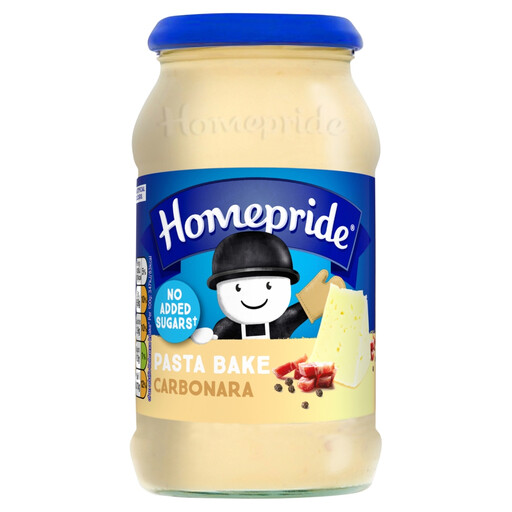 Image unavailable
Consider this 485g carbonara pasta bake sauce if baking pasta at home suits your office lunch preparation. Its no-added-sugar name does not establish a comparative reduced-sugar claim; check the pack’s nutrition, ingredients, preparation and after-opening instructions for your planned portions.
No. Tesco Groceries lists 4.5g sugars per 100g for its No Added Sugar Bolognese sauce, while Sainsbury’s lists 3.9g per 100g for its No Added Sugar Tomato & Hidden Veg sauce. Check the sugars figure rather than assuming either claim means zero.
Under UK legislation on nutrition claims, a reduced-sugar claim requires at least 30% less sugar than a similar product. Check whether the pack actually makes that comparative claim; ‘no added sugar’ is different wording.
Sainsbury’s lists 3.9g sugars per 100g for its No Added Sugar Tomato & Hidden Veg sauce, compared with Tesco Groceries’ 4.5g per 100g for its No Added Sugar Bolognese sauce. That comparison concerns these specific 500g products, not every sauce from either retailer.
Follow the microwave and food instructions, stir where appropriate and allow any instructed standing time. Check that the centre is thoroughly hot: the Food Standards Agency warns that microwave heating can be uneven and advises reheating food only once.
Follow that jar’s label. Tesco Groceries says its No Added Sugar Bolognese sauce should be refrigerated and consumed within 14 days of opening; Sainsbury’s says to refrigerate its No Added Sugar Tomato & Hidden Veg sauce and use it within seven days. Those instructions are specific to the named products.