Salt-first lunch planners
Parents or carers willing to cook a sauce from tomatoes or passata so they can compare the declared salt in the base and account for what they add.


For a secondary-school packed lunch, plain chopped tomatoes or passata have lower declared salt figures than the ready-made sauces checked, but they need preparing as a sauce. If preparation time matters more, consider a sauce labelled reduced salt and compare the salt per 100g and the amount used; check the current sauce and pasta labels and the school’s packed-lunch policy before packing.
Parents or carers willing to cook a sauce from tomatoes or passata so they can compare the declared salt in the base and account for what they add.
Households looking for a ready-seasoned sauce that is labelled reduced salt, while still checking its salt figure against the portion they will pack.
Families who need to check the exact sauce and pasta labels and their school’s rules rather than assume a tomato-based sauce either contains gluten or is gluten free.
For a secondary-school pasta lunch, start with the salt shown on the pack and the amount of sauce used, then decide whether there is time to prepare a tomato base. The NHS advises a maximum of 6g of salt a day for children aged 11 and over; the sauce is only one part of the day’s food.
| Concern | What to check | Who this matters to |
|---|---|---|
| Declared salt | Compare salt per 100g on the exact pack and the amount going into the lunch portion. Include any salt from ingredients added to a homemade sauce. | When I prepare pasta for school, I want to know how much salt the sauce contributes once I have added the other ingredients. About 50% of consumers put declared salt first. |
| Preparation time | Decide whether there is time to make a sauce from tomatoes or passata, cool the meal and portion it. Check the jar’s storage instructions after opening. | If lunch needs preparing quickly, I want a seasoned sauce rather than another ingredient to cook. About 30% of consumers prioritise ready-to-use convenience. |
| Allergens and school rules | Read the current sauce and pasta labels, then check the individual school’s packed-lunch and allergy policy. | If allergens or school rules affect what I can pack, I need to confirm the actual products before making lunch. About 20% of consumers put those checks first. |
Chopped tomatoes and passata offer a starting point, not the seasoning and preparation of a ready-made pasta sauce.
Choose them when you have time to make the sauce, cool the meal and check the ingredients you add.
Tesco Groceries lists 0.64g salt per 100g for Tesco No Added Sugar Bolognese and 0.67g per 100g for Dolmio Low Fat Bolognese. Neither name establishes that the product is reduced salt.
Compare the salt line per 100g and the amount you will serve instead of relying on a no-added-sugar or low-fat description.
A tomato-based name does not establish whether the sauce contains gluten; the pasta needs checking too. GOV.UK says allergens present in prepacked food must be declared in the ingredients list.
Read both current labels. Where gluten avoidance is necessary, look for an explicitly gluten-free product and check the school’s own policy.
The lunch depends on the formulation and storage directions of the products actually being used.
Before packing, check the physical pack’s ingredients, allergen declaration, salt figure and storage instructions.
Chopped tomatoes and passata for making a sauce rather than opening a finished jar.
Plain own-label chopped tomatoes for a homemade sauce.
A ready-to-use tomato-and-basil sauce for shoppers seeking a product labelled reduced salt.
The checked own-label bolognese sauce offers a ready-made option, but its no-added-sugar name addresses a different question.
The checked Low Fat Bolognese is a ready-made sauce to assess by its salt figure, not its low-fat name.
These passata products suit a pasta lunch made from a tomato base. Check the salt on the pack and allow for any ingredients added; neither selection stands in for a ready-to-use sauce labelled reduced salt.
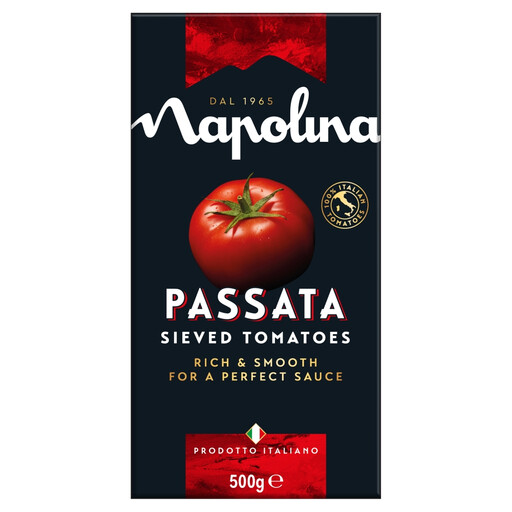 Image unavailable
For a lunch you can prepare ahead, this passata provides a smooth tomato base to make into a sauce.
The product information lists 0.12g salt per 100g. Allow time to prepare and cool the meal, and check the current passata and pasta labels before packing.
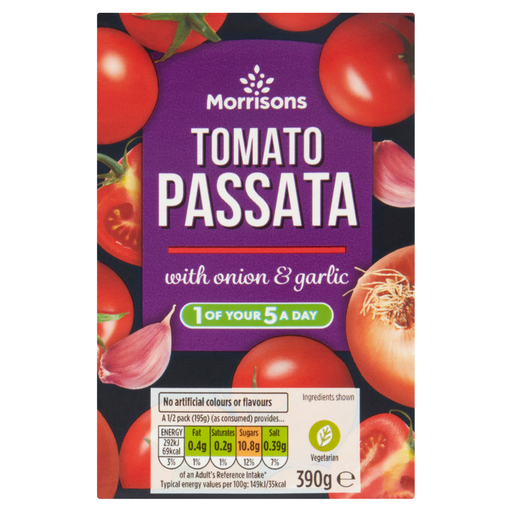 Image unavailable
For a tomato base that already includes onion and garlic, this passata offers a different starting point from plain passata.
The product information lists 0.2g salt per 100g and 0.39g per stated 195g serving. It is not identified as reduced salt; check the current labels and the amount used in the lunch.
Compare the salt per 100g on each exact pack, then consider how much goes into the lunch portion and what you add while cooking. ASDA Groceries lists 0.01g per 100g after hob heating for its checked chopped tomatoes, while Waitrose & Partners lists 0.48g per 100g for the checked Mr Organic ready-made sauce; the tomatoes still need preparing as a sauce.
No category-wide assumption is safe: check the current sauce and pasta labels. GOV.UK says allergens present in prepacked food must be declared in the ingredients list; where gluten avoidance is necessary, choose products explicitly labelled gluten free rather than relying on a tomato-based name.
Check your child’s school instead. Department for Education guidance for England says schools must publish an allergy safety policy, but the packing arrangements you need to follow are those in the individual school’s current policy.
Follow that product’s instructions for storage after opening and use. Check the pack before preparing a later packed lunch rather than applying one product’s instructions to a different jar or carton.
No. Tesco Groceries lists 0.64g salt per 100g for the checked Tesco No Added Sugar Bolognese and 0.67g per 100g for the checked Dolmio Low Fat Bolognese. Read the salt figure when that is the buying priority.