Salt-conscious family lunch planners
You want to compare sauce labels per 100g and consider how much sauce goes into each serving, rather than judging its salt content by taste.


For a lower-salt school-holiday pasta lunch, start with plain dry pasta and compare sauces by their declared salt per 100g. Barilla lists 0.013g per 100g for Spaghetti N°5, while the tomato sauces listed by M&S, Dolmio UK and Ocado in this comparison range from 0.45g to 0.96g per 100g. If smooth texture or vegetables in the sauce matter more to your household, check the chosen pack’s salt, ingredients, allergens and storage instructions; portion size and cooking additions also affect the finished lunch.
You want to compare sauce labels per 100g and consider how much sauce goes into each serving, rather than judging its salt content by taste.
You want a sauce that fits a straightforward pasta lunch, with a jar size and opened-jar storage period that suit your plans for the next few days.
A smooth sauce or one containing vegetables may fit a child’s preferences. You still need to compare salt declarations and check ingredients and allergens on the exact pack.
Compare sauces on a per-100g basis first, then weigh preparation, leftovers and texture against the lunch you intend to make.
| Concern | What to check | Who this matters to |
|---|---|---|
| Salt in the lunch | Compare sauces by salt per 100g, then consider the amount of sauce served and any salt added during cooking. | When preparing a child’s lunch, I want to know what the sauce contributes before choosing a portion; about 50% of consumers put salt comparison first. |
| Preparation and leftovers | Check how the sauce is prepared, the jar size and its refrigerated use-within instruction after opening. | If one jar needs to cover several lunches, I want a convenient meal without leaving sauce unused; about 30% of consumers put quick preparation and manageable leftovers first. |
| Texture and ingredients | Check whether the sauce is smooth or contains vegetables, then read its salt declaration and allergen information. | When a child is particular about sauce texture or visible vegetables, I want a version they will accept; around 20% of consumers place meal acceptance first. |
Barilla declares 0.013g salt per 100g for its dry Spaghetti N°5. The ready-made sauces listed by M&S, Dolmio UK and Ocado here declare between 0.45g and 0.96g per 100g, so choosing the pasta alone does not settle the sauce comparison.
Compare sauce labels using the same per-100g measure, then account for how much sauce you plan to serve.
Terms such as organic, vegan and gluten-free address different characteristics. Ocado lists 0.90g salt per 100g for Barilla Basilico and 0.96g for Barilla Napoletana, both described as vegan and gluten-free.
Use the nutrition panel, rather than those descriptions, to compare salt.
M&S lists peppers, carrots and courgette in its Tomato and Hidden Veg Pasta Sauce, alongside 0.73g salt per 100g. Its product information also identifies celery and states allergy unsuitability for milk, nuts, peanuts and eggs.
Read the current ingredients and allergen information for the exact sauce before serving it to anyone with an allergy.
Storage instructions differ: M&S says to refrigerate its listed Daylesford tomato-and-basil sauce after opening and use it within five days, while its Hidden Veg sauce has a three-day instruction.
Choose a jar size you can use within the chosen product’s instructions and follow the storage directions on its pack.
Sauce left beyond its stated use-within period may have to be discarded.
A dry-pasta and separate-sauce option for households preparing lunch from components.
Its Smooth Tomato Sauce for Bolognese is a texture-led option to consider with pasta.
M&S lists both Daylesford Organic Tomato and Basil Sauce and its own Tomato and Hidden Veg Pasta Sauce, which meet different lunch preferences.
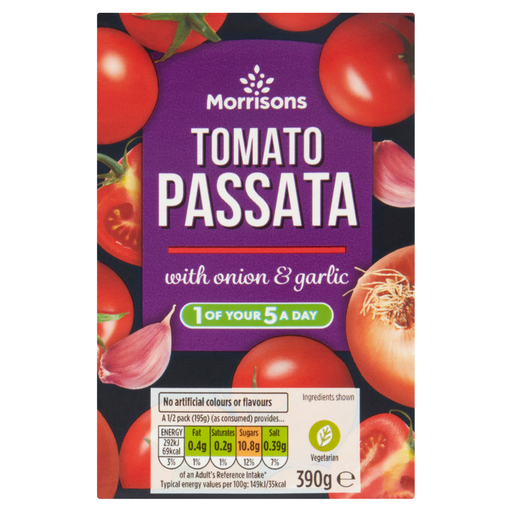
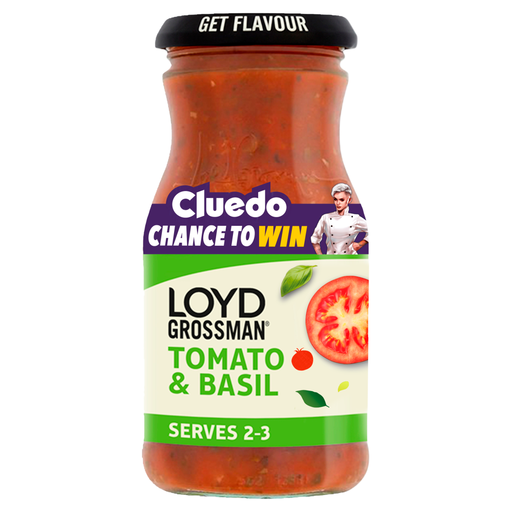
These Joybuy listings offer a passata and a tomato-and-basil sauce to consider alongside dry pasta. Check the current pack before relying on a salt figure or serving either product to someone with an allergy.
 No image available
Consider this onion-and-garlic passata when you want a tomato base for a pasta lunch. Before choosing it for a lower-salt meal, compare the current pack’s salt per 100g with other sauces and check its ingredients and allergen information.
 No image available
Consider this tomato-and-basil sauce if that flavour fits your planned pasta lunch. Compare its current salt declaration per 100g before choosing it for a lower-salt meal; the listing also advises checking a may-contain-nuts warning and using the refrigerated sauce within three days of opening.
Compare their declared salt per 100g, then consider how much sauce each serving uses and whether you add salt during cooking. For context, M&S lists 0.45g per 100g for Daylesford Organic Tomato and Basil Sauce, while Dolmio UK lists 0.67g per 100g for Smooth Tomato Sauce for Bolognese; those label figures are not totals for a finished meal.
The NHS gives maximum daily amounts of 3g for children aged 4 to 6, 5g for ages 7 to 10, and 6g for people aged 11 and over. These are daily amounts, not allowances for a single pasta lunch.
No: those descriptions do not state its salt content. Ocado describes Barilla Basilico and Napoletana sauces as vegan and gluten-free, but lists salt figures of 0.90g and 0.96g per 100g respectively. Read the nutrition declaration for the sauce you intend to use.
Check the ingredients, emphasised allergens and any suitability statements on the exact current pack. M&S lists celery in its Tomato and Hidden Veg Pasta Sauce and states that it is unsuitable for people with milk, nut, peanut or egg allergies; do not assume another sauce has the same information.
Follow the chosen jar’s refrigerated storage and use-within instructions. M&S says to use its listed Daylesford tomato-and-basil sauce within five days of opening, but gives three days for its Tomato and Hidden Veg Pasta Sauce, so the periods are not interchangeable.