Sugar-label comparers
You want a sauce for Christmas pasta and need to compare its total sugars, not just the claim on the front of the jar.


Start with sauces labelled no added sugar, then compare the total sugars shown per 100g; the claim does not mean the sauce is sugar-free. For a Christmas meal, also check the stated servings, salt and ingredients of the sauce and finished dish against your guests’ needs.
You want a sauce for Christmas pasta and need to compare its total sugars, not just the claim on the front of the jar.
You are serving several guests and need to consider portions, flavour and dietary suitability alongside the sugar label.
You need to check the exact sauce and every ingredient added to the finished dish for your guests’ requirements.
For Christmas pasta, compare sauces on the same per-100g basis before checking portions and the ingredients in the complete meal.
| Concern | What to check | Who this matters to |
|---|---|---|
| Total sugars | Compare “of which sugars” per 100g, then consider the amount of sauce served. | If I want to compare what is in each sauce, a no-added-sugar claim alone cannot tell me which has the smaller total-sugars figure. About 42% of consumers put total sugars first. |
| Added sugar | Check the exact no-added-sugar wording and the current ingredient list. | A familiar tomato sauce without added sugar may matter more to me than choosing the smallest total-sugars figure. About 33% of consumers prioritise avoiding added sugar. |
| Guest fit | Check stated servings and salt, plus ingredients relevant to guests’ requirements. | When I am cooking for several guests, the sauce needs to suit the portions and people at the table. For about 25% of consumers, that meal fit is the primary concern. |
NHS guidance explains that naturally occurring sugars appear in the total-sugars figure. Tesco’s No Added Sugar Bolognese sauce lists 4.5g sugars per 100g, while Sainsbury’s No Added Sugar Tomato & Hidden Veg sauce lists 3.9g per 100g.
Use the claim to shortlist sauces, then compare the nutrition panels per 100g and consider your serving size.
Choosing by the sugar label alone does not tell you how much salt the sauce contributes to a portion.
If salt matters for your meal, compare it per 100g and consider how much sauce you will serve.
Tesco and Sainsbury’s describe their 500g no-added-sugar sauces as four-serving jars; the 350g Loyd Grossman No Added Sugar Tomato & Basil sauce is stated to serve two to three.
Check the serving guidance against your guest count and the rest of the dish before deciding how many jars you need.
If the stated servings fall short of your guest count, you may need another jar.
Dolmio describes a specific no-added-sugar sauce, while its Original Bolognese is a separate product. Barilla’s Basilico product information does not make a no-added-sugar claim.
Match the claim and nutrition panel to the complete name on the jar you intend to use.
Tesco lists a 500g No Added Sugar Bolognese Pasta Sauce for a tomato-based pasta meal.
Sainsbury's lists a 500g No Added Sugar Tomato & Hidden Veg Pasta Sauce containing tomatoes, peppers, carrots and onions.
Dolmio describes a specific no-added-sugar pasta sauce made with tomatoes, herbs and spices.
Barilla describes Basilico as a 400g tomato-and-basil sauce and identifies it as gluten free.
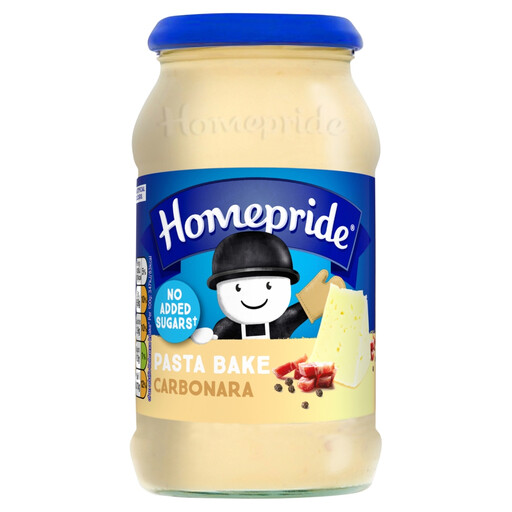
These two sauces offer different pasta-dish formats: a carbonara pasta bake and a tomato, mascarpone and Grana Padano sauce. Check the current pack against your sugar and guest requirements before choosing.
 No image available
Consider this 485g carbonara pasta-bake sauce if you want a no-added-sugar claim for a baked pasta dish. It contains pork bacon and lists milk, barley, celery and egg; check the current pack for guest suitability, total sugars and serving guidance.
 No image available
Consider this 350g tomato and cheese sauce if that flavour suits the pasta you plan to serve. The supplied ingredient information lists apple juice concentrate, milk and egg, so check the current pack’s sugar claim, nutrition panel, ingredients and serving guidance rather than choosing it on the basis of a claim alone.
No. NHS guidance explains that naturally occurring sugars are included in the total-sugars figure. Read “of which sugars” on the nutrition panel rather than treating the claim as a zero-sugar figure.
Sainsbury's No Added Sugar Tomato & Hidden Veg lists 3.9g sugars per 100g, compared with 4.5g per 100g for Tesco No Added Sugar Bolognese. Those are figures for the named products, not either retailer’s full sauce range; check the current jars before buying.
Use per 100g to compare different sauces on the same basis. Then check each jar’s stated serving and the amount you intend to use for your Christmas dish.
Check the current ingredient and allergen information for the exact sauce, pasta and every addition to the finished dish. A sugar claim does not establish dietary suitability; Barilla identifies its Basilico sauce as gluten free, but that statement does not cover the complete meal or other sauces.