Buying priorities for a PC gaming monitor
Start with the performance your PC can maintain in your usual games, then confirm the display mode, connection and desk format that make that performance practical.
| Priority |
What to check |
Your needs |
| Motion smoothness |
Compare refresh rate at the monitor’s native resolution and selected mode. Check typical in-game FPS, GPU output, cable and intended HDMI or DisplayPort input. Confirm the relevant VRR setting for the graphics card. |
I mainly play fast games and want a display mode my PC can drive consistently, rather than paying for a refresh ceiling it rarely reaches. |
| Resolution and format |
Choose between 2560 x 1440, 3840 x 2160 and 3440 x 1440 based on GPU workload. Check whether your regular games suit 16:9 or 21:9, and measure the available desk width. |
I want the level of image detail or wider view that suits my games without making the desired frame rate unrealistic for my PC. |
| VRR compatibility |
Identify the GPU and operating system first. Check the exact monitor certification, the planned input and driver settings; NVIDIA’s G-SYNC Compatible and AMD FreeSync requirements are not interchangeable labels. |
I need variable refresh rate to work through my existing graphics card, cable and monitor settings instead of assuming any adaptive-sync label covers my setup. |
| OLED ownership |
Read the exact model’s panel-care instructions and warranty conditions. Consider frequent static HUDs, taskbars, desktop windows and paused screens alongside the monitor’s protection features. |
I use the monitor for games and desktop tasks, so I want to understand how static on-screen elements fit into everyday OLED care. |
Joybuy product options for PC desk gaming
These Joybuy options focus on high-refresh, adaptive-sync and dual-mode monitors for dedicated PC gaming desks. Match the selected resolution and refresh mode to your graphics card, games and connection path.
 No image available
LG UltraGear OLED 32GS95UV-B 32-inch 4K Dual-Mode Monitor
For a desk used for cinematic 4K games and fast competitive play through separate display modes.
32-inch UHD 4K QD-OLED; 0.03ms response time; 4K 240Hz or FHD 480Hz; G-SYNC Compatible; FreeSync Premium Pro; HDMI 2.1 and DisplayPort.
The 480Hz mode is Full HD rather than 4K. Check the preferred mode, sustained PC frame rate and OLED care arrangements for frequent static content.
Joybuy
 No image available
LG UltraGear G8 27G850A 27-inch 4K Dual-Mode Monitor
For one PC desk that needs a 4K mode for detailed games and a 1080p mode for faster play.
27-inch 4K UHD Nano IPS; 1ms GtG; 4K 240Hz or 1080p 480Hz; FreeSync Premium Pro; DisplayHDR 600; DisplayPort 2.1 and HDMI 2.1.
The 480Hz setting is stated at 1080p rather than 4K. Check the mode you expect to use and verify NVIDIA VRR support if relevant.
Joybuy
 No image available
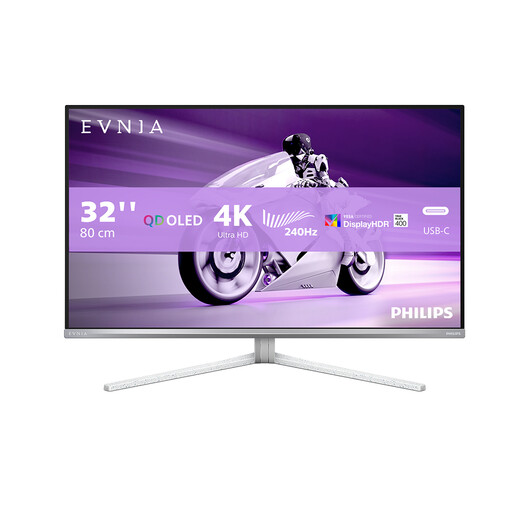
PHILIPS Evnia 32M2N8900 32-inch 4K OLED Monitor
For detailed 4K PC gaming with a stated high-refresh OLED configuration.
32-inch UHD OLED; 3840 x 2160; 240Hz; 0.03ms; HDR400; FreeSync Premium Pro; G-SYNC Compatible; HDMI 2.1 and DisplayPort 1.4.
Check panel-care functions, applicable UK warranty terms, stand adjustment and viewing-distance fit if the screen will be used for extended desktop work.
Joybuy
 No image available
Acer Predator X27U W3 26.5-inch QHD QD-OLED Monitor
For competitive PC gaming at 2560 x 1440 on a standard-ratio desk display.
26.5-inch 2560 x 1440 QD-OLED; 240Hz; 0.03ms response; HDR10; FreeSync Premium Pro; G-SYNC Compatible; HDMI 2.1 and DisplayPort 1.4.
Your PC needs to sustain high frame rates at 2560 x 1440 to make practical use of 240Hz. Check OLED protection features and warranty terms if static content is frequent.
Joybuy
 No image available
MAG 274QP QD-OLED X24 27-inch WQHD Monitor
For fast-action PC gaming at 2560 x 1440 with stated Adaptive-Sync support.
26.5-inch 2560 x 1440 QD-OLED; 240Hz; 0.03ms GtG; 48–240Hz Adaptive-Sync; HDMI 2.1 and DisplayPort 1.4a.
Verify VRR compatibility with your specific GPU, driver settings and intended port. Confirm applicable UK warranty and OLED maintenance terms before purchase.
Joybuy
Frequently asked questions
Do I need a G-SYNC monitor if my desktop uses an NVIDIA graphics card?
Not necessarily, but check the exact combination. NVIDIA states that G-SYNC Compatible operation needs a validated G-SYNC Compatible display, a Pascal-class-or-later GPU, Windows 10 or later, compatible games and setup in NVIDIA Control Panel. An adaptive-sync label alone does not establish NVIDIA validation.
What should an AMD Radeon owner check before relying on FreeSync?
Check that the exact display is FreeSync-certified, the GPU is supported, and the planned connection and monitor preset allow FreeSync. AMD says FreeSync can operate through DisplayPort and HDMI on certified displays, but some monitor presets or custom settings can disable it.
Should I choose 4K or a higher-refresh 1440p gaming monitor?
Choose 4K when image detail and a 4K desktop matter more than maximising competitive refresh rate; choose high-refresh 1440p when your games and PC can benefit from much higher sustained frame rates. PCMag UK separates gaming-monitor recommendations by 1080p, 1440p, 4K, esports and ultrawide use, so game type and PC capability should guide the choice.
Can one monitor suit both cinematic 4K games and competitive fast-action games?
A dual-mode display can suit both if you accept switching modes. LG specifies its UK 32GX870A-B with 4K 240Hz and FHD 480Hz modes, so check the mode you intend to use, GPU performance, cable path and desk size before buying.
What maintenance should I expect from an OLED gaming monitor?
OLED needs deliberate static-content care where taskbars, HUDs or paused images remain visible for long periods. ASUS states that prolonged static high-contrast imagery can cause image persistence and describes protection functions including pixel shift, screen saver and pixel cleaning; follow the exact model’s instructions and check its applicable UK warranty terms.


