Small-batch sauce makers
If you usually make one or two portions, you may want a compact bowl, control over chopping and a way to add liquid without occupying much shared counter space.


For one or two portions of peanut sauce, start by comparing compact choppers with pulse control and a small bowl; check the instructions against your recipe, especially if the mixture is thick. A full food processor makes more sense when you also need larger batches or other preparation functions, while a personal blender needs its suitability for thick nut mixtures checked. In a shared kitchen, agree how peanut-contact parts will be cleaned, separated and stored before choosing any appliance.
If you usually make one or two portions, you may want a compact bowl, control over chopping and a way to add liquid without occupying much shared counter space.
If peanut sauce is one of several jobs, a processor with attachments for tasks such as chopping and grating may justify more cupboard space and washing up.
If someone sharing the kitchen has a peanut allergy, or their allergen needs are unclear, decide how equipment and ingredients will be cleaned, separated and stored before using a shared appliance. Food Standards Scotland advises careful hygiene and separation to reduce allergen cross-contact.
Choose the appliance format around your usual sauce quantity and other food-prep tasks, then check whether its cleaning arrangements work for everyone sharing the kitchen.
Consider it when: You make modest portions and want pulse control and gradual liquid addition; KitchenAid describes those features on its 830 ml 5KFC3516.
Trade-off: A small bowl gives you less room when making sauce for a group.
Consider it when: You also want a drinks appliance and your recipe uses enough liquid for the model's permitted uses.
Trade-off: A drinks-oriented bottle does not establish suitability for a thick peanut mixture; check the instructions.
Consider it when: You regularly prepare larger quantities or want attachments for other chopping and grating tasks.
Trade-off: A larger bowl and more accessories take up space and leave more parts to clean; check the minimum useful batch size.
| Concern | What to check | Who this matters to |
|---|---|---|
| Small-batch control | Check bowl capacity, pulse control and whether the instructions permit adding liquid during processing. | If I make just a portion or two, I want to adjust the sauce's consistency without starting with a large bowlful. Around 42% of consumers put small-batch control first. |
| Cleaning and peanut cross-contact | Check how blades, lids and seals come apart for cleaning, and agree whether peanut use is permitted on shared equipment. | When I share equipment with someone who has an allergy, I need a cleaning and separation routine everyone can follow. For roughly 33% of consumers, managing shared-kitchen cleaning is the primary concern. |
| Capacity and other uses | Check usable bowl capacity, storage space and which attachments you would actually use for other meals. | If I prepare sauce for several people and do other chopping or grating, one appliance needs to cover those jobs. Wider food-prep usefulness comes first for about 25% of consumers. |
Dishwasher-safe parts may simplify routine washing, but that label alone cannot establish safe shared use where someone has a peanut allergy. Food Standards Scotland warns that even a small amount of an allergen can trigger a reaction and advises hygiene and careful separation.
Before buying, agree whether peanuts may be used in shared equipment and how food-contact parts will be cleaned, separated and stored.
A separate appliance or separately stored components may be needed if the household cannot reliably follow an agreed arrangement.
A larger processor offers room for other preparation tasks, but bowl capacity alone does not tell you whether it will process your usual small quantity effectively.
Start with your normal recipe quantity. Check the model's minimum-quantity guidance and choose extra capacity when you will use it regularly.
A compact bottle blender can be useful for drinks, but its drinks-focused description does not establish how it handles every low-liquid peanut-sauce recipe.
Check the manual for permitted nut mixtures, liquid requirements and minimum quantities; compare a pulse chopper if you need to add liquid gradually.
These manufacturer-described product lines illustrate different bowl sizes and appliance formats, rather than a judgement about every model from each brand.
KitchenAid describes its 5KFC3516 as an 830 ml mini food chopper with two speeds, pulse action and an in-lid basin for adding liquid.
Bosch UK lists a 2.3 L bowl for its MCM3201BGB food processor and a 0.6 L bottle format for its MMB2111MG mini blender.
Ninja describes the BN650UK as an 850 W food processor and lists a compatible 2.1 L bowl for chopping, slicing, grating, puréeing and mixing.
These choices include hand-blender sets with small chopper attachments and a larger food processor. Compare each model's instructions with your sauce quantity and cleaning arrangements before choosing.
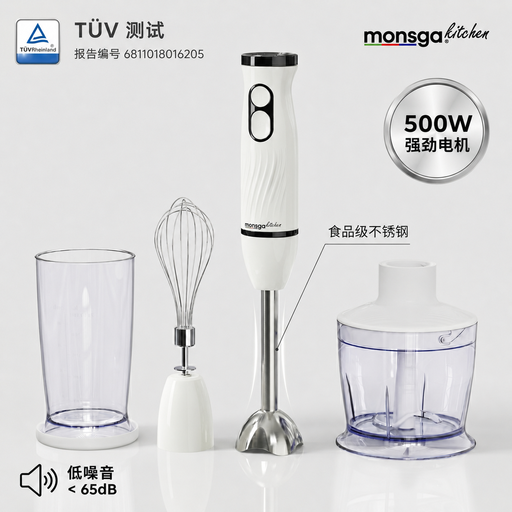 No image available
The 500mL chopper attachment gives this set a small-bowl option for modest portions; check the manual against the thickness and quantity of your peanut-sauce recipe.
The named set also has a 500mL beaker, normal and turbo modes, and dishwasher-safe parts. Dishwasher suitability alone does not settle how equipment should be shared with someone who has a peanut allergy.
 No image available
Consider this processor if you want capacity for larger preparations and will use its other attachments; check its instructions for your usual peanut-sauce quantity and nut mixture.
The named variant has a 3L bowl, 1000W rating, eight accessories and an integrated digital scale. Plan for the space and cleaning involved in keeping its accessories in a shared kitchen.
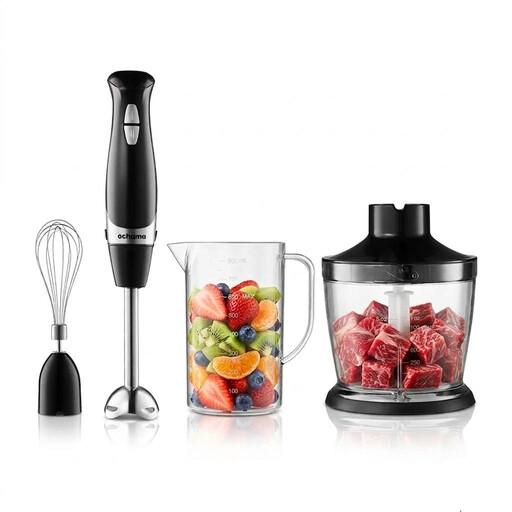 No image available
Its small chopper cup may suit modest preparations when you also want a hand-blender set; check the manual for permitted nut mixtures, sauce thickness and minimum quantity.
The named set has two speed settings, detachable accessories and an 800ml beaker. Check its cleaning instructions for food-contact parts before agreeing how it will be used in a shared kitchen.
A compact food chopper is the more directly described option for a small, thicker sauce: KitchenAid lists nuts, sauces and thick sauces among the uses for its 830 ml 5KFC3516, which has pulse control and an in-lid drizzle basin. If you prefer a personal blender for drinks as well, check its instructions for your peanut mixture and the amount of liquid it requires.
No allergy-safety conclusion follows from a dishwasher-safe label alone. Food Standards Scotland advises good hygiene and careful separation because even a small amount of an allergen can trigger a reaction; agree whether peanut use is permitted and how equipment will be cleaned and stored before sharing it.
Start with the quantity you normally make, then check the model's minimum-quantity and thick-mixture instructions. KitchenAid describes its 830 ml chopper for small portions, while Bosch UK lists a 2.3 L bowl for the MCM3201BGB processor; the larger capacity is relevant if you also prepare bigger batches or use its other functions.
The GOV.UK and Food Standards Agency guidance here addresses businesses that sell or provide food, rather than setting out rules for ordinary household cooking. If food is sold or catered from the shared kitchen, check the requirements for that activity and location; for household meals, agree how peanut ingredients and equipment will be separated and cleaned.