Small-worktop daily juicers
You want to make pear juice regularly, but need a machine you can leave out or put away without making clean-up a chore. Compare the exact model’s footprint and removable parts rather than relying on a compact label.


For ripe pears, start with a masticating juicer if extracting juice from soft fruit matters most: Sage Appliances UK describes this type as particularly suited to softer produce, though it operates more slowly and may involve more chopping and cleaning. If limited space and everyday clean-up matter more, compare compact centrifugal models by their actual dimensions and care instructions; consider a multifunction system only if you will use its additional functions and have room to store it.
You want to make pear juice regularly, but need a machine you can leave out or put away without making clean-up a chore. Compare the exact model’s footprint and removable parts rather than relying on a compact label.
You juice ripe pears often and are willing to allow more time for preparation and cleaning. Sage Appliances UK describes masticating juicers as particularly suited to softer fruits; that guidance does not establish how much juice any individual model will extract from pears.
You also want to make smoothies, citrus juice or plant-based milks. A multifunction system is worth considering if you will use those functions and its assembled and stored size works in your kitchen.
Decide whether space and cleaning, soft-pear extraction, or wider drink-making use is your primary need. Then compare dimensions, preparation and cleaning instructions for the exact models on your shortlist.
| Concern | What to check | Who this matters to |
|---|---|---|
| Fit and clean-up | Measure the counter and storage space; check removable parts and the model’s cleaning instructions. | If I need to put the juicer away after each use, its stored size and cleaning routine may decide whether I use it regularly. Around 33% of consumers would put fit and clean-up first. |
| Soft-pear extraction | Check whether the mechanism is masticating or centrifugal, and what preparation the instructions require for pears. | When ripe pears are my usual ingredient, I care more about the extraction approach than finishing quickly. Soft-fruit extraction would come first for around 42% of consumers. |
| Preparation and versatility | Compare the feed chute, permitted ingredient sizes and included attachments against the drinks you intend to make. | I would rather prepare fewer pieces of fruit or use one appliance for several kinds of drinks, provided I can accommodate the machine. Around 25% of consumers would prioritise preparation and versatility. |
Juicer mechanisms differ. Sage Appliances UK describes masticating models as particularly suited to softer fruit, while noting that they work more slowly and may require more preparation and cleaning.
Choose which trade-off matters to you before comparing individual models, and check their instructions for preparing pears.
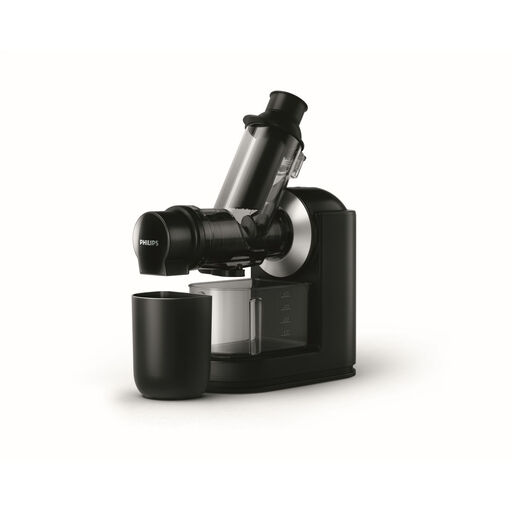
Philips describes its HR1836/00 as a compact, half-size model, but that description does not establish whether it fits your cupboard. Kuvings specifies its EVO820S at 201 × 239 × 450 mm and 7.1 kg: the lifting and storage space matter as well as the worktop footprint.
Measure the intended location, including clearance above the assembled juicer, and compare it with the exact model’s dimensions.
A product-listing extraction claim cannot establish a like-for-like result for ripe pears across different juicers. Mechanism and feed-chute specifications describe the machine, not its measured pear-juice yield.
Use the instructions and verified model features to narrow your choice rather than treating unlike extraction figures as a ranking.
Relevant when comparing a compact centrifugal example with a masticating model for frequent juice making.
Relevant if pear juice is one of several drinks you want to make with one system.
Relevant if a wide feed chute is more important to you than finding the smallest machine.
These models represent two approaches to making pear juice: a masticating juicer for consumers considering soft-fruit extraction, and a centrifugal juicer for those comparing preparation and routine cleaning. Check each machine’s fit in your kitchen and its instructions for pears before choosing.
 No image available
Consider this masticating model if soft pears are a regular ingredient and you can allow time for preparation. The Joybuy listing describes a 70 mm feed tube and detachable parts that are dishwasher-safe. Check its dimensions against your storage space and read the cleaning instructions before buying.
 No image available
Consider this centrifugal juicer if chute size and everyday cleaning matter more to you than choosing a masticating mechanism. Its product name specifies a 3-inch chute, 1.5 L pulp basin and dishwasher-safe design; check which parts the cleaning instructions permit in a dishwasher. Measure your available space, and confirm the actual variant’s voltage and UK compatibility before buying.
Start with a masticating juicer if soft-fruit extraction is your main concern: Sage Appliances UK describes this type as particularly suited to softer fruits, while noting its slower operation and possible extra preparation. If space and a simpler daily routine take priority, compare compact centrifugal models by their actual dimensions and cleaning instructions rather than assuming either type will give a particular pear-juice yield.
Compare the exact model’s assembled dimensions with your worktop and cupboard clearance, then consider its stored size and weight. Philips calls the HR1836/00 half-size, while Kuvings specifies the EVO820S at 201 × 239 × 450 mm and 7.1 kg; neither description replaces measuring your intended space.
Read the model’s cleaning instructions and check exactly which parts detach and can go in a dishwasher. The Joybuy listing describes detachable, dishwasher-safe parts for the Philips HR1889/71, but that feature should not be assumed for another model or for every component.