Hosts preparing drinks at short notice
You want to make several pear drinks without repeatedly cutting fruit or emptying a small container.


Choose a centrifugal juicer if you need to make several pear drinks quickly for visiting friends; a wide feed chute and a jug can reduce pauses, though the juice may be frothier. Choose a slow juicer if you prefer its crushing-and-pressing process and can allow more time. For either type, check the exact model’s pear-preparation instructions, cleaning routine and electrical specification before buying.
You want to make several pear drinks without repeatedly cutting fruit or emptying a small container.
You prefer a crushing-and-pressing process and can give preparation more time than a speed-first host.
You mainly make juice when friends visit, so cleaning effort and storage space matter alongside the extraction method.
Choose it when: You need several drinks ready promptly for arriving friends.
Trade-off: Good Housekeeping UK notes that centrifugal speed can produce frothier juice.
Choose it when: You prefer crushing and pressing and the serving time is flexible.
Trade-off: The slower process is less suited to making drinks in a hurry.
| Concern | What to check | Who this matters to |
|---|---|---|
| Serving several friends promptly | Check usable jug capacity and feed-chute dimensions against the pears you plan to prepare. | If friends are about to arrive, I want to make a shared batch without frequent pauses. Around 31% of consumers put prompt group serving first. |
| Preparation and clean-up | Check how the sieve, lid and other juice-contact parts come apart and how the manual says to clean them. | For an occasional visit, I do not want the wash-up to outlast the drinks. Easy preparation and clean-up come first for around 31% of consumers. |
| Slow-press process | Confirm the extraction type and the model’s instructions for preparing pears. | I would rather take my time with a crushing-and-pressing juicer than prioritise serving speed. Around 23% of consumers make that process their primary concern. |
| Occasional ownership | Compare storage dimensions and the effort needed to assemble and clean the exact model. | If I use a juicer mainly when friends visit, it needs to fit my cupboard and my routine. Around 15% of consumers prioritise that occasional-use fit. |
The extraction method alone does not establish that pear juice from one type is nutritionally superior.
Choose between the methods using the serving time, texture you prefer and cleaning routine, rather than assuming a health outcome.
A large jug helps with batch preparation, but it does not indicate how much each guest should drink. The NHS advises limiting fruit juice and smoothies combined to 150ml a day for adults and children.
Plan the batch for your guests, then pour individual portions rather than treating the jug as a portion guide.
A rinse feature may make a sieve easier to clean, but pear pulp can still remain on juice-contact parts.
Check the model’s disassembly and cleaning instructions before choosing it for occasional use.
Sage’s Nutri Juicer Cold XL is a centrifugal example for hosts focused on preparing a shared batch; its features do not describe every Sage model.
The Philips Viva Collection HR1855/70R1 is a centrifugal example for comparing batch capacity and cleaning features.
The Kuvings EVO820S is a slow-juicer example for consumers who prefer pressing to a speed-first approach.
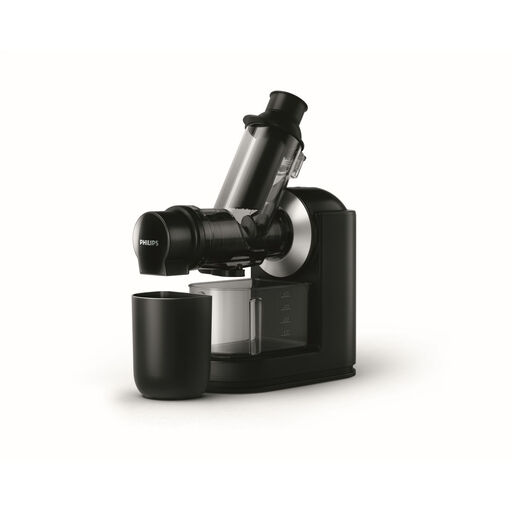
This slow-juicer option is for consumers who favour a masticating process when making pear drinks and can prepare them without rushing.
 No image available
A masticating juicer to consider if you prefer slow extraction to preparing drinks as quickly as possible for guests.
Check the manufacturer’s instructions for your intended pear ripeness and preparation, and confirm the plug and electrical specification for your delivery location.
Choose centrifugal if making several pear drinks promptly is your priority; choose slow juicing if you prefer its pressing process and have more time. Check the exact model’s instructions for the pears you intend to use.
No nutritional advantage follows automatically from the juicer type. Base the choice on practical differences such as serving speed, froth and cleaning rather than treating an extraction-method claim as a health result.
The NHS advises adults and children to have no more than 150ml of fruit juice and smoothies combined per day. That guidance concerns consumption, not the capacity of the juicer’s jug.
Confirm the exact model’s voltage, plug arrangement and intended delivery market with the seller. Do not assume that a product described for UK shoppers has the right configuration for your home.
Keep the order details and evidence of the fault, then contact the seller promptly. GOV.UK’s consumer-rights guidance covers goods bought both remotely and in person; the appropriate remedy depends on the circumstances of the fault.