
24/7 Customer Support

Free returns

Same-day & Next-day Delivery

Quality Guaranteed

Unlock Your Welcome Offers: FREE Delivery | Up to 80% OFF | Free 30-day JoyPlus trial
Download the APP
A bin can look suitable online yet become inconvenient once it is in daily use. The pedal may feel awkward, the lid may strike a wall, or the capacity may be too small for a busy kitchen. For UK households, the right choice depends less on appearance alone and more on dimensions, opening mechanism, liner compatibility and cleaning access.
Whether you need a kitchen bin, bathroom bin, recycling bin or compact office model, these are the main buying pitfalls to avoid.
A 30-litre bin may suit a couple or small family, but larger households could find it fills quickly. On the other hand, a 60-litre bin can take up considerable floor space and may be unnecessarily large for a flat, bedroom or home office.
Capacity should match both your household size and how often you want to empty the bin. Remember that a recycling bin with two compartments divides its total capacity between separate sections.
Stainless steel bins can complement modern kitchens, but fingerprints and marks may be visible on untreated surfaces. A removable inner bucket is also important because it allows you to remove the liner, clean spills and wipe the interior more thoroughly.
Decorative plastic finishes, such as faux rattan, can be practical in bathrooms, provided they are wipe-clean and do not absorb moisture.
A standard pedal opens the lid hands-free, but the action and closing speed vary between products. A soft-close bin can reduce noise in an open-plan kitchen or during early mornings. Tight-closing lids may also help contain unpleasant smells, although no household bin can remove odours entirely without regular emptying and cleaning.
Measure the available area, including space needed to open the lid and remove the liner. Slim bins are useful beside kitchen units, under desks and in narrow bathrooms, but a tall, narrow shape may be less stable if placed on an uneven floor.
Common options include:
Always compare the listed dimensions with skirting boards, cupboard doors and walkways rather than relying on capacity alone.
Pedal operation is useful when handling food, cleaning products or bathroom waste. Look for a pedal that allows hands-free opening without requiring the bin to be held in place. A non-slip base, rubber feet or anti-tilt feature can help reduce movement across hard floors.
For quiet rooms and open-plan areas, check whether the product description specifically lists a soft-closing or silent-close lid. These terms describe a mechanism designed to lower the lid gradually; they should not be treated as a guarantee of completely noiseless operation in every situation.
A bin with removable inner bucket is generally easier to empty and clean. Some buckets include ventilation holes, which can help reduce the vacuum effect when removing a full liner.
Liner compatibility also matters. Brand-specific liners may provide a neater fit, but they can add to ongoing costs. Before ordering, check the recommended liner code, whether standard carrier bags can be used and how the liner is retained. For food waste, a tight-fitting lid and regular cleaning are more useful than relying on an “odour-proof bin” label alone.

Why This Fits Their Persona: Its compact footprint and 5-litre capacity suit renters, students and households furnishing a cloakroom, en-suite or guest bathroom without using much floor space.
The wipe-clean plastic construction avoids moisture absorption associated with natural woven materials, while the swing lid keeps contents covered.
5-litre capacity; faux-rattan plastic finish; concealed liners and a swing/flip lid.
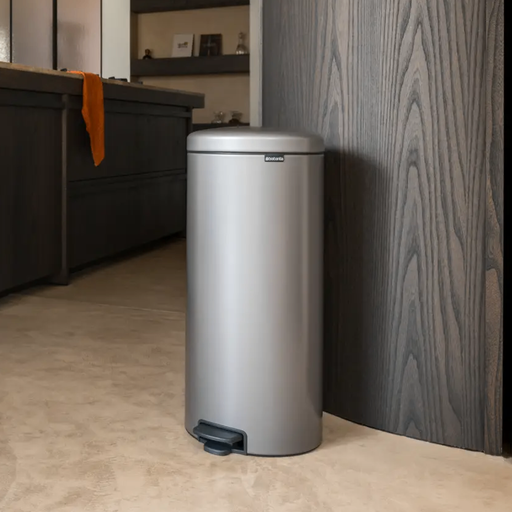
Why This Fits Their Persona: This 30-litre model is suited to kitchen users who want a coordinated appearance, hands-free operation and quieter lid movement in a family or open-plan home.
The removable inner bucket supports more straightforward cleaning, while the soft-close lid and tight-close design address noise and exposed waste concerns.
30-litre capacity; plastic inner bucket with ventilation holes; non-slip base and anti-tilt block.

Why This Fits Their Persona: Families and busy kitchens can separate waste at the point of disposal, reducing the need for multiple standalone bins.
Its stated capacity is clearly divided into two 20-litre compartments, so the available space is not mistaken for one 40-litre waste section.
40 litres total; two removable 20-litre compartments; separate foot pedals and a satin-coated stainless steel finish.
Place the bin on a stable, flat surface and leave enough clearance for the lid. Avoid abrasive cleaners on painted, plastic or stainless steel surfaces, as they may mark the finish. Empty wet or food waste regularly, even when the bin is not full, and wipe the pedal and lid area as part of routine cleaning.
For bedrooms, offices and compact bathrooms, compare width and depth carefully. The Simplehuman 10L Plastic Slim Pedal Bin, for example, measures 34.3cm high by 32.5cm wide and 19.6cm deep, making its slim depth relevant for under-desk or narrow-space placement. For a bathroom with limited floor area, the 5-litre Addis model offers a smaller alternative.
We have compiled a complete, real-time list of products that fully satisfy these strict selection criteria and UK safety regulations.
Yes. Hands-free opening is convenient when cooking or handling waste. For a kitchen, consider a capacity of around 30 litres or more, a removable inner bucket and a lid that closes securely. Households producing substantial waste may prefer a larger model or a recycling bin with divided compartments.
Lifespan depends on construction, frequency of use, cleaning and how much force is applied to the pedal. Steel pedals, stable bases and replaceable or removable inner components can support ongoing maintenance. Product guarantees and stated mechanism ratings should be checked before purchase rather than assumed.
A soft-close lid does not directly reduce liner or waste-collection costs. Its practical value is quieter operation and less impact on the lid mechanism. Ongoing costs are more closely affected by liner size, how often the bin is emptied and whether the capacity suits your household’s routine.