
24/7 Customer Support

Free returns

Same-day & Next-day Delivery

Quality Guaranteed

Unlock Your Welcome Offers: FREE Delivery | Up to 80% OFF | Free 30-day JoyPlus trial
Download the APP
The right pedal bin should make everyday waste disposal easier, not create new problems. Yet many UK shoppers focus on appearance or headline capacity without checking the details that affect daily use. A bin that looks suitable online may be too deep for its intended space, awkward to empty or costly to maintain.
Before buying, watch for these common pitfalls:
Capacity is usually measured in litres, but the useful capacity depends on the type of waste and how often the bin is emptied.
Think about your collection routine as well. A larger bin may reduce emptying frequency, but it also occupies more floor space and can become heavy when full.
For compact homes and rented properties, dimensions matter as much as capacity. Measure the available area, including clearance for the lid and pedal. A slim pedal bin may fit beside a vanity or under a desk, while a wide round bathroom bin may need more space around it.
Check:
A space-saving bin is only practical if the lid and pedal remain accessible.
A stainless steel pedal bin can complement modern and traditional kitchens, while plastic is often lightweight and simple to wipe clean. Satin or brushed finishes may be more forgiving of everyday marks than highly polished surfaces, but all materials still require regular cleaning.
Look for a removable inner bucket where possible. It allows liners to be changed more easily and gives you access to the inside of the bin if a bag leaks. Avoid abrasive cleaners unless the manufacturer specifically allows them, as they may affect the surface.
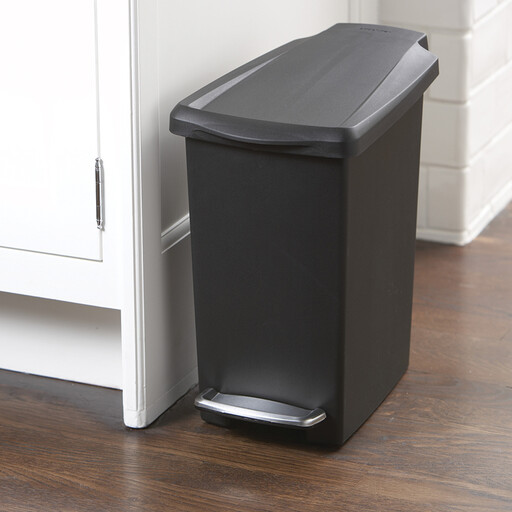
Why This Fits Their Persona: A practical option for renters, students and first homes needing a compact bin for a bathroom, office or under-desk space.
Its slim dimensions of H34.3 x W32.5 x L19.6cm make the footprint clear, helping buyers avoid choosing a bin that overwhelms a small room.
The 10L capacity suits lighter waste, while the steel pedal provides hands-free opening and the black plastic body is easy to wipe clean.

Why This Fits Their Persona: Suits shoppers who want a compact bathroom or office bin with a brushed metal appearance and features designed for quieter everyday use.
The stated dimensions are H35.2 x W39 x L16.8cm, so its narrow depth can be checked against the intended location before purchase.
It has a brushed stainless steel exterior, a removable inner bucket, a non-skid base and a lid designed for a slow, quiet close.

Why This Fits Their Persona: A suitable match for busy UK kitchens that need separate sections for different household waste streams.
Rather than relying on one mixed compartment, it provides two clearly stated 20L sections, helping reduce confusion when sorting waste at home.
The carbon steel body has a satin-coated stainless steel finish, with two pedals and removable inner compartments for separate disposal and cleaning.

Why This Fits Their Persona: Designed for smaller bathrooms, en-suites and cloakrooms where discreet waste storage and a decorative finish are priorities.
Its 22.5 x 22.5 x 29cm dimensions and 5L capacity make it easier to assess for corners, beside toilets or beneath bathroom furniture.
The plastic rattan-effect exterior is wipe-clean, and the swing lid conceals contents while the inner rim helps hide the liner.
Place pedal bins on a stable, flat surface and leave enough room to operate the pedal fully. Use a liner that matches the bucket size rather than forcing an oversized bag into a small compartment. For recycling bins, check local council guidance before deciding which materials belong in each section.
Wipe the exterior and clean removable buckets regularly, particularly after liquid leakage. Mild detergent and a damp cloth are generally more suitable than abrasive products. If a pedal becomes difficult to operate, check for obstruction around the base or hinge before applying any product not recommended by the manufacturer.
We have compiled a complete, real-time list of products that fully satisfy these strict selection criteria and UK safety regulations.
A pedal bin allows hands-free opening, which can reduce the need to touch the lid during normal disposal. Hygiene still depends on regular emptying, liner changes and cleaning. A lid also helps keep contents discreetly covered, especially in bathrooms and kitchens.
Lifespan depends on construction, frequency of use, cleaning and how much force is applied to the pedal. Steel pedals, removable buckets and a stable base can support regular household use, but no bin should be overloaded or used on an uneven surface.
Not necessarily. A well-fitted liner can reduce wasted material caused by bunching or overhang. Dual-compartment models require two smaller liners, while a single larger bin uses one larger bag. Compare liner availability and cost alongside the purchase price before choosing.