What matters when choosing
Decide where you want to see your pen strokes before comparing screen sizes. Then check whether the chosen setup fits the shared desk, connects to your computer and supports the way you finish the artwork.
Screenless pen tablet
Choose it when: You have a monitor you are happy to use and regularly need to clear or change desks.
Trade-off: You draw on the tablet while watching a separate screen, which takes adjustment if you are used to drawing on paper.
Compact pen display
Choose it when: You want to draw on the visible artwork but have limited room for another screen.
Trade-off: It still needs a workable position and compatible host-device connections; check the contents of the exact bundle.
Larger pen display
Choose it when: You want a larger visible canvas for finished pages and have room to position it for regular use.
Trade-off: Plan for its footprint, cables and viewing angle alongside your computer, keyboard and reference material.
| Concern |
What to check |
Who this matters to |
| Drawing surface |
Decide whether you can draw on a screenless tablet while watching a separate monitor, or need to draw on the visible image. |
If I am sketching expressions and inking characters, I may want each mark to appear beneath my pen. Around 40% of consumers put that direct-drawing need first. |
| Shared-desk fit |
Measure usable desk space and check where the device, computer, reference sheets and cables will sit. |
When I move between desks or pack away after a session, the setup must leave room for the rest of my work. For around 30% of consumers, that practicality is the primary concern. |
| Colour and detail |
For a drawing display, compare the exact model’s resolution, stated colour coverage and position under the office lighting; confirm print requirements separately. |
If I finish illustrated pages on the drawing surface, I need to inspect fine details and judge colours without assuming the screen matches a printed book. Around 20% of consumers make that review their leading need. |
| Workstation setup |
Check the viewing angle, reach and glare across the whole workstation. For daily work use, ask whether an employer DSE assessment applies. |
For long, regular office sessions, I need the tablet to work with my screen, seating and desk arrangement. That overall setup comes first for around 10% of consumers. |
Brands to consider
These brands offer different drawing formats; compare specific models and bundles rather than assuming every product in a brand’s range has the same features.
Wacom
Wacom’s Intuos Pro is a screenless pen tablet, while Wacom One 13 touch provides a compact pen-display option.
- Wacom states that Intuos Pro supports USB and Bluetooth connections and pairing with up to three devices.
- Wacom lists a 13.3-inch screen and 10-finger touch for Wacom One 13 touch.
- Check the exact Wacom One bundle, host-device connections and driver support before purchase.
Huion
Huion’s Kamvas 16 models are pen displays for drawing directly on the image, with specifications that differ by generation.
- Huion lists a 15.8-inch, 2560 × 1440 screen and 99% sRGB coverage for Kamvas 16 (Gen 3).
- Kamvas 16 (2021) is listed with a 15.6-inch, 1920 × 1080 screen and anti-glare film.
- For a USB-C connection to Kamvas 16 (2021), check Huion’s stated host-port requirements rather than relying on connector shape.
XPPen
XPPen offers both the screenless Deco Pro (Gen 2) pen-tablet line and the Artist Pro 16 (Gen 2) drawing display.
- XPPen lists Bluetooth 5.0 for Deco Pro (Gen 2) and a 2560 × 1600 display with an integrated foldable stand for Artist Pro 16 (Gen 2).
- XPPen’s stated battery-life and performance figures should not be treated as guarantees for every working environment.
Joybuy products for direct drawing
These TECLAST ArtPad Pro variants are Android tablets with built-in screens, rather than the screenless pen tablets or computer-connected pen displays discussed above. They are worth considering only if your intended drawing app, stylus arrangement and page-finishing workflow work on the exact variant.
 Image unavailable
TECLAST ArtPad Pro 2025, 12.7-inch 2K, stylus included
Consider this variant if you want to draw on a built-in screen and need a stylus in the bundle; confirm that your illustration apps and file workflow suit Android 15.
The product name specifies 4096-level pressure sensitivity, 256GB storage and a 10,000mAh battery. Check its dimensions and screen characteristics against your shared desk and colour-review needs; the battery capacity does not establish drawing time.
View on Joybuy
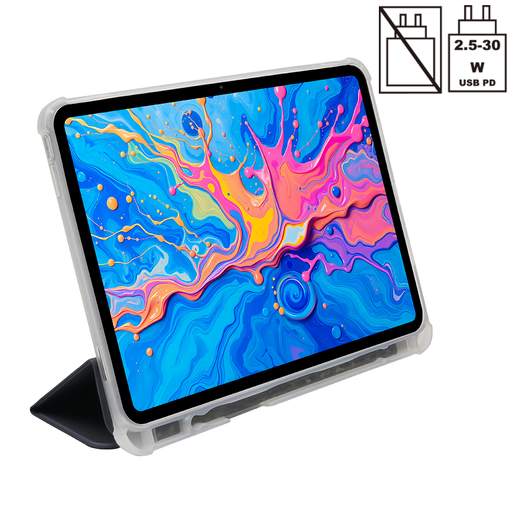 Image unavailable
TECLAST ArtPad Pro 12.7-inch 2K, case included
Consider this variant if you want a built-in drawing screen and the listed case; confirm that a suitable drawing app works for your story pages and whether the stylus you need is included.
The product name states T-Pen compatibility, 4096-level pressure sensitivity, 256GB storage and a 10,000mAh battery. Check the tablet’s physical fit and screen characteristics before relying on it for shared-desk use or colour review.
View on Joybuy
Common questions
Should I use a screenless pen tablet or a pen display for a children’s story?
Choose a screenless pen tablet if you can draw while watching your existing monitor and need to clear the shared desk regularly. Choose a pen display if drawing on the visible artwork matters more for your sketches and linework, and you can accommodate its screen and connections.
Will any USB-C computer work with a drawing display?
No: check the requirements of both the exact display and the computer’s port. For example, Huion specifies USB 3.1 Gen 1 data transfer and DisplayPort 1.2 support for a USB-C connection to Kamvas 16 (2021); also confirm how the chosen setup receives power.
Do I need a stand for a drawing display at a shared desk?
A stand may help you position the drawing surface, but check the entire desk arrangement rather than the tablet angle alone. The Health and Safety Executive’s display screen equipment guidance covers posture, furniture and desk arrangement, lighting and glare, and changes of activity.
When does an employer need to assess a UK office workstation?
The Health and Safety Executive says employers must assess a workstation if a worker uses display screen equipment daily as part of normal work, continuously for an hour or more. An assessment is also needed when a new workstation is set up or an existing one or its use changes; whether those conditions apply depends on the working arrangement and use pattern.
Do more advertised pressure levels mean better story illustrations?
A pressure-level figure alone cannot tell you which tablet will suit your illustration work. Check the drawing format, pen and software compatibility, desk fit and how you will review finished pages alongside that model specification.


