Shared-desk space savers
If a laptop, keyboard, books or another person must fit at the desk, a compact screenless pen tablet keeps the existing monitor as the only screen. You will draw on the tablet while looking at that monitor.


Choose a compact screenless pen tablet if keeping space free on the shared desk matters more than drawing directly on the image. Choose a compact pen display if seeing the pen on the artwork is the priority, provided there is room for the screen and its connections work with your computer.
If a laptop, keyboard, books or another person must fit at the desk, a compact screenless pen tablet keeps the existing monitor as the only screen. You will draw on the tablet while looking at that monitor.
If placing character sketches and lines directly on the visible page matters more than free desk area, a compact pen display may suit you. Allow room for the screen, its position and its cables.
If your current computer determines the choice, check operating-system support and the exact display connection before selecting a pen display. A USB-C socket alone does not establish that it can carry video.
For children’s-story illustration at a shared desk, decide whether workspace or drawing on the visible page matters more, then check the connection requirements of any display you are considering.
| Concern | What to check | Who this matters to |
|---|---|---|
| Desk space and cables | Measure the usable area with your other desk items in place. Check whether the exact pen-tablet variant uses a cable or Bluetooth. | If I share space with a laptop, keyboard and another person, I want to put the drawing surface away without accommodating a second screen. Around 33% of consumers put workspace first. |
| Drawing on the image | Check the display footprint and where its cables exit. If the story will be printed, assess test prints against your printer’s or publisher’s requirements rather than relying on a colour-gamut figure alone. | When sketching characters and refining lines, I want to see the pen move on the artwork, even if the display occupies more desk space. Direct-on-screen work comes first for around 42% of consumers. |
| Computer and setup | Check the exact model’s operating-system support, supplied cables and power requirements. For a direct USB-C display connection, confirm that your computer’s port supports the video mode the model requires. | If I use my existing laptop, I need to know the drawing setup will connect before I make room for it. Connection and compatibility are the primary concern for around 25% of consumers. |
A port that charges devices or transfers data may not carry the video signal needed for a direct USB-C display connection. XPPen specifies video output for the Artist 13.3 Pro V2 connection; Huion specifies USB 3.1 Gen 1 and DisplayPort 1.2 Alt Mode for its stated one-cable route.
Check your computer’s port specification alongside the exact display manual before choosing a cable arrangement.
If the direct connection cannot be used, a different cable or connection arrangement may be needed.
A 13.3-inch drawing screen still needs a place beside or in front of the computer, with space for its cable exits.
Lay out the laptop, keyboard and proposed display position on the shared desk before deciding that a pen display will fit your working arrangement.
A manufacturer’s display-gamut or calibration specification does not, by itself, determine how illustrations will appear on paper. Printer, paper, inks, software settings and colour management also affect the result.
If the story will be printed, use test prints and the printer’s or publisher’s colour requirements when assessing your workflow.
A desk layout that suits one user may leave another twisting towards the screen or reaching awkwardly for the drawing surface.
Reposition the screen, keyboard and tablet for the current user. For employees who use display screen equipment daily for continuous periods of an hour or more, the Health and Safety Executive says employers must assess the workstation.
Wacom offers both compact screenless pen tablets and compact pen displays relevant to a shared-desk setup.
XPPen has a Bluetooth screenless option and a compact pen-display option for different shared-desk priorities.
Huion’s Kamvas 13 (Gen 3) is a 13.3-inch FHD pen display for a direct-on-screen setup.
These ArtPad Pro models offer a way to draw on a tablet screen at a shared desk. They are standalone tablets, rather than screenless pen tablets or pen displays connected to a computer; check that your intended illustration app and desk arrangement suit the exact version you choose.
 No image available
Consider this version if you want to sketch directly on a tablet screen and want a stylus in the package. Its listed features include a 12.7-inch 2K display, 4096-level pressure sensitivity, T-Pen drawing support, Android 15 and an included stylus.
Before ordering, check your intended illustration app’s compatibility with Android 15 and whether the tablet’s dimensions and your planned stand arrangement fit the shared desk.
 No image available
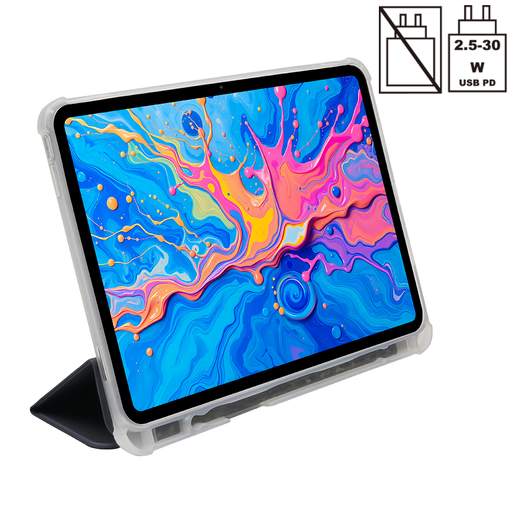
Consider this version if you want to draw on the visible tablet screen and would use the included case in a shared setup. Its listed features include a 12.7-inch 2K display, 4096-level pressure sensitivity and T-Pen compatibility.
Confirm whether a T-Pen is in the exact package, whether your illustration app works with the tablet, and how its dimensions and stand arrangement fit your desk.
Choose a pen display when drawing directly on the visible page is your priority and you can accommodate its screen and connections. A screenless pen tablet better preserves room for the computer and other desk users, but you draw on its surface while watching the existing monitor.
No: the connector shape does not establish video support. XPPen says the Artist 13.3 Pro V2’s direct USB-C computer connection needs a full-featured port with video output; Huion specifies USB 3.1 Gen 1 data transfer and DisplayPort 1.2 Alt Mode for the host port and cable used with its stated one-cable route.
Put the main screen in front of the current user and adjust the keyboard and drawing surface so they do not have to twist towards the work. The Health and Safety Executive advises positioning the screen about an arm’s length away. For employees using display screen equipment daily for continuous periods of an hour or more, it says employers must assess the workstation.
Check your local council’s electrical-waste instructions rather than putting it in general waste. Oxfordshire County Council, for example, classifies items with electrical parts, a plug or a battery as waste electrical and electronic equipment and describes recycling and retailer take-back options; collection arrangements can differ by area.