Live geometry demonstrators
Teachers who construct diagrams, trace arcs and mark angles during a lesson may value placing the pen directly on the displayed work and adjusting the drawing surface to a comfortable position.


Choose a pen display if placing the pen directly on a geometry diagram matters most; choose a screenless pen tablet if you can work comfortably with your existing computer screen and do not want another display beside the window. Either way, position the screen to limit reflections and check that your teaching software, connections and power arrangement suit the device before buying.
Teachers who construct diagrams, trace arcs and mark angles during a lesson may value placing the pen directly on the displayed work and adjusting the drawing surface to a comfortable position.
If reflections make diagrams difficult to see, screen position and lighting matter alongside any anti-glare treatment. The Health and Safety Executive advises arranging screens and lighting to avoid reflections and glare.
Teachers who already have a suitably positioned laptop or monitor may prefer a screenless pen tablet with configurable controls, provided they are comfortable drawing on one surface while looking at another.
Consider it when: You regularly draw constructions or correct diagrams live and want the pen tip on the image.
Trade-off: Its screen still needs careful placement beside the window, and the host computer must support the required display and power connections.
Consider it when: Your existing screen is well positioned and a separate drawing surface suits your lesson setup.
Trade-off: You draw while watching a different surface, and the computer screen can still catch window reflections.
| Concern | What to check | Who this matters to |
|---|---|---|
| Reflections and legibility | Check the exact display's surface treatment and whether you can position it away from the window's reflection. A screenless tablet leaves legibility dependent on your computer screen. | If window glare obscures my diagrams during lessons, I need a screen position that lets me read them clearly. Around 40% of consumers put this need first. |
| Drawing directly on diagrams | Check whether a pen display's drawing area and your geometry software suit live constructions; with a screenless tablet, allow for drawing while looking at another screen. | When I mark a vertex or correct a construction live, I want to place the pen where the mark appears. For around 30% of consumers, direct annotation is the primary need. |
| Workflow with an existing screen | Check operating-system and teaching-app compatibility, connection requirements and whether shortcuts can be assigned to the tools you use. | I would rather use the screen already on my desk and keep the drawing setup compact, even if indirect pen control takes practice. A compact workflow comes first for around 30% of consumers. |
Pressure sensitivity describes pen input, not whether a screen remains readable beside a bright window. The Health and Safety Executive's guidance addresses reflections through screen and lighting arrangement.
Assess the display surface and where the screen can sit before making a pressure-level figure decisive.
A matching connector shape does not establish video or power support. Wacom specifies 15 W (5 V/3 A) Power Delivery from the computer for full-function single-USB-C use of the Wacom One 13 touch.
Check your computer's video-output and power capabilities against the exact model's connection instructions and supplied accessories.
If the computer cannot provide the required connection, you may need a supported cable or another specified power arrangement.
Wacom lists 10-finger touch for the Wacom One 13 touch, whereas Huion says the Kamvas 13 (Gen 3) does not support multi-touch. That distinction matters if you intend to pinch-zoom while teaching.
Confirm touch support on the exact model, or plan navigation through supported pen controls, shortcuts, a keyboard or a mouse.
The Wacom One 13 touch is a 13.3-inch pen display for direct annotation; the Intuos range offers screenless pen-tablet options.
The Kamvas 13 (Gen 3) is a 13.3-inch Full HD pen display; the Inspiroy 2 M is a screenless pen tablet with programmable controls.
The Artist Pro 14 (Gen 2) is a pen display for teachers considering a dedicated drawing screen with a foldable stand.
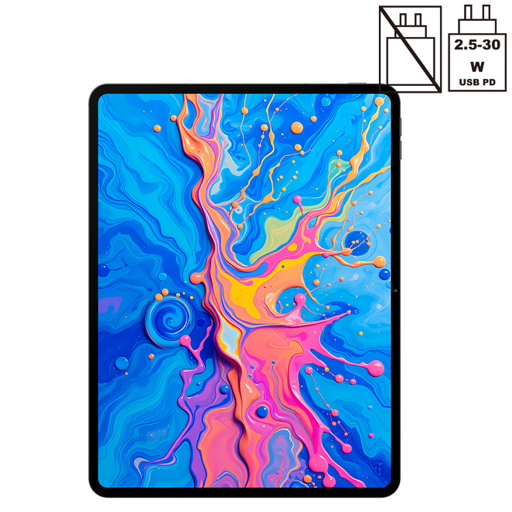
This standalone tablet offers another way to draw on a screen during geometry lessons. Check that it runs your teaching apps and fits your classroom presentation setup; it should not be treated as a pen display for an existing computer.
 No image available
Consider this Android tablet if you want to draw on the device's own screen while teaching geometry. It has a 12.7-inch 2K display, supports 4096 pressure levels for T-Pen drawing and lists Android 15. Check which pen is supplied, whether your geometry and whiteboard apps work on it, how you would present its screen to the class and whether reflections are manageable beside your window.
No anti-glare treatment alone establishes that a display will be readable in your chosen position. Huion describes an anti-glare effect for the Kamvas 13 (Gen 3), while the Health and Safety Executive also advises arranging screens and lighting to avoid reflections; check whether you can angle or move the screen away from the window's reflection.
No: a screenless pen tablet can provide input for live geometry work if you are comfortable drawing while watching a separate computer screen. A pen display instead lets you place the pen on the visible diagram, but adds a screen whose position and computer connections need checking.
Check the computer's video-output and power capabilities against the exact display's requirements, rather than relying on the port shape. For the Wacom One 13 touch, Wacom specifies 15 W (5 V/3 A) Power Delivery from the computer for full-function single-USB-C use; check its supported alternative cable arrangement if your computer cannot provide the required connection.