Regular ice-cooler makers
If ice or frozen fruit often goes into your watermelon drink, look for stated support for those ingredients rather than judging blending ability by wattage alone.


For a watermelon cooler with ice or frozen fruit, prioritise a blender whose maker states that it handles those ingredients; choose a plug-in format only if you can use a suitable office socket. A rechargeable model suits blending away from a socket, but either way, check the cup’s fill line, cleaning arrangements and whether the noise will be acceptable to colleagues.
If ice or frozen fruit often goes into your watermelon drink, look for stated support for those ingredients rather than judging blending ability by wattage alone.
If you blend in the kitchen and carry your drink back to a desk, a lidded blending cup can save you from decanting it. Check its usable fill level as well as its stated capacity.
If you share washing facilities and sockets with colleagues, choose parts you can clean promptly and check the workplace’s appliance rules before bringing in a blender.
Decide whether ice is part of your usual cooler, then check the serving vessel and where you are allowed to blend or charge the appliance.
| Concern | Buying checks | Who this matters to |
|---|---|---|
| Ice and frozen fruit | Check the exact model’s stated ingredient capability and follow its loading instructions. | If I regularly add ice to watermelon, I want the maker to say the blender can handle it, rather than relying on motor power alone. Around 36% of consumers would put this need first. |
| One drink to carry | Compare the usable fill line with the stated cup capacity, and check the drinking lid. | When I take a cooler back to my desk, I would rather blend and carry it in the same manageable cup. That is the main concern for around 27% of consumers. |
| Socket independence | Check where blending and charging are permitted, along with the supplied charging method. | If a suitable socket is unavailable where I prepare my drink, I need to blend without a mains cable at that point. Around 19% of consumers would prioritise that flexibility. |
| Shared-kitchen upkeep | Check how the cup, lid and blade parts must be cleaned, and confirm local appliance rules. | I need to leave the shared kitchen clean and use an appliance my workplace permits. For around 18% of consumers, that is the primary consideration. |
A cup’s stated size is not necessarily the amount you can blend. According to nutribullet UK, the PRO 900’s 900 ml cup has a 700 ml maximum-fill line, while its 700 ml cup has a 560 ml line.
Plan your ingredients around the marked line, particularly when adding ice; make another batch if needed.
A battery removes the mains cable during blending, but it does not establish how much noise colleagues will hear.
Hear the exact model if possible, and agree where and when blending is acceptable at work.
The Health and Safety Executive advises that electrical equipment used at work should be suitable for its use and supply and maintained safely. An employer may also have its own appliance rules.
Check with office management before purchase, and do not use equipment with a damaged plug or cable.
A lidded cup may be convenient to carry, but the cup, lid and blade parts still need cleaning after use.
Check the model’s cleaning instructions and wash its parts promptly using the facilities available at work.
Bosch Home UK lists the compact, plug-in MMB2111SG with a 0.6 L usable volume and a bottle designed for blending directly into.
The plug-in PRO 900 is an option for shoppers who want the maker’s stated ice-crushing capability and a choice of cup sizes.
The rechargeable Ninja Blast Max offers a cable-free blending format with a 570 ml Twist & Go cup, according to John Lewis & Partners.
These choices include plug-in blenders for preparing a cooler at an approved kitchen socket and a rechargeable option for blending away from one. Match the cup and ingredient guidance to your drink rather than treating the formats as interchangeable.
 No image available
A plug-in cup blender to consider if your cooler includes ice or frozen fruit and an office socket is approved.
The product title lists a 24,000 rpm extractor and two cup sizes; use each cup’s marked fill line rather than its nominal capacity.
Confirm the kit contents before ordering, as the product information also describes a different piece count.
 No image available
Consider this rechargeable format if you need to blend away from a socket and carry a single drink.
The title lists a to-go lid and USB-C charging cable. Check the cup’s fill guidance and whether charging is permitted at work; cordless use does not establish quiet operation.
 No image available
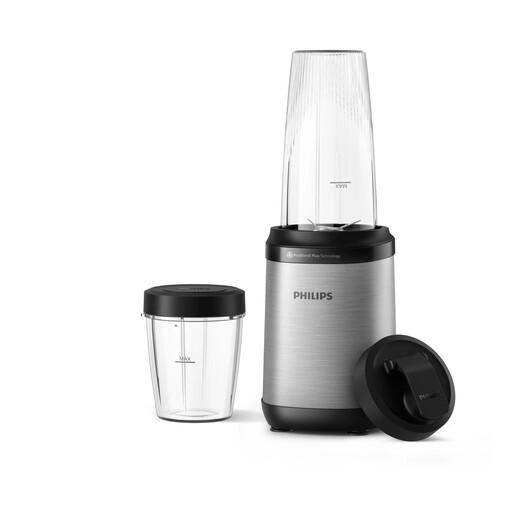
Consider this plug-in model only if its drinking-cup arrangement and electrical connection fit your office routine.
Check the tumbler’s marked fill line. The product information identifies a standard EU power cord and says a suitable adapter is needed in the UK, so confirm the electrical arrangement and workplace approval before use.
 No image available
This plug-in cup format may suit a cooler with ice where workplace socket use is permitted.
The title identifies a 900 ml cup and ice-crushing use. Follow the cup’s fill guidance and check whether the appliance’s sound is acceptable in your office.
 No image available
This plug-in kit may suit an ice-containing cooler that you want to take away in a blending cup.
The title lists 900 W and frozen-fruit and ice use. Check the cups’ fill lines and confirm the included components: the product information gives both 10-piece and 11-piece descriptions.
Annual portable appliance testing is not a general legal requirement, according to the Health and Safety Executive. Electrical equipment that could cause injury must be maintained safely, and your employer may set its own inspection or appliance-registration rules, so ask before bringing one in.
Check that your employer permits it and that the appliance and electrical supply are suitable for the intended use. The Health and Safety Executive advises checking equipment condition; do not use a blender with a damaged plug or cable.
Use the cup’s maximum-fill line, not its nominal size, to plan a batch. nutribullet UK gives 700 ml as the maximum fill for its PRO 900’s 900 ml cup and 560 ml for its 700 ml cup; Bosch Home UK lists 0.6 L as the MMB2111SG’s usable volume. Check the markings on the exact cup you buy.
Clean the cup, lid and blade parts according to the blender manual, and follow your workplace’s shared-kitchen rules. Do not leave fruit residue or loose parts in a communal sink.