
24/7 Customer Support

Free returns

Same-day & Next-day Delivery

Quality Guaranteed

Unlock Your Welcome Offers: FREE Delivery | Up to 80% OFF | Free 30-day JoyPlus trial
Download the APP
Replacing a bulb should be straightforward, yet many UK shoppers buy the wrong fitting, choose a bulb that cannot work with their dimmer or pay for smart features they will rarely use. Philips LED light bulbs are available in standard, decorative and connected formats, so comparing the details matters more than relying on a prominent wattage figure or attractive packaging.
This guide explains the main buying pitfalls, the specifications worth checking and a selection of Philips LED options for different homes and uses.
A bulb can look suitable but still fail to fit your light fitting. UK homes commonly use:
Check the old bulb or the fitting label before ordering. A globe, candle or spotlight description refers to the shape, not necessarily the connection type.
Modern LED packaging may show an incandescent-equivalent figure such as 40W, 60W or 100W. This helps shoppers understand the approximate traditional replacement, but the actual LED electricity use and brightness should be checked separately.
Where available, compare lumens for brightness and watts for energy consumption. A higher equivalent wattage does not automatically mean the bulb is suitable for every room or fitting.
Many standard Philips LED bulbs are non-dimmable. Installing one on a dimmer can lead to flickering, buzzing or unreliable operation. Smart bulbs generally require the wall switch to remain on so that they can receive power and connect to the app.
Before purchasing, confirm:
Measure the available space, particularly in enclosed shades and compact table lamps. A standard A60 globe may be around 60mm wide, while decorative filament or smart globe designs can be wider or taller.
For spotlights, check both the GU10 base and the physical diameter. For small decorative fittings, an E14 LED bulb may be required instead of an E27 model.
Warm white LED bulbs around 2,700K create a softer appearance commonly suited to bedrooms, lounges, hallways and dining areas. Adjustable smart bulbs can offer warm-to-cool white settings, allowing the colour to change according to the time of day or activity.
Colour-changing LED bulbs are useful for decorative lighting and entertaining, but they may be unnecessary for a basic replacement bulb. If you mainly need consistent general illumination, a standard warm white bulb can be a simpler choice.
Philips WiZ bulbs can connect to a Wi-Fi network and be controlled through the WiZ app on iOS or Android. The listed smart models offer colour selection, dynamic modes and scheduling without requiring a separate hub or gateway.
However, check your home network and intended location first. Smart functions depend on power and wireless connectivity, while a normal LED bulb continues to work from the wall switch alone. For rented properties, smart bulbs can also provide flexible lighting without changing the fitting.
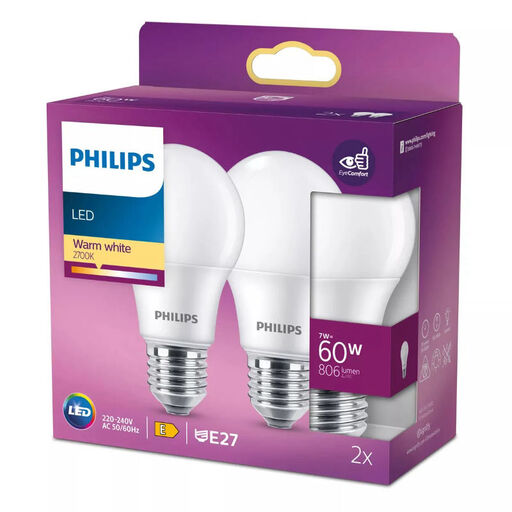
Why This Fits Their Persona: A practical two-pack for households replacing everyday screw-fit bulbs in bedrooms, lounges or hallways.
The listing clearly identifies an E27 screw fitting, warm white colour and non-dimmable operation, helping avoid compatibility assumptions.
Two bulbs per pack; frosted plastic globe; warm white colour; approximately 107mm high and 60mm wide.
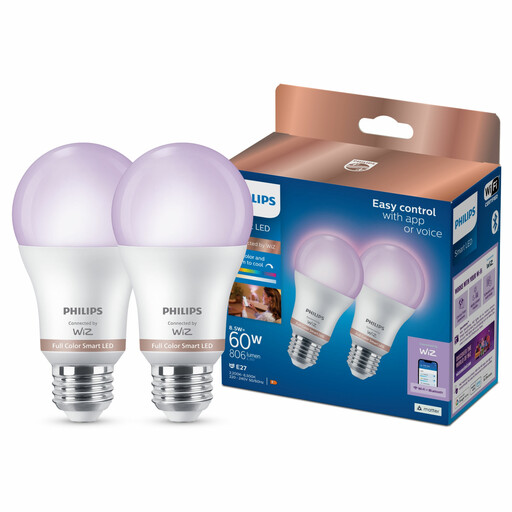
Why This Fits Their Persona: Suitable for shoppers wanting app control, scheduled lighting and adjustable colour without adding a separate hub.
The E27 fitting and WiZ app requirements are stated clearly, while the adjustable white and colour modes avoid relying on vague smart-lighting claims.
Two-pack; full-colour capability; warm-to-cool white spectrum; smartphone control and scheduling; no additional hub required.
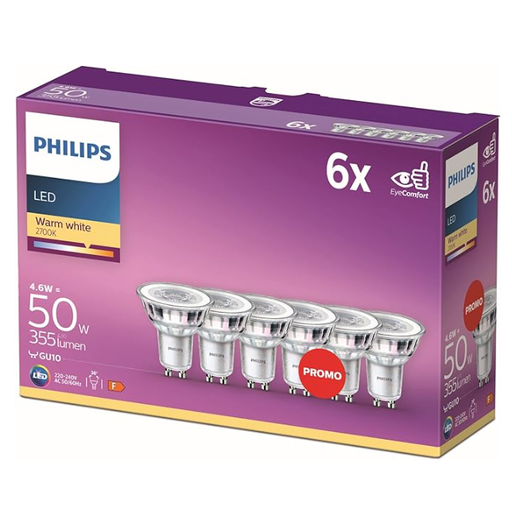
Why This Fits Their Persona: A six-pack is suited to kitchens, hallways or rooms with several recessed GU10 spotlights requiring matching replacement bulbs.
The GU10 pin base, warm white 2,700K colour temperature and non-dimmable specification are stated, reducing the risk of buying a screw or bayonet bulb.
Six bulbs per pack; 2,700K warm white light; glass construction; spotlight format measuring approximately 54mm high and 50mm wide.
Switch off the power before replacing a bulb and allow a recently used bulb to cool. Use each product only in a suitable dry indoor environment or a luminaire with the appropriate IP protection. Do not place a standard indoor bulb in a bathroom or exposed fitting unless the complete luminaire is rated for that location.
LEDs generally use less electricity than traditional incandescent or halogen lamps for a comparable lighting purpose, but the saving depends on the actual wattage, usage hours and electricity tariff. For an accurate comparison, multiply the bulb’s wattage by the number of hours used and your current unit rate.
Dispose of used bulbs through a local electrical-waste or WEEE recycling route rather than ordinary household waste.
We have compiled a complete, real-time list of products that fully satisfy these strict selection criteria and UK safety regulations.
Many are, but you must match the base type. UK shoppers should check whether they need a B22 bayonet, E27 screw, E14 small screw or GU10 spotlight fitting. The bulb’s dimensions must also suit the shade or luminaire.
The Philips WiZ products listed here connect to a Wi-Fi network through the WiZ smartphone app and do not require an additional hub or gateway. They still need a compatible fitting and continuous power for app-based control.
It is not advisable. Select a product specifically marked dimmable if your light fitting uses a dimmer. The Philips standard options featured in this guide are identified as non-dimmable, so they are intended for ordinary on-and-off switches.