
24/7 Customer Support

Free returns

Same-day & Next-day Delivery

Quality Guaranteed

Unlock Your Welcome Offers: FREE Delivery | Up to 80% OFF | Free 30-day JoyPlus trial
Download the APP
Replacing household lighting should be straightforward, but bulb listings often make comparison harder than it needs to be. A familiar wattage figure may describe an incandescent equivalent rather than the LED’s actual power use, while terms such as “smart”, “full colour” and “dimmable” can hide compatibility limitations.
This guide from the Joybuy Product Recommendation Officer explains what to check before buying Philips smart LED light bulbs, Philips WiZ smart bulbs or standard Philips LED bulbs for a UK home.
A bulb can have the right shape and still be unusable if its base does not match the lamp. UK homes commonly use:
Check the existing bulb, fitting instructions or socket before ordering. A smart B22 bayonet bulb cannot be installed in an E27 screw socket without an appropriate, safely rated fitting—and improvised adapters may affect clearance and safety.
The “40W”, “60W” or “100W” figure shown in a listing may refer to the traditional bulb equivalent. Actual brightness is measured in lumens, so use lumens where supplied and consider the room and shade as well as the equivalent wattage.
A larger room, opaque lampshade or ceiling fixture may need more light than a small bedside lamp. Also check the bulb’s physical dimensions: a globe bulb may be wider or longer than the bulb it replaces and could touch a shade or enclosed housing.
Philips WiZ smart bulbs in this selection connect through the WiZ app and Wi-Fi without an additional hub or gateway. They offer scheduled routines, remote control and adjustable light settings. However, “hub-free” does not mean “works without Wi-Fi”: app-based setup requires a suitable wireless network.
Do not assume a colour-changing LED bulb is compatible with a traditional wall dimmer. Follow the individual product instructions. Standard non-dimmable bulbs should not be used with a dimmer switch, while smart bulbs are generally controlled through their app or compatible smart-home system rather than by cutting power repeatedly.
Match the cap first, then check the bulb shape. A60 globe bulbs are suitable for many general lighting applications, while P45 or C37 candle bulbs are more appropriate for compact decorative fittings. G95 filament globe bulbs are visibly larger and designed to contribute to the appearance of an open fixture.
Compare the listed height and width with your fitting. For example, the Philips smart B22 globe is listed at approximately 120mm high and 60mm wide, while the E14 smart candle bulb is approximately 101mm high and 45mm wide.
A standard warm-white bulb is generally suited to relaxing areas such as bedrooms, living rooms and dining spaces. The Philips warm-white products listed here include bulbs with a 2,700K colour temperature, producing a warm appearance.
For more flexibility, a warm-to-cool white light bulb allows the tone to be adjusted, while a full-colour smart bulb can produce millions of colours and dynamic modes. These functions are useful when one lamp needs to serve different purposes, such as reading, entertaining and evening ambience.
Check whether the product is marked dimmable or non-dimmable. Several standard Philips LED bulbs in this range are explicitly non-dimmable. Use bulbs only in dry locations unless both the bulb and luminaire are rated for another environment. Avoid enclosed fittings unless the product information confirms suitability.
Switch off the power before replacing a bulb and allow a recently used bulb to cool. Where installation is not straightforward, use a qualified electrician or competent person. Dispose of failed bulbs through an appropriate WEEE electrical-waste route, rather than general household waste.
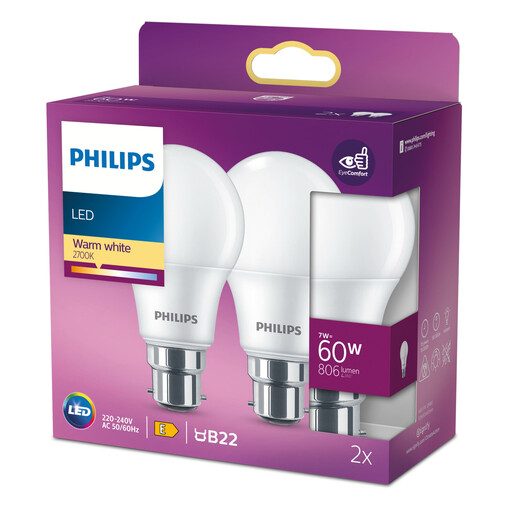
Why This Fits Their Persona: A practical two-pack for renters or homeowners replacing everyday B22 bulbs in lamps and general room fittings.
The B22 cap and non-dimmable specification are clearly identified, helping avoid an incorrect fitting or dimmer mismatch.
Warm white light, frosted A60 globe design and two bulbs supplied in one pack.
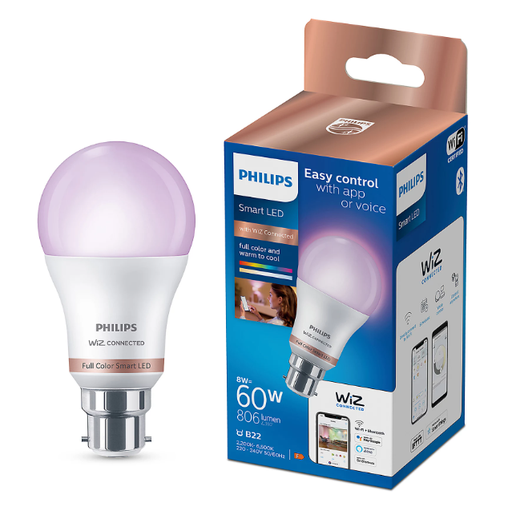
Why This Fits Their Persona: Suitable for a connected UK home where one ceiling or lamp fitting needs adjustable white light, colours and scheduled control.
It states the B22 fitting and uses the WiZ app for smart control without requiring a separate hub.
Full-colour modes, warm-to-cool white adjustment, iOS and Android app control and scheduling.
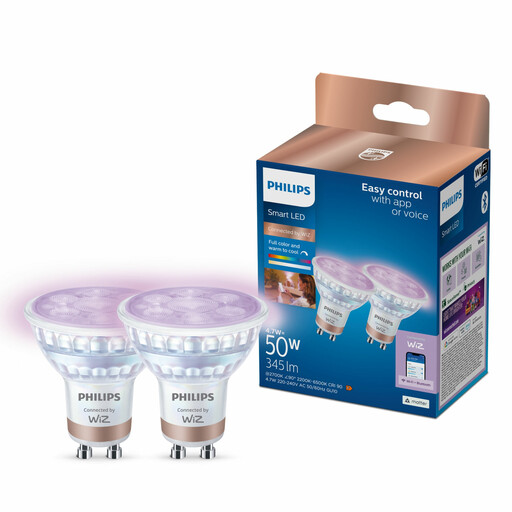
Why This Fits Their Persona: A two-pack option for kitchens, hallways or living rooms using GU10 directional spotlights.
The GU10 pin-base format is specified rather than inferred from the spotlight shape, reducing fitting errors.
Full-colour capability, warm-to-cool white spectrum, WiZ app control and two bulbs per pack.
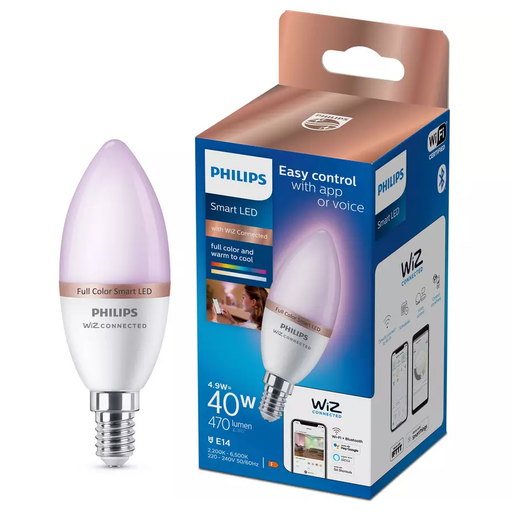
Why This Fits Their Persona: Designed for smaller E14 screw fittings in decorative lamps, wall lights, bedrooms and dining areas.
The E14 candle format and approximately 116mm height help shoppers check both cap and clearance before purchase.
Millions of colour options, adjustable white tones, WiZ scheduling and smartphone control.
We have compiled a complete, real-time list of products that fully satisfy these strict selection criteria and UK safety regulations.
The Philips WiZ smart bulbs listed here are designed for hub-free smart lighting. They connect through Wi-Fi and are controlled using the WiZ app for iOS or Android. You still need a compatible wireless network for setup and remote functions.
LED technology generally uses less electricity than an equivalent traditional incandescent bulb, but the running cost depends on the bulb’s actual wattage, daily usage and electricity tariff. For a meaningful comparison, check the product’s stated wattage and energy information rather than relying only on a “60W” or “100W” equivalent label.
Lifespan varies by model, operating conditions, ventilation and usage pattern. Check the individual product listing or packaging for the stated lifespan and guarantee. Avoid overheating by following the instructions for enclosed fittings and switch off the mains before replacement or maintenance.