
24/7 Customer Support

Free returns

Same-day & Next-day Delivery

Quality Guaranteed

Unlock Your Welcome Offers: FREE Delivery | Up to 80% OFF | Free 30-day JoyPlus trial
Download the APP
A charger can look like a simple purchase until your phone charges slowly, your laptop is left without enough power or a cable stops working after a few weeks. UK shoppers also need to consider plug compatibility, charging standards and how many devices they use each day.
The right choice depends less on headline wattage and more on the complete setup: charger output, device compatibility, cable quality and intended location.
A charger advertised at 100W or more will not automatically charge every phone at that speed. Your device, cable and charging protocol all set limits. A phone that accepts 20W may draw considerably less from a 100W USB-C power adapter, while a laptop may require 45W, 65W or more.
Check the output profile rather than only the maximum figure. For USB-C devices, look for support for suitable USB Power Delivery (PD) profiles, such as 5V, 9V, 12V, 15V or 20V.
A multi-port charger may advertise 65W, 100W or 140W as its total output. That figure can be divided between ports when several devices are connected. A charger that is suitable for one laptop may provide less power to each device when charging a phone, tablet and laptop together.
For regular multi-device use, choose a charger with clearly stated per-port and combined output.
A high-output charger cannot deliver its potential through an unsuitable cable. Some USB-C cables support charging only, while others also support data transfer. The cable should have an appropriate power rating for the charger and device. Stop using any cable with fraying, exposed wiring, excessive heat or damaged connectors.
A USB-C to Lightning cable may be necessary for some older Apple devices, while newer devices may use USB-C to USB-C. Check the connector at both ends before ordering.
For a standard smartphone, a 20W fast phone charger can be a practical wired option when the device supports USB-PD. Tablets and smaller laptops often need more power, making 30W, 65W or 100W chargers more suitable.
Gallium nitride, commonly called GaN, allows some chargers to deliver higher output in a compact body. It can be useful for commuters and travellers, but GaN does not remove the need to check compatibility, ventilation and output sharing.
A UK wall charger should have a suitable three-pin plug for standard UK sockets. Some compact travel chargers use an EU-standard plug and may require a separate UK adaptor. An adaptor does not increase the charger’s output and adds another connection to carry.
Look for clear manufacturer information, safety instructions and appropriate conformity markings. Do not use a charger with a cracked casing, damaged plug or loose socket connection.
One USB-C port keeps a charger compact, while two or more USB-C ports are more practical for a phone, tablet and laptop. USB-A remains useful for older charging cable types and accessories.
Wireless charging offers a tidy desk or bedside setup, but the phone must be correctly aligned with the charging coil. A wireless charging stand is particularly convenient for viewing notifications, while a 3-in-1 wireless charger can accommodate a compatible phone, earbuds case and smartwatch in one place. Use the specified power adapter, especially when charging three devices at once.
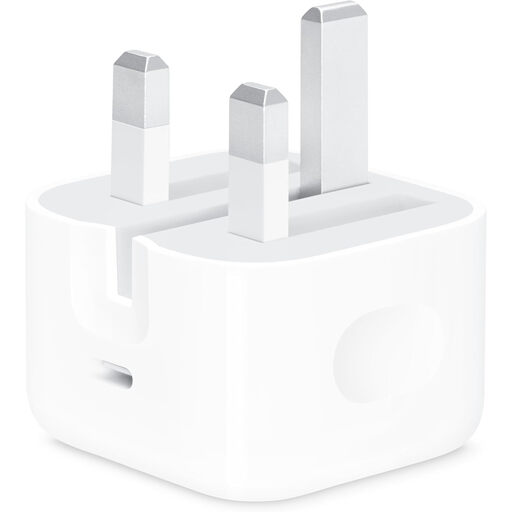
Why This Fits Their Persona: A straightforward option for Apple users who need a compact charger for home, an office drawer or a short journey around the UK.
Its stated output is 20W with one USB-C port, so there is less ambiguity about shared power. A compatible charging cable is required and is not included.
UK three-pin plug, single USB-C port, 20W maximum output and compact design for compatible iPhone and iPad models.
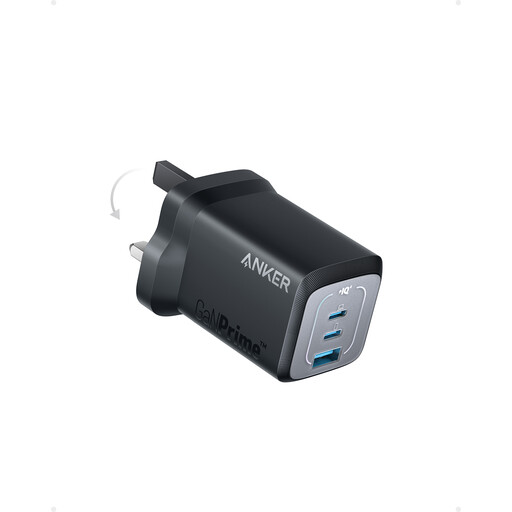
Why This Fits Their Persona: Suitable for users who want one compact charger for a phone, tablet, earbuds and occasional laptop use at home, work or while travelling.
The specification identifies two USB-C ports and one USB-A port, while also stating that output changes when two ports are used together.
67W single-device maximum, three ports, GaN construction and compatibility information covering phones, tablets, laptops and earbuds.
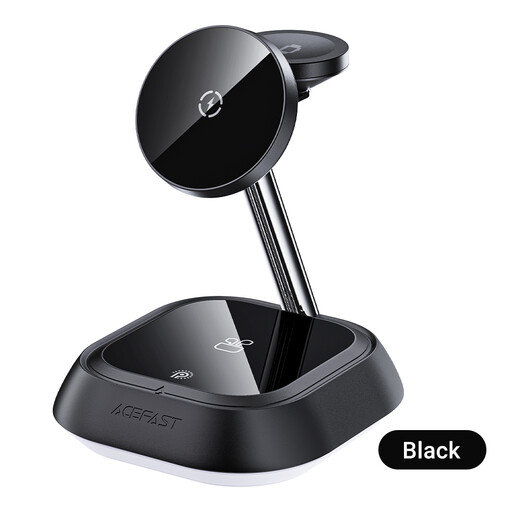
Why This Fits Their Persona: A practical fit for households charging a compatible phone, TWS earbuds case and Apple Watch in one regular location.
It separates the charging areas for the phone, earbuds and watch. It must be connected to a USB-C power adapter capable of supporting simultaneous charging.
Three-device layout, magnetic Apple Watch alignment and indicator lighting. Correct placement and a dry, ventilated environment are required.
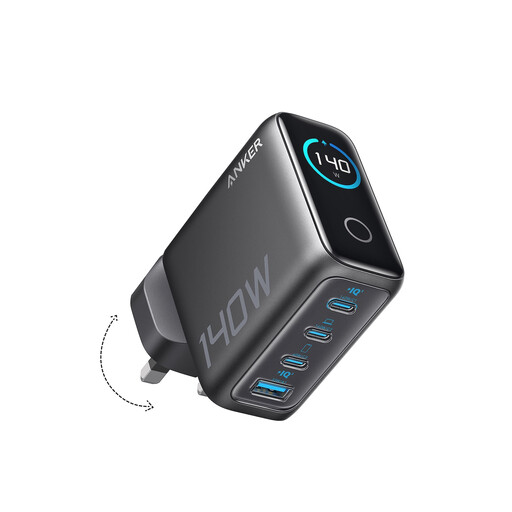
Why This Fits Their Persona: Designed around demanding desks where a laptop, phone, tablet and accessories may need power from one mains socket.
Four ports reduce the need for multiple adapters. Check the manufacturer’s port allocation and your laptop’s required wattage before connecting several devices.
Four-device charging, dual high-speed USB-C ports, GaN technology and a display showing charging status, temperature and port details.
We have compiled a complete, real-time list of products that fully satisfy these strict selection criteria and UK safety regulations.
The cost depends on the device battery, charging frequency, electricity tariff and energy lost during conversion. A higher-wattage charger does not continuously draw its maximum rating; actual consumption varies with the connected device and charge level. Unplug chargers when not needed and avoid covering them during use.
There is no fixed lifespan. Heat, damaged cables, moisture, repeated drops and poor storage can shorten service life. Keep chargers dry and ventilated, avoid bending cables sharply at the connector and replace any unit that becomes unusually hot, smokes or makes unfamiliar sounds.
Yes, if the charger provides the laptop’s required wattage and supports a compatible charging protocol. A 20W Apple charger may suit compatible phones and tablets but is not a general substitute for a laptop charger. For mixed-device use, compare the laptop specification with the charger’s single-port output, then check how power is divided when other ports are occupied.