Railway-detail display makers
You want larger prints for examining rolling-stock markings, signals, station architecture or track layouts with a class.


Choose an A3+ photo printer if pupils need larger railway photographs for displays or close inspection. A refillable all-in-one also covers classroom documents and scanning, while a dedicated pigment printer is a specialist photo-printing choice. Compact postcard and instant-film printers suit individual handouts or activities, but their smaller output cannot replace an A3+ display print.
You want larger prints for examining rolling-stock markings, signals, station architecture or track layouts with a class.
You need photographs alongside routine printing, copying or scanning, and want a manageable way to replenish consumables.
You mainly want small railway photographs that pupils can handle or take away, rather than prints for a wall display.
Settle the required print size first. Then decide whether the printer must also handle everyday classroom work or support a short, phone-led activity.
Choose when: One device must produce larger railway photographs and also print, copy or scan classroom documents.
Trade-off: Plan for the space, paper and ink needed for repeated larger-format printing.
Choose when: Specialist photographic output for railway displays takes priority over copy and scan functions.
Trade-off: Check the chosen model’s ink, paper and maintenance requirements against how often the class will print.
Choose when: Pupils need individual photo handouts rather than larger wall prints.
Trade-off: Postcard output leaves less room to examine small details in a railway scene.
Choose when: Making a small physical print is part of a phone-led classroom activity.
Trade-off: The image area is small, and the appropriate film must be obtained separately.
| Concern | What to check | Who this matters to |
|---|---|---|
| Railway-photo display detail | Check maximum print size and the feed for your intended photo paper. A larger print cannot add detail absent from the image file. | If pupils will inspect signals or rolling-stock markings on a display, I want a larger photograph they can examine; around 44% of consumers put display detail first. |
| Repeated classroom use | Check whether the device copies and scans, and confirm its connection methods and replacement consumables. | When one printer must serve photo activities and everyday documents, I need a workflow I can manage repeatedly; roughly 33% of consumers prioritise that classroom use. |
| Compact activity prints | Check the actual image dimensions and whether the required paper or film comes with the printer. | For an activity handout, I would rather give each pupil a small railway photograph than make a wall print; about 23% of consumers put compact prints first. |
Canon UK lists the SELPHY CP1500 as a postcard-size printer, while Fujifilm gives the instax Link WIDE a 62 × 99 mm image area. Neither offers the display area of A3+ output.
Decide whether the photographs are for a wall display, individual handouts or an instant-print activity before choosing a format.
Ink supplied with Epson’s SureColor SC-P700 is used during initial setup, which also leaves the maintenance box with limited remaining service life.
Check replacement ink, suitable paper and any maintenance items for the exact printer before planning repeated classroom use.
Replacing ink and maintenance consumables adds to the work of keeping the printer ready.
A model’s specifications do not establish that it can be ordered when the class needs it.
Confirm current availability, the supplied power connection and the consumables for the exact model before placing an order.
A school may have purchasing and IT requirements that affect both the ordering route and how a printer can be connected.
Ask the relevant school staff about approved purchasing routes and device access. The Department for Education lists specialist printers and consumables within its school-buying guidance.
Epson’s UK range includes the refillable EcoTank ET-8550 all-in-one and the dedicated SureColor SC-P700 photo printer.
Canon offers different formats for this decision: the dedicated A3+ imagePROGRAF PRO-310 and the compact SELPHY CP1500.
The instax Link WIDE is a phone-led instant-film option for activities built around small physical prints.
This compact option is for postcard-size railway-photo handouts or take-away prints, not larger classroom displays.
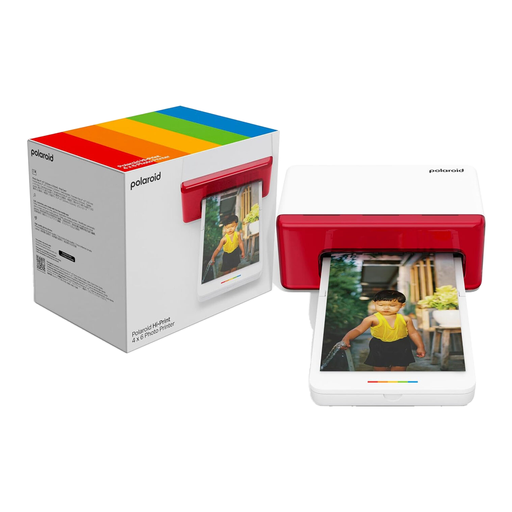 Image unavailable
Consider this model when pupils need individual railway-photo handouts rather than A3+ display prints.
It is a Bluetooth photo printer for 4 × 6 in prints. Check whether the required Polaroid Hi-Print 4x6 paper cartridge is in the box and whether its phone connection fits classroom device rules.
Choose A3+ when the photographs are intended for larger displays or close inspection of railway details; postcard output can serve individual handouts. Epson lists A3+ output for the ET-8550, and Canon UK specifies A3+ borderless output for the PRO-310.
Some models offer those connections, but classroom access depends on school device rules. Epson lists Wi-Fi, Wi-Fi Direct, Ethernet, SD-card and USB printing for the ET-8550; check which methods staff and pupils are permitted to use before choosing a printer.
Check the box contents for the exact model and the paper or film it requires. Epson says supplied SC-P700 ink is used during setup, while Fujifilm says INSTAX WIDE film for the Link WIDE is sold separately. For the Polaroid Hi-Print 4x6 option, confirm whether its required paper cartridge is included.
Confirm desk space, permitted printer connections and the school’s purchasing procedure before ordering. The Department for Education’s school-buying guidance covers specialist printers and consumables, but the appropriate route for a particular classroom should be checked with the school.