Snapshot-sharing organisers
If members want prints to pass around or put in albums, a compact 100 × 148 mm printer fits that finished size. Check whether it accepts photos from the phones, cards or shared computer the group will actually use.


For a community group handing out conventional holiday snapshots, start with a compact printer that makes 100 × 148 mm prints. Choose an A4 photo printer if larger displays or scanning and copying are part of the plan; choose a pocket printer only if small, phone-printed keepsakes are the intended result. Before ordering, agree on print size, the devices members will use and the compatible media needed for a session.
If members want prints to pass around or put in albums, a compact 100 × 148 mm printer fits that finished size. Check whether it accepts photos from the phones, cards or shared computer the group will actually use.
If holiday photos will go on noticeboards or the printer will also handle scanning and copying, an A4 photo-printer route is worth considering. Allow for a larger machine and check that its supported paper formats match the group’s plans.
If the activity is making small sticky prints from phones at a meeting, a pocket printer serves a different purpose from a conventional snapshot printer. Confirm the print dimensions, media capacity and app requirements before relying on one for a group session.
Choose it when: the group chiefly wants 100 × 148 mm photos to hand out or keep in albums.
Trade-off: compatible ink-and-paper sets are required, and this format does not provide A4 display prints.
Choose it when: larger photo displays or regular scanning and copying are genuine group needs.
Trade-off: it takes more space than a compact snapshot printer.
Choose it when: members want to make small, sticky prints from supported phones during an event.
Trade-off: its small media and tray do not suit a plan centred on conventional handout-size photos.
| Concern | What to check | Who this matters to |
|---|---|---|
| Standard snapshots | Agree on a finished size; for 100 × 148 mm prints, check the exact printer’s compatible ink, paper and cassette requirements. | I need photos that members can pass around or put into albums, rather than tiny stickers. Around 40% of consumers put conventional snapshot output first. |
| Larger and mixed-use prints | Check whether A4 borderless output, scanning and copying will actually be used, and allow space for the machine. | Our holiday pictures need to work as display prints, and the printer may have other jobs between trips. For around 40% of consumers, larger or mixed-use output is the primary need. |
| Portable keepsakes | Confirm the media dimensions, tray capacity and app compatibility with members’ phones. | I want members to make small sticky mementos during the gathering, not take home standard-size photos. Portable keepsakes come first for around 20% of consumers. |
HP Support UK lists 2.3 × 3.4 inch media and a 10-sheet tray for the Sprocket Select. That is a small-keepsake format, not the 100 × 148 mm output a group may mean by holiday snapshots.
Agree on the finished print size before comparing machines. Consider a pocket model for the activity only if small prints are the goal.
A compact printer can be ready for a session only if the right consumables are available. Canon UK Store lists the RP-108 ink-and-paper set as compatible with the SELPHY CP1500’s 100 × 148 mm format.
Check the exact model’s compatible media and obtain enough for the planned session; other print formats may require a separate cassette.
Epson United Kingdom lists A4 borderless photo printing, scanning and copying for the ET-8500. Those capabilities matter only if the group intends to use them.
If the plan is limited to small handouts, compare the required print size with a compact snapshot printer before choosing a larger machine.
Connection methods differ: Canon UK lists Wi-Fi, USB-C and compatible SD-family cards for the SELPHY CP1500, while HP Support UK describes a phone-app workflow for the Sprocket Select and says that model is not compatible with macOS.
List the devices members intend to use, then check the exact printer’s supported connection and app requirements.
Canon’s SELPHY CP1500 represents the compact route for 100 × 148 mm holiday photos.
Epson’s EcoTank ET-8500 represents an A4 refillable route for photos alongside scanning and copying.
HP’s Sprocket Select is a pocket-format option for small, phone-printed keepsakes.
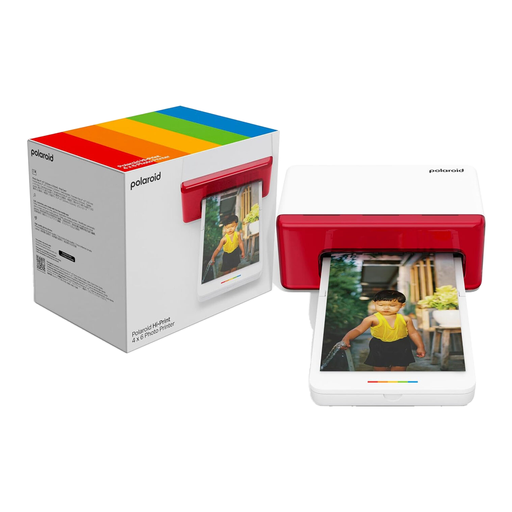
This 4x6 photo printer is relevant if the group has settled on shareable snapshot-size prints and wants to check a Bluetooth printing workflow against members’ devices.
 No image available
Consider this model if the group wants 4x6 holiday prints to share. Confirm that members can use its Bluetooth printing workflow, that compatible media is available and that its session capacity meets the planned print quantity.
Choose 100 × 148 mm if the group wants small photos to pass around or put into albums. Canon UK lists that postcard format for the SELPHY CP1500; if the group also needs larger display photos, Epson United Kingdom specifies borderless output up to A4 for the ET-8500.
It depends on the exact printer and the devices members bring. Canon UK lists Wi-Fi, USB-C and compatible SD-family card options for the SELPHY CP1500; HP Support UK describes Bluetooth printing through the Sprocket app for the Sprocket Select and states that this model is not compatible with macOS.
Match the media to the printer and the intended print size before the first session. Canon UK Store lists the RP-108 ink-and-paper set for the SELPHY CP1500’s 100 × 148 mm prints; for any model, check compatible supplies and how many prints the group intends to make.
Establish who will buy the printer, check the seller’s applicable return terms and identify an electrical-equipment collection route for when it is no longer needed. GOV.UK’s cancellation guidance concerns customers buying as consumers, so a purchase made on behalf of an organisation should not be assumed to have identical change-of-mind terms; faulty or misdescribed goods are a separate issue. GOV.UK also identifies waste electrical and electronic equipment as subject to a UK framework intended to reduce disposal through general waste.