
24/7 Customer Support

Free returns

Same-day & Next-day Delivery

Quality Guaranteed

Unlock Your Welcome Offers: FREE Delivery | Up to 80% OFF | Free 30-day JoyPlus trial
Download the APP
Splitting tablets can be difficult when the tablet is small, hard, oddly shaped or needed in quarters. A suitable pill cutter can make the task more manageable, whether you are organising daily medication, helping an older relative, preparing vitamins or administering tablets to a pet.
However, not every pill splitter is suitable for every tablet. Marketing descriptions may focus on features such as “professional” cutting or “large capacity” storage without explaining what those terms mean in everyday use. Before buying, look beyond the headline and check the cutter’s blade, adjustment system, tablet support and storage requirements.
Some tablets should not be divided because doing so may affect how the medicine is released or protected. Modified-release, enteric-coated and certain film-coated tablets may need to remain intact. Always check the medicine’s patient information leaflet and ask a pharmacist if you are unsure.
A pill cutter is a handling aid, not a replacement for professional medicine advice. It should only be used when the tablet is suitable for splitting and the prescribed instructions allow it.
A basic tablet cutter may work for one familiar tablet but become awkward when used with small pills, large vitamins or differently shaped tablets. A tablet that moves during cutting can produce uneven pieces and additional fragments.
If your household uses several tablet sizes, look for an adjustable pill cutter or a design with a guard that holds the tablet in place. This can be more practical than buying separate cutters.
Powder and small fragments can collect around the blade and hinge. This is particularly inconvenient if the same tool is used for different medicines, supplements or pet tablets. A cutter that is difficult to open and clean may become less convenient over time.
For travel or daily routines, consider whether you also need a pill organiser, weekly pill box or tablet storage box. Keeping tablets organised separately from the cutting area can make routines easier to manage.
A pill cutter with stainless steel blade may be a useful option for regular household use because stainless steel is commonly selected for its resistance to rust and ease of wiping. Still, the blade material alone does not guarantee a clean split. The tablet holder, lid alignment and cutting pressure also matter.
A vertical press-down mechanism can be easier to operate than a loose hand-held blade, particularly for people who prefer a more controlled movement. Check that the cutter has a guard or enclosed cutting area to reduce direct contact with the blade.
A small pill cutter should hold small tablets securely rather than allowing them to slide beneath the blade. Conversely, a large pill cutter needs enough internal space for larger tablets and vitamins.
If you need quarters rather than halves, choose a pill quarter cutter specifically designed for four-way division. Check the product description carefully: a standard splitter may only be intended to divide a tablet into two sections.
An adjustable design can be useful when tablet sizes vary. Look for a holder that can be repositioned without excessive force and a lid that closes securely. A cleaning brush may also be helpful for removing residue from corners and around the blade.
Do not store loose medication in a cutter unless the product is specifically designed for that purpose. Keep medicines in their original packaging where possible, and follow storage instructions relating to moisture, heat and light.
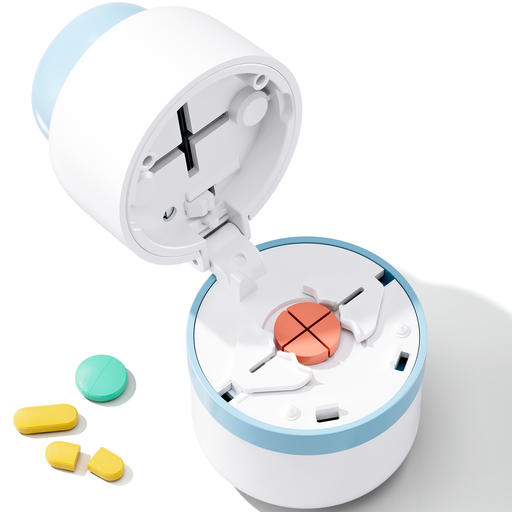
Why This Fits Their Persona: A practical choice for someone beginning to split tablets, vitamins or pills in different sizes at home.
Its product name specifies quarter cutting and a stainless steel blade, helping shoppers distinguish it from a basic half-only splitter.
Designed for small or large pills and identified as a 1/4 pill cutter with a stainless steel blade.
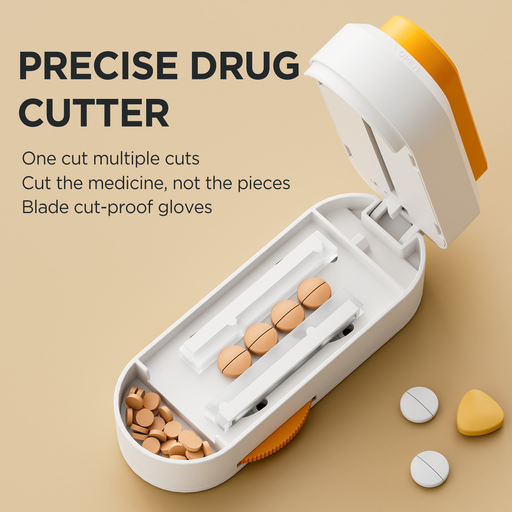
Why This Fits Their Persona: Suits regular users who want an adjustable format for different small, tiny and large tablets.
The adjustable holder addresses the common problem of using one fixed position for tablets with different dimensions.
Features vertical press-down cutting, an adjustable design, a blade guard and an included cleaning brush.
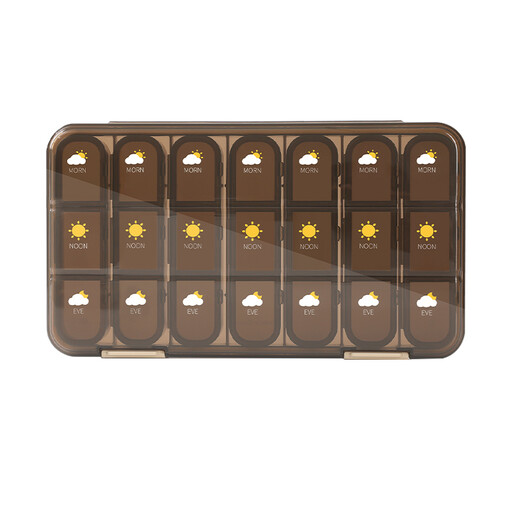
Why This Fits Their Persona: Designed for people managing multiple daily doses or travelling with a planned weekly supply.
Its stated 21 compartments and sealed portable format provide clearer organisation than carrying several loose containers.
Weekly layout, 21 compartments, large-capacity format and portable sealed construction.
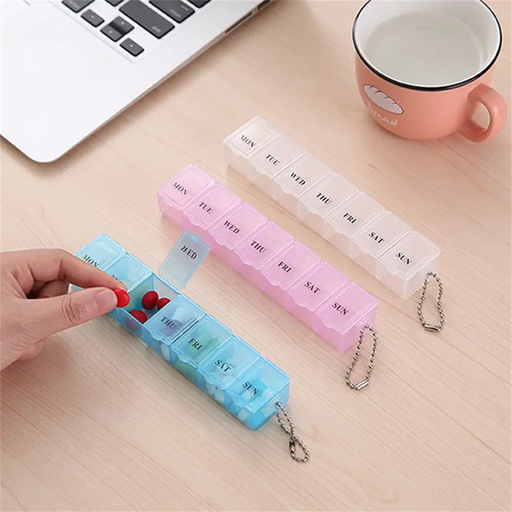
Why This Fits Their Persona: A straightforward option for keeping a small supply of tablets or vitamins separate and easier to carry.
A dedicated pill box reduces the temptation to use a cutting tool as long-term medication storage.
Supplied as a two-piece pill box set for separating or carrying tablets and vitamins.
We have compiled a complete, real-time list of products that fully satisfy these strict selection criteria and UK safety regulations.
No. Some tablets must not be split, including certain modified-release and enteric-coated medicines. Check the leaflet supplied with the medicine or ask a pharmacist before using a pill cutter.
Lifespan depends on frequency of use, tablet hardness, cleaning and construction. A cutter should be replaced if its blade, hinge, guard or tablet holder becomes damaged or stops holding the tablet securely.
They serve different purposes. A pill cutter divides a suitable tablet, while a pill organiser or weekly pill box helps arrange doses. People managing several medicines may find that using both separately is more convenient, provided medicines are stored according to their instructions.