
24/7 Customer Support

Free returns

Same-day & Next-day Delivery

Quality Guaranteed

Unlock Your Welcome Offers: FREE Delivery | Up to 80% OFF | Free 30-day JoyPlus trial
Download the APP
A pill organiser can make daily routines easier, but the wrong design may create frustration, spills or confusion. UK shoppers often focus on compartment numbers and overlook details that affect everyday use.
Before buying a pill organiser, watch for these common pitfalls:
Start by counting how many doses you need to organise. A simple daily pill case may be enough for one day, while a weekly pill organiser is more suitable for preparing several days in advance.
Consider whether you need:
Capacity should be judged by the size of your own tablets, rather than the number of compartments alone. A slim box may look convenient but leave little room for larger capsules.
A clear day layout can reduce mix-ups, particularly when a carer or family member is helping with preparation. Look for clearly printed, etched or fade-resistant day labels and check whether the markings are easy to read in normal lighting.
For users with arthritis or limited hand strength, an easy-open pill organiser with push-button or ergonomic lids may be more practical than small hinged compartments. However, the lids should still close securely enough to prevent accidental opening inside a bag.
Many organisers in this selection use BPA-free plastic. This can offer a lightweight, easy-to-clean format, but it is still important to check the care instructions. Most should be wiped with a damp cloth or washed as directed, then dried fully before refilling.
Do not assume that a medicine organiser replaces the original labelled packaging. For prescription medicines, follow the storage instructions supplied with the medicine and ask a pharmacist whether transferring tablets into a pill box is suitable. Keep organisers away from children and direct sunlight.
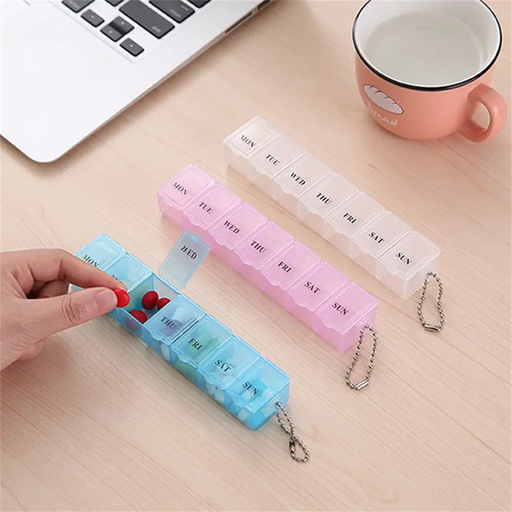
Why This Fits Their Persona: A two-piece set can suit someone starting with simple daily organisation or needing separate boxes for home and work.
The two-box format avoids paying for a large weekly layout when only a compact storage solution is needed.
Includes two pill boxes; suitable for basic daily storage and keeping a spare in another location.
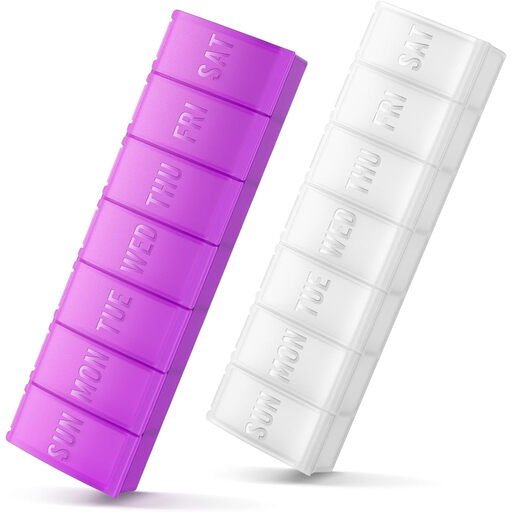
Why This Fits Their Persona: This option suits users who want a clearly marked weekly medicine organiser with larger compartments and easy-open lids.
Permanent day labels and ergonomic lids address fading markings and difficult opening, two common long-term usability issues.
BPA-free medical-grade plastic; two organisers; roomy compartments; etched day labels and easy-open lids.
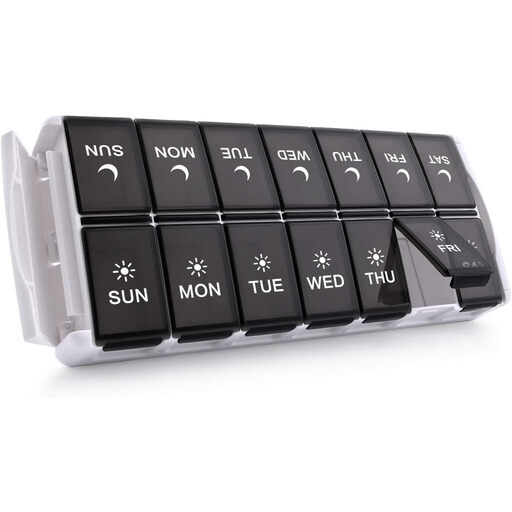
Why This Fits Their Persona: The AM PM pill organiser is designed for people sorting morning and evening medication, vitamins or supplements for a full week.
The twice-daily layout avoids squeezing different doses into one compartment, while the removable bottom cap supports batch filling.
Seven days of AM/PM sections; stated capacity for multiple capsules; snap-shut lids; compact format for home or travel.
We have compiled a complete, real-time list of products that fully satisfy these strict selection criteria and UK safety regulations.
For short trips, a portable pill box with three or four compartments may be more convenient than carrying a full weekly case. The GAONLY three-compartment pack of two is designed for pocket or handbag storage, while the small JORDAN&JUDY case combines pill storage with a tablet cutter.
When using a cutter, check that the tablet is suitable for splitting. Do not use it for hard or irregular-shaped pills unless advised. Keep the metal cutter away from children and clean it according to the product instructions.
For longer travel, a detachable weekly organiser with three compartments per day can separate doses more clearly. A larger pill box may be useful for vitamins and supplements, but check its packed size before placing it in hand luggage.
Ask a pharmacist before transferring prescription medicine from its original packaging. Some medicines require specific storage conditions, moisture protection or original labels. A pill organiser should support organisation, not replace professional guidance or the instructions supplied with the medicine.
Lifespan depends on the hinges, closures, cleaning routine and frequency of use. Inspect the box regularly for cracked plastic, loose lids, damaged labels or moisture entering the compartments. Replace it if doses can no longer be kept separated and secure.
A daily pill case normally provides storage for one day, often with several sections. An AM/PM weekly organiser provides labelled morning and evening compartments across seven days, making it more suitable for preparing a recurring twice-daily routine. Choose the layout that matches the actual schedule rather than selecting extra compartments you will not use.