
24/7 全天候客户支持

免费退货

当日/次日达

品质保障

开启新人专享福利: 全场免邮 | 低至 2 折 | 免费试用 30 天 JoyPlus 会员
下载 Joybuy
A pill organiser can make daily medication, vitamins and supplements easier to manage, but the wrong design may create more hassle than it removes. A compact box may not hold larger capsules, while a weekly model can be awkward if its lids are difficult to open.
This guide from the Joybuy Product Recommendation Officer focuses on practical details rather than marketing language. It covers common buying traps, the specifications worth checking and suitable options for different routines.
A product advertised as a 7-day pill box may have only one small section per day. That may suit a simple routine but leave little room for several tablets, fish-oil capsules or larger supplements.
Check whether the stated capacity refers to:
A 28-compartment pill organiser normally divides seven days into four daily doses, but it may be larger than needed for occasional supplements. Conversely, a small pill case may be convenient for a handbag but unsuitable for a full day’s medication.
Descriptions such as waterproof pill case, moisture-proof and airtight do not necessarily indicate the same level of protection. A snap lid with a silicone ring can help limit exposure to humidity, but it should not be assumed to be suitable for immersion or wet environments unless the product information specifically states this.
For medicines that are sensitive to moisture, heat or light, ask a pharmacist whether transferring them from their original packaging is appropriate. Some medicines should remain in their supplied packaging, particularly where dosage instructions, expiry information or special storage requirements apply.
A secure closure is not useful if it is too stiff for the intended user. Small hinged lids, tight snap tabs and narrow slots can be challenging for older people or anyone with reduced hand strength.
If accessibility matters, look for easy-open lids, push-button mechanisms or larger tabs. An arthritis-friendly pill box should still be checked in person where possible, as “easy open” is a design description rather than a guarantee for every user.
Choose the layout around the actual schedule:
Clear day labels reduce mix-ups, but labels should be easy to read and durable. Permanently etched or clearly printed markings are preferable to labels that can peel or fade.
Many organisers use plastic, commonly polypropylene or another rigid material. Look for a smooth finish without rough edges, exposed sharp points or hinges that catch when opened. BPA-free or food-grade descriptions can provide useful material information, but they do not determine whether a container is suitable for a particular medicine.
Before refilling, compartments should be clean and completely dry. Follow the product instructions: some boxes are intended for wiping or hand washing and should not be placed in a dishwasher, microwave or freezer.
A portable pill box should fit the intended location without becoming overloaded. Consider whether it will be carried in a coat pocket, handbag, work bag or suitcase. A separate daily container can be convenient for commuting, while a larger weekly box may be more practical at home.
For travel, check:
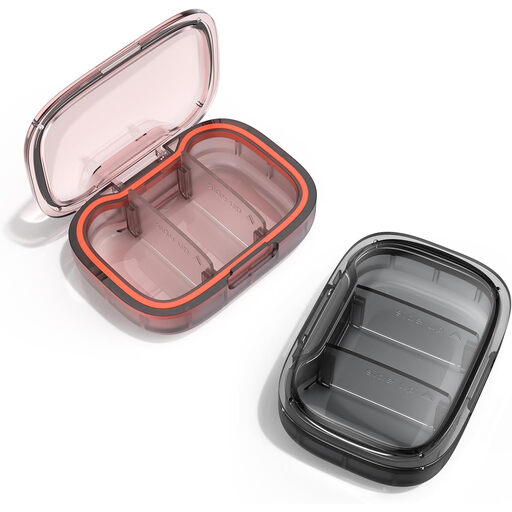
Why This Fits Their Persona: A two-piece set with three compartments per case suits users who need a simple portable pill box for short trips, workdays or separating a few vitamins.
The defined three-compartment layout makes capacity easier to judge than a vague “large capacity” claim. Its listing also describes the case as moisture-proof, but it should not be treated as immersion-proof.
Pack of two; compact three-section format for travel or daily carrying.
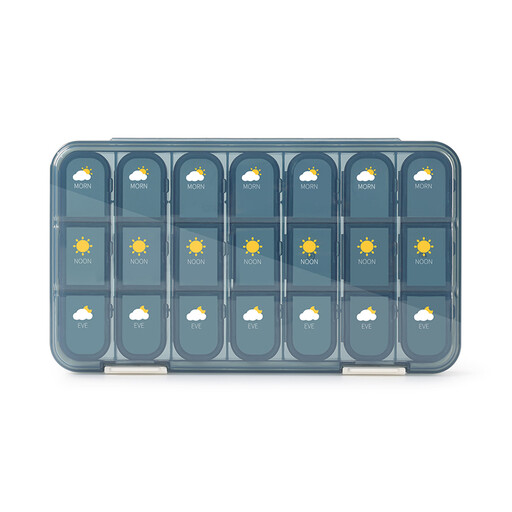
Why This Fits Their Persona: This option is suited to users who prepare a full week in advance and want separate daily sections for a more structured routine at home, work or while travelling in the UK.
The listing identifies 21 compartments, avoiding confusion between a weekly organiser and a four-dose-per-day format. Confirm the daily layout before purchase if you need more than three time slots.
Large weekly format; 21 individually separated compartments.
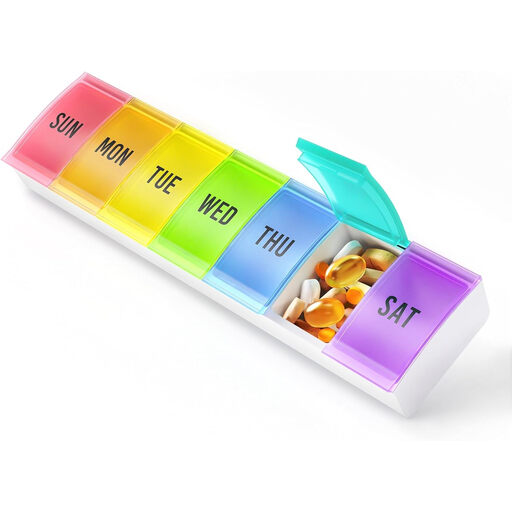
Why This Fits Their Persona: The seven-section design is aimed at users managing a regular weekly supply, including people who prefer larger compartments for capsules, vitamins or supplements.
The product information specifies seven compartments and ergonomic lids, rather than relying only on a general accessibility claim. Users should still check lid resistance before regular use.
Seven clearly marked compartments; ergonomic lids; BPA-free plastic stated in the product information.
For users who need to split tablets, a tablet cutter pill box such as the JORDAN&JUDY Small Pill Organiser with Tablet Cutter combines storage with a cutting mechanism. Follow the supplied warnings: not every tablet is suitable for splitting, and the cutter should be kept away from children.
We have compiled a complete, real-time list of products that fully satisfy these strict selection criteria and UK safety regulations.
Clean it when residue or dust appears and before changing the type of contents. Use the manufacturer’s recommended method, usually a damp cloth or mild soap and water. Allow every compartment to dry fully before refilling, as trapped moisture can affect some tablets and capsules.
Lifespan depends on the plastic, hinges, seals and frequency of opening. Replace it if a lid no longer closes securely, compartments crack, labels become unreadable or a silicone seal shows damage. A low-cost small pill case may be suitable for occasional travel, while a sturdier weekly organiser may suit regular use.
Ask a pharmacist before transferring prescription medicines. Some products require their original packaging or specific protection from moisture, light or air. An organiser is generally a storage and scheduling aid, not a replacement for professional instructions. Keep it away from children and pets, and check each compartment carefully when refilling.