
24/7 Customer Support

Free returns

Same-day & Next-day Delivery

Quality Guaranteed

Unlock Your Welcome Offers: FREE Delivery | Up to 80% OFF | Free 30-day JoyPlus trial
Download the APP
A pill organiser can make daily medicines, vitamins and supplements easier to sort, carry and check. However, choosing by appearance alone can lead to practical problems: lids that are difficult to open, compartments that do not hold enough tablets, or seals that offer less protection than expected.
Whether you need a weekly pill organiser, a compact travel pill case or a large-capacity solution for several daily doses, the right choice depends on your routine. This guide explains the features worth checking and highlights suitable options for different UK households.
A basic daily pill box may suit one dose per day, but it can become confusing if you take medicines at breakfast, lunchtime, tea time and bedtime. Conversely, a 28-compartment organiser may be unnecessarily bulky if you only need to carry a few tablets.
Check whether the organiser is arranged by:
A clear layout can reduce mix-ups, particularly when a carer is preparing medicines for someone else.
A small pill case is convenient for a handbag, coat pocket or work bag, but small compartments may not hold larger tablets or fish oil capsules. A weekly pill organiser can offer more capacity, although it may take up more space in luggage.
Look for a secure closure and consider whether the organiser needs to be carried separately from your main medication supply. For prescription medicines, keep the original packaging and follow advice from your pharmacist when travelling.
Terms such as “airtight”, “moisture-proof” and “waterproof” can describe the design, but they do not mean an organiser can be submerged or used for liquid medication. A seal may also become less effective if the lid, hinge or silicone ring is damaged.
Keep tablets in a cool, dry place away from direct sunlight. Check the product instructions, close each compartment properly and replace the organiser if it develops cracks or no longer shuts securely.
Capacity should be assessed by the type and number of tablets you take, not just the advertised number of compartments. Large capsules and supplements such as fish oil may need deeper sections.
For a straightforward routine, a daily pill box or seven-section model may be enough. If you take medicines at several times, consider a 4-times-a-day pill box or a 7-day medicine organiser with separate sections for each dose.
Push-button or ergonomic lids can be useful for older users and people with arthritis, but the mechanism should still close securely. Clearly printed or permanently marked day labels make it easier to identify doses.
Avoid selecting a box with tiny lettering if eyesight is a concern. Colour-coded lids may also help distinguish days or dose periods, although they should not replace written labels.
Many products use polypropylene or other plastic materials. If you specifically want a BPA-free pill container, check that BPA-free status is stated in the listing rather than assuming it from the product’s appearance.
The organiser should be easy to wipe clean and fully dry before refilling. Do not mix medicines if your pharmacist has advised that particular tablets must remain in their original packaging. A medication storage box is intended for organisation, not for changing how medicines are prescribed or taken.
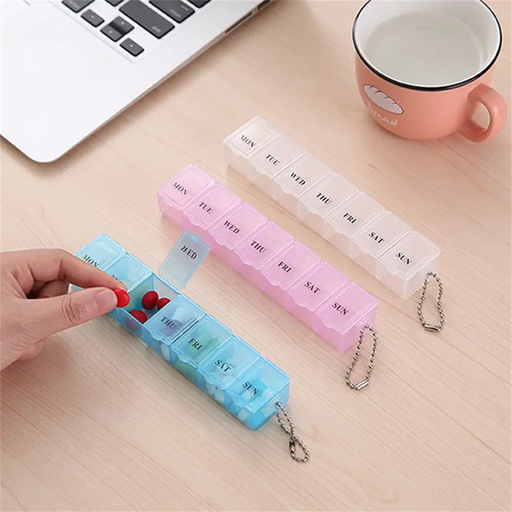
Why This Fits Their Persona: A two-piece option is practical for trying a pill organiser without committing to a larger weekly system. One box can be kept at home while the other is used for a bag or work drawer, subject to the user’s storage needs.
The two-box format avoids buying a bulky organiser when a simpler arrangement is sufficient. Check the compartment dimensions before ordering.
Two organisers are included; the compact format can support separate home and portable routines.

Why This Fits Their Persona: This seven-day format is suited to people who want a more structured vitamin and supplement organiser for home, office or travel preparation.
Its listed design includes removable daily boxes and a snap-lock lid with a silicone sealing ring. The seal should still be checked regularly for damage.
Seven removable daily compartments; listed large-capacity design; silicone sealing ring.
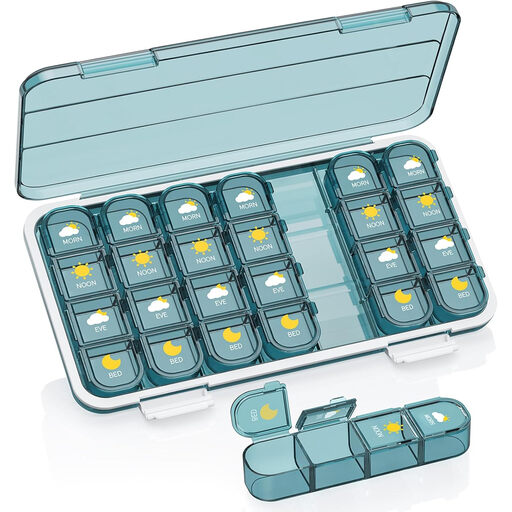
Why This Fits Their Persona: A four-dose daily schedule benefits from separate morning, midday, evening and bedtime sections across the week.
The four-times-a-day layout avoids forcing multiple doses into one undifferentiated compartment, which can make a schedule harder to follow.
Seven-day organisation; four daily dose periods; separate case included according to the listing.
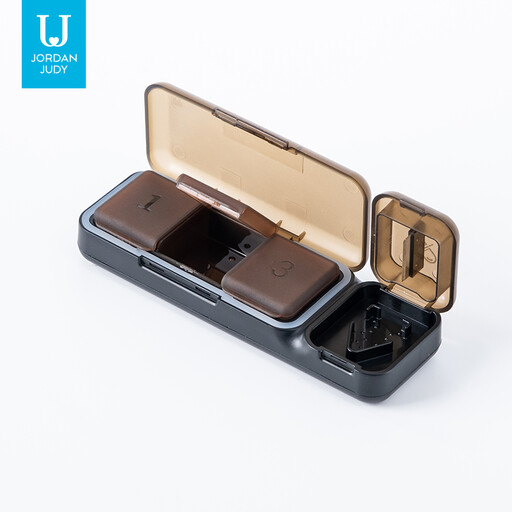
Why This Fits Their Persona: The compact format is suitable for a handbag, pocket or desk, while the integrated tablet cutter may help users who need to split suitable tablets.
The combined storage and cutter design avoids carrying separate items. The cutter should not be used on hard or irregular-shaped pills, and pharmacist guidance is advisable before splitting medicine.
Integrated tablet cutter; compact portable design; suitable for daily carry.
An organiser does not replace reminders, dosage instructions or advice from a GP or pharmacist. If you are unsure whether a medicine can be removed from its original packaging, ask a pharmacist.
A portable pill organiser with secure lids and appropriately sized compartments is usually easier to pack than a large weekly box. For short trips, a three- or four-compartment travel pill case may be sufficient. For longer trips, a detachable weekly organiser can make preparation easier, but prescription medicines should be carried according to current UK travel and pharmacy guidance.
There is no universal replacement period. Replace a pill organiser when it cracks, becomes difficult to close, loses a seal, develops residue that cannot be cleaned, or has labels that are no longer readable. With regular cleaning and careful handling, its usable life depends on the material and opening mechanism.
A vitamin and supplement organiser can be convenient, but medicines should only be combined or transferred if this is suitable for the specific product. Some medicines are sensitive to moisture, light or air, while others need their original packaging. Check the label and ask a pharmacist before reorganising prescription or over-the-counter medicines.