
24/7 全天候客户支持

免费退货

当日/次日达

品质保障

开启新人专享福利: 全场免邮 | 低至 2 折 | 免费试用 30 天 JoyPlus 会员
下载 Joybuy
Managing medicines, vitamins or supplements is easier when each dose has a clear place. However, not every pill organiser is equally practical. A container may look compact online but have cramped compartments, stiff lids or labels that become difficult to read.
This guide explains the features worth checking before buying, from a weekly pill organiser for home use to a travel pill case for short trips. The aim is to help UK households, carers and people with limited hand dexterity choose a useful format without paying for features they will not use.
A 7-day pill box may provide one compartment per day, but that does not necessarily suit someone taking medicine at different times. If your routine involves morning and evening doses, look for an AM/PM pill organiser. For more complex schedules, a 4-times-a-day format with separate sections may be more suitable.
Before ordering, check whether the compartments represent:
Some lids require a firm pinch or fingernail grip. This can be inconvenient for older users, people with arthritis or anyone with reduced hand dexterity. A product described as easy to open should still be checked for its actual opening mechanism, such as a push button, broad lid or ergonomic edge.
A pill organiser for arthritis should balance easy access with a closure that will not open accidentally inside a handbag or suitcase.
A small portable pill container is convenient for a day out, but it may not hold larger tablets, fish oil capsules or several supplements. Conversely, a large weekly dispenser can take up more space than expected.
Check the stated dimensions and compartment size rather than relying on product photographs. Also consider whether you need a vitamin organiser, a supplement storage box or a dedicated daily medicine organiser.
For a standard routine, a 7-day pill box or weekly organiser can reduce the need to sort doses every day. Look for clear day markings and enough room for the tablets or capsules you actually take.
The VVM weekly model listed on Joybuy has seven compartments and is described as holding up to 17 capsules or eight fish-oil capsules per section. Capacity varies according to tablet shape, so treat these figures as a guide rather than a guarantee.
For twice-daily routines, an AM/PM organiser separates morning and evening doses across seven days. If you take several doses daily, a four-times-a-day weekly design may provide more useful separation.
The opening system is particularly important for people with arthritis or limited grip strength. Push-button lids and broad ergonomic covers can be easier to operate than small hinged tabs, but the product should still close securely after filling.
A snap-shut or latching closure can help prevent accidental opening during transport. It should not, however, be treated as childproof storage. Keep all medicines away from children and follow the storage instructions supplied with the medicine.
A BPA-free pill box may be preferable for shoppers who want to avoid BPA in the organiser’s plastic. Several products in this selection are described as BPA-free or made from polypropylene. Check the listing for the exact material rather than assuming every plastic pill case has the same specification.
Day labels should remain readable after regular use. Permanently etched or printed markings may be more practical than labels that can peel, while clear colour coding can support quick identification. Clean the organiser as directed, allow each compartment to dry fully and avoid storing damp tablets inside it.
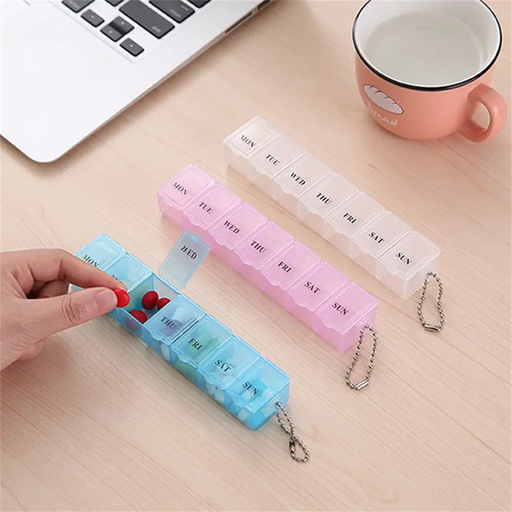
Why This Fits Their Persona: A two-piece option can suit shoppers starting with a straightforward storage routine or wanting a spare organiser for home, work or a handbag.
The pack format gives you a second unit rather than requiring one organiser to serve every location. Check the individual compartment layout before purchase.
Two organisers are included; suitable for separating locations or routines.
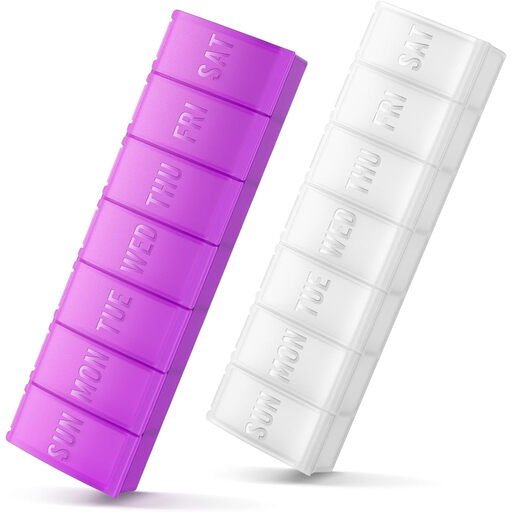
Why This Fits Their Persona: This pair suits households that value durable labelling, larger compartments and a spare weekly unit for uninterrupted organisation.
Its listed permanently etched day labels address the problem of markings that fade or peel. The organiser is described as BPA-free medical-grade plastic.
Two-piece pack; large compartments; smooth hinges and ergonomic lids.
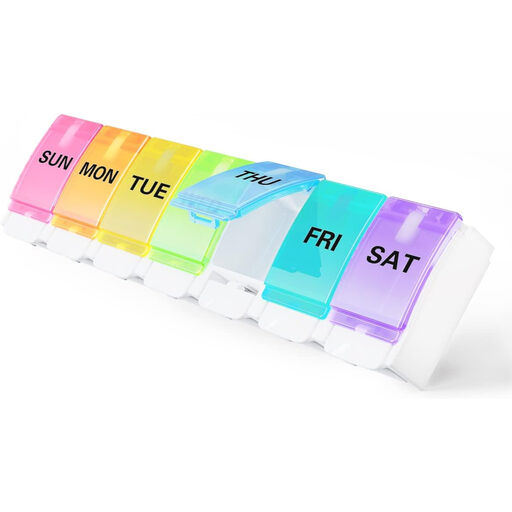
Why This Fits Their Persona: A practical match for users taking medicines, fish oils or supplements twice daily and needing a compact organiser for home or travel.
The AM/PM layout avoids forcing two daily doses into one undifferentiated compartment. Push-button lids can be more accessible than narrow tabs.
Seven-day AM/PM arrangement; BPA-free polypropylene; secure push-button lids.
Before filling a new daily medicine organiser, compare the compartments with your prescription instructions. If a medicine has special storage requirements, needs to remain in its original packaging or should not be removed from a blister pack, follow the label or ask a pharmacist.
A simple setup routine can help:
For holidays, a compact travel pill case can be useful for short-term quantities, but keep medicines clearly identifiable and carry prescriptions or supporting documentation when appropriate. A wider range of compact cases and medicine storage accessories is available in the medicines pouch category.
We have compiled a complete, real-time list of products that fully satisfy these strict selection criteria and UK safety regulations.
Lifespan depends on the plastic, hinges, closure and frequency of use. Replace it if lids no longer close securely, labels become unreadable, compartments crack or residue cannot be removed. A model with permanently etched markings may remain easier to identify than one using adhesive labels.
Not always. Some medicines are sensitive to moisture, light or air, while others should remain in their original packaging. Check the medicine label or speak with a pharmacist before transferring tablets or capsules. Do not mix different medicines in one compartment unless you can identify them safely and the storage instructions allow it.
Choose according to the number of days, doses and capsules required. A four- or seven-compartment portable pill container may suit a short outing, while a sealed 21- or 28-compartment organiser can be more appropriate for longer trips or multiple daily doses. Always compare internal capacity, not just the outside dimensions.