
24/7 Customer Support

Free returns

Same-day & Next-day Delivery

Quality Guaranteed

Unlock Your Welcome Offers: FREE Delivery | Up to 80% OFF | Free 30-day JoyPlus trial
Download the APP
By Joybuy Product Recommendation Officer
A pill organiser can simplify a daily routine, but the wrong design may create more inconvenience than it removes. This is particularly relevant for older adults, people with arthritis, carers managing several schedules and anyone travelling with medication.
The most useful approach is to compare the layout, opening mechanism, capacity and protection offered, rather than choosing based only on appearance or a product title.
A slim daily pill box may look convenient, but narrow sections can be unsuitable for larger tablets, fish-oil capsules or several supplements. Check the stated dimensions and compartment capacity where available. A seven-day layout is not automatically suitable for a large daily routine.
Terms such as “airtight”, “waterproof” or “moisture-proof” can describe different designs. A snap-lock lid with a silicone sealing ring offers a different level of closure from a basic hinged flap. Even a moisture-proof pill case should be kept away from steam, direct sunlight and excessive humidity. Always check whether the medicine itself requires original packaging or specific storage conditions.
Small tabs and stiff catches may be difficult for users with reduced grip strength or arthritis. Conversely, a loose lid can open inside a handbag or suitcase. Look for a practical balance between easy opening and secure closure, particularly when the organiser will be carried outside the home.
Match the organiser to the number of doses taken each day:
Capacity should be judged by the physical size of the pills, not simply the number of compartments. Capsules and fish oils often need deeper sections than small tablets.
Clearly printed or permanently etched day labels help reduce mix-ups. For an arthritis-friendly pill organiser, wide lids, push-button mechanisms or ergonomic tabs may be easier to operate than tiny snap catches. Test whether each lid can be opened individually without disturbing the neighbouring compartments.
A removable daily case can also be useful for work, appointments or an overnight stay, while a fixed weekly organiser may be more straightforward for bedside use.
Food-grade or BPA-free polypropylene is commonly used for lightweight tablet storage. The organiser should have smooth internal surfaces and a closure that remains secure during normal handling. Some models should be hand-washed with mild soap and dried completely before refilling; others are intended to be wiped with a damp cloth.
Do not use a pill organiser for liquids, loose powders or medicines that require specialist storage unless the packaging instructions or a pharmacist confirm that it is appropriate. Keep all organisers out of reach of children and pets.
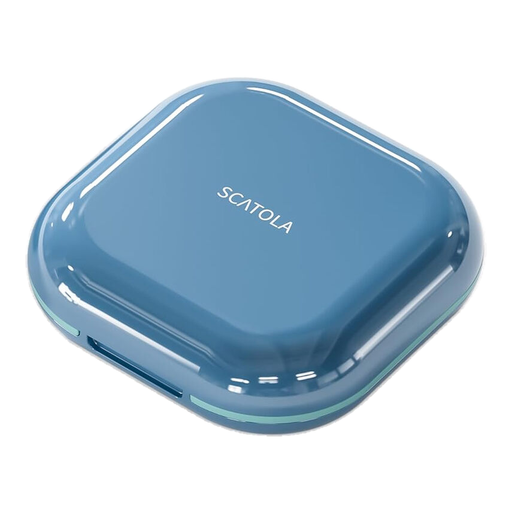
Why This Fits Their Persona: A compact option for someone starting a simple medication or vitamin routine, with four sections for a handbag, desk drawer or short UK trip.
Its four-compartment layout avoids paying for unused weekly sections, while the compact format is easier to carry than a large medicine organiser.
Four separate compartments; small format designed for travel or purse storage.
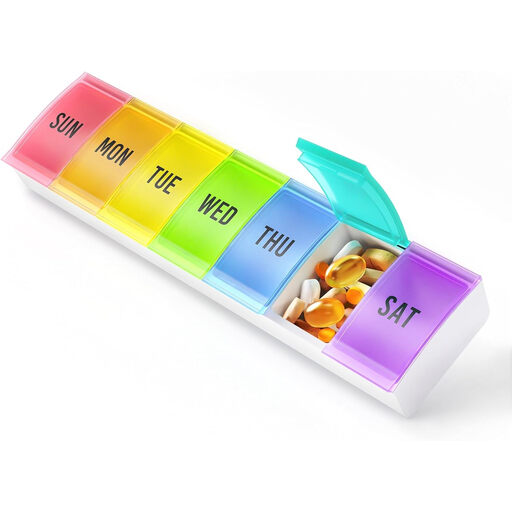
Why This Fits Their Persona: A practical choice for users who value durable labels, larger compartments and a lid design intended to be easier to open.
The product information specifies ergonomic lids, seven compartments and fade-resistant day markings, addressing common access and labelling concerns.
BPA-free food-grade plastic; seven compartments; stated capacity for larger capsules and supplements.

Why This Fits Their Persona: Suitable for users managing multiple doses or larger supplement routines at home, in the office or while travelling between UK destinations.
Seven removable daily boxes separate a full week into individual days, reducing the need to carry one oversized open tray.
21 compartments; snap-lock lid with silicone sealing ring; removable daily sections.
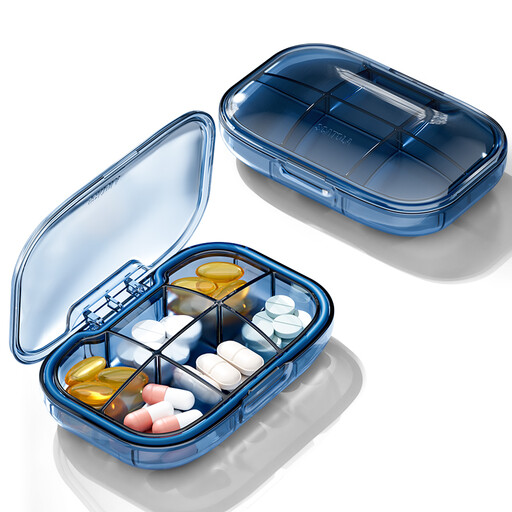
Why This Fits Their Persona: Two compact cases can help separate medicines for a handbag, overnight bag or different destinations without taking a full weekly organiser.
The six-compartment format gives more separation than a single pocket, while the two-pack provides a spare or a way to divide routines.
Pack of two; six separate compartments per case; portable plastic construction.
We have compiled a complete, real-time list of products that fully satisfy these strict selection criteria and UK safety regulations.
No. Some medicines may be sensitive to moisture, light or air, or may need to remain in their original packaging. Check the dispensing label and leaflet, and ask a pharmacist before transferring tablets or capsules. Do not mix different medicines in one compartment unless you have confirmed that this is suitable.
Replace it when hinges, seals or lids become loose, cracked or difficult to close. Faded labels can also increase the chance of selecting the wrong compartment. Regularly clean the box as directed and refill it only when every section is completely dry.
Choose a travel pill organiser with a secure closure and enough capacity for the journey, but keep prescription information and medicines in line with the relevant travel requirements. A portable pill container is useful for short trips, while a removable weekly design may suit longer stays. For flights or international travel, check airline and destination-country guidance before departure.