
24/7 全天候客户支持

免费退货

当日/次日达

品质保障

开启新人专享福利: 全场免邮 | 低至 2 折 | 免费试用 30 天 JoyPlus 会员
下载 Joybuy
A pill organiser can simplify a regular medicine, vitamin or supplement routine, but the wrong design may create more problems than it solves. Compartment labels can be difficult to read, lids may be awkward to open, and a compact case may not hold larger fish oil capsules.
Before buying a pill organiser, look beyond attractive colours and phrases such as “large capacity” or “portable”. The practical details are what determine whether a case remains useful at home, work or while travelling.
A case with many sections is not automatically suitable for your routine. A 7-day pill organiser may provide only one compartment per day, while a weekly pill organiser with three or four daily sections can separate morning, midday, evening and bedtime doses.
Capacity also varies according to pill size. Fish oil capsules and larger supplements can occupy considerably more space than standard tablets. Check whether the product description gives useful capacity information rather than relying only on the number of compartments.
A lid that closes firmly can help prevent accidental opening inside a handbag or suitcase. However, an overly stiff latch may be frustrating for older adults or anyone with arthritis, reduced grip strength or long nails.
Look for push-button, ergonomic or smooth-hinge designs where possible. If the organiser is intended for someone else, consider whether they can open every compartment independently before filling it with medication.
Terms such as “sealed”, “airtight” and “waterproof” describe design features, but they do not mean medicines can be stored in every environment. A pill storage box should be kept away from heat, direct sunlight, bathrooms and damp kitchen areas unless your pharmacist advises otherwise.
Some medicines also need to remain in their original packaging. Always check the label, patient information leaflet or ask a pharmacist before transferring prescribed medication into a medication organiser.
Start by writing down how many doses you take each day and how many days you want to prepare. Suitable formats include:
Clear day and time markings can reduce mix-ups, especially where several medicines, vitamins or supplements are involved. Colour coding may also help, although the printed labels should remain the primary reference.
For everyday storage, inspect the listed material and construction. Products described as BPA-free plastic, polypropylene or food-grade PP may be suitable for storing dry tablets and capsules, provided the product is used according to its instructions.
A secure snap closure can be useful when carrying a case in luggage. A silicone sealing ring, where specified, may offer additional moisture resistance. Nevertheless, no pill case should be treated as childproof unless it is specifically described and certified for that purpose. Keep all medicines and organisers away from children and pets.
Compare the external dimensions with the space available in a drawer, handbag or coat pocket. A large capacity pill organiser may be more convenient at home but less practical for daily carrying.
Check whether the compartments are wide enough for the tablets you use. If you take large capsules, look for descriptions mentioning roomy sections or capacity for fish oil. For cleaning, many organisers can be wiped or hand-washed with mild soap and water. Allow every compartment to dry completely before refilling, as trapped moisture can affect the contents.
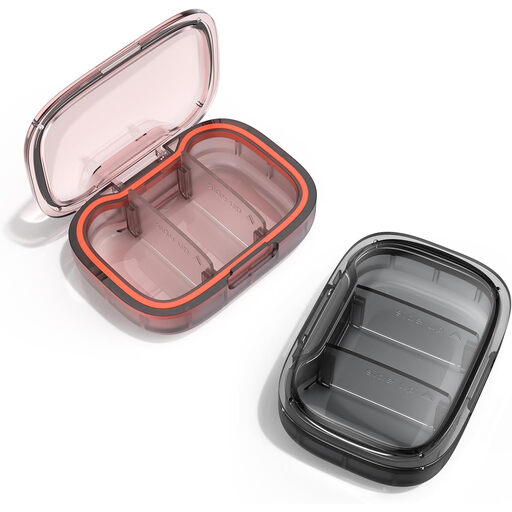
Why This Fits Their Persona: Two compact cases provide a straightforward option for separating a small daily supply, vitamins or supplements at home and on short journeys.
The three-compartment layout is more informative than a single undivided pocket, while the moisture-proof design is listed for portable use.
Pack of two; three separate compartments per case; suitable for vitamins, fish oil and supplements.
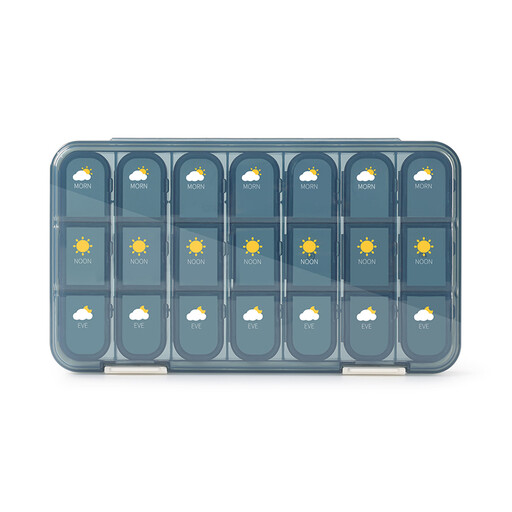
Why This Fits Their Persona: A structured weekly system suits shoppers who want separate daily sections and a more enclosed case for home, office or travel use.
Seven removable daily boxes and a silicone sealing ring provide clearer organisation than one large mixed compartment.
21 compartments; removable Monday-to-Sunday sections; snap-lock lid with silicone sealing ring.
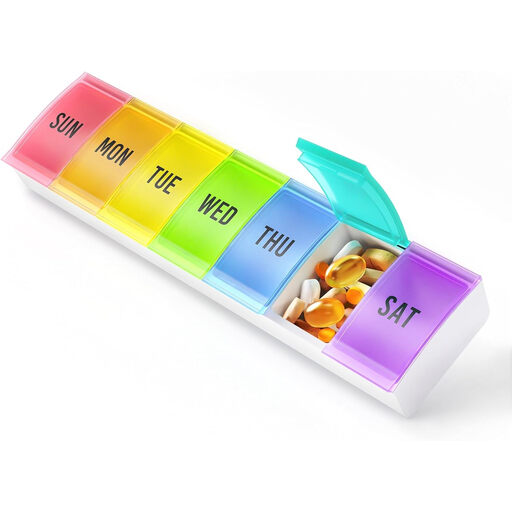
Why This Fits Their Persona: Its seven compartments and stated capacity for large supplements make it suitable for people managing several tablets or capsules each day.
Colour covers and raised day markings make the compartments easier to distinguish, while secure snap-shut lids address accidental opening.
BPA-free plastic; seven compartments; listed capacity of up to eight fish oils or 17 capsules per compartment.
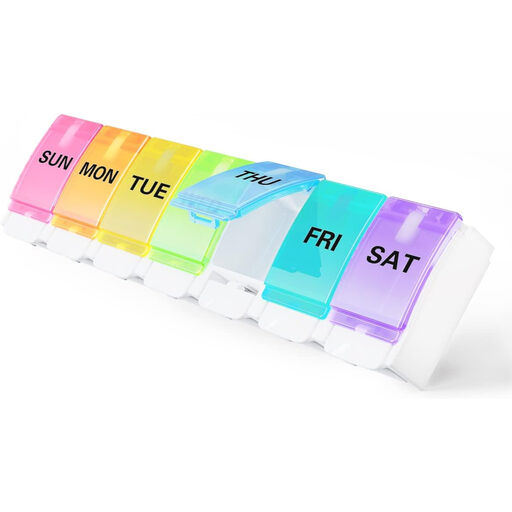
Why This Fits Their Persona: Morning and evening sections offer a simpler routine for users who prefer fewer, clearly marked daily decisions in a compact case.
Push-button lids are described as easy to open, helping address the common problem of stiff closures.
BPA-free polypropylene; AM/PM layout; push-button opening; compact dimensions for home or travel.
We have compiled a complete, real-time list of products that fully satisfy these strict selection criteria and UK safety regulations.
Wash or wipe the organiser according to its instructions, then let it dry fully. Fill one day or dosing period at a time in a well-lit area, checking each medicine against its label. Keep medicines that require original packaging, refrigeration or special handling in accordance with the instructions. If you are unsure whether a medicine can be transferred, ask a pharmacist.
There is no universal replacement period. Inspect the hinges, lids, labels and seals regularly. Replace the case if it develops cracks, loose closures, damaged seals, faded markings or residue that cannot be cleaned. A pill organiser should also be replaced if it no longer opens reliably or can no longer keep compartments separate.
A portable pill box can be convenient for carrying a small supply, but travel requirements depend on the medicine and destination. For prescribed medication, carrying it in the original labelled packaging may be advisable. Keep a copy of relevant prescriptions where appropriate and check airline, destination and pharmacist guidance before departure.