Weekend pizza-batch hosts
If you prepare several portions for a short stay, look for freezer storage that lets you label and retrieve individual containers without rearranging all the cottage’s frozen food.


For a heated holiday-cottage kitchen, choose a fridge-freezer whose freezer can be set to around −18°C and has room for your portioned dough; frost-free operation can reduce defrosting. If the appliance will stand in a cold annex, check the exact model’s operating guidance for both compartments. An integrated replacement must also match the cabinet aperture and door hinges.
If you prepare several portions for a short stay, look for freezer storage that lets you label and retrieve individual containers without rearranging all the cottage’s frozen food.
If the appliance will stand in an intermittently heated utility room or garage-like annex, check its permitted ambient temperature before choosing by freezer size. A low-temperature freezer rating does not necessarily cover the fridge compartment.
If the kitchen layout cannot change, measure the existing housing and identify its sliding or fixed door-hinge arrangement. Freezer space for dough matters only if the replacement can be installed correctly.
Start with the installation location: a heated kitchen, cold annex and existing fitted cabinet impose different constraints. Then compare the space your dough portions will actually occupy with the freezer layout, rather than relying on total appliance capacity.
| Concern | What to check | Who this matters to |
|---|---|---|
| Freezer space and organisation | Compare freezer-compartment litres and drawer dimensions with your portion containers or trays. | If I prepare dough for a group, I need room to separate labelled portions from other frozen food without crushing them. Around 36% of consumers would put usable freezer space first. |
| Kitchen fit | Measure the appliance space and delivery route; for an integrated replacement, check the aperture and hinge type. | When the cottage has a narrow kitchen or a fitted cabinet, I need a model that can actually get into place and work with the existing door. Roughly 29% of consumers would make fit their primary concern. |
| Cold-room operation | Check the exact model’s permitted ambient range and whether its guidance applies to both compartments. | If the annex cools between stays, I need to know whether the freezer can operate there and where chilled ingredients will go. For around 21% of consumers, cold-location suitability would come first. |
| Routine upkeep | Compare frost-management features and the accessibility of temperature controls. | With guests using the appliance during short stays, I want straightforward checks and less manual defrosting between visits. About 14% of consumers would prioritise easier upkeep. |
The Food Standards Agency advises keeping a domestic freezer around −18°C. Check that the chosen freezer can be set to and maintained around that temperature in its intended location; a fast-freeze function does not replace the normal storage setting.
Beko states that the freezer compartment of its CFG4501 can operate at ambient temperatures down to −15°C, but its low-ambient guidance cautions against using the fridge compartment in such conditions. That distinction matters if the same appliance must also hold chilled ingredients.
Compare the coldest likely room temperature with the exact model’s guidance for each compartment, and plan chilled-food storage separately if necessary.
A suitable freezer volume will not resolve a mismatch between the appliance, cabinet aperture and door-hinge system. Match the hinge type when replacing a built-in appliance.
Measure the housing’s internal height, width and depth, identify the existing hinge arrangement and compare both with the installation instructions.
A mismatch may also mean cabinet alteration or replacement door hardware is needed.
Warm food adds to the freezer’s cooling load, while a single large batch is harder to organise and portion after freezing.
Cool the dough first, then divide it into labelled portions that fit your freezer bags or containers.
The stated total includes the fridge. Dough trays and containers need usable freezer space and a suitable drawer layout.
Compare freezer-compartment capacity with the dimensions of the containers you intend to use, including the space needed for other frozen cottage food.
Relevant when a cottage freezer may need to operate in a low-temperature annex.
Relevant for freestanding models with freezer controls or drawer access suited to portioned dough.
Relevant when replacing a fridge-freezer within an existing fitted kitchen.
A reference for checking climate class and freezer temperature when assessing a cottage location.
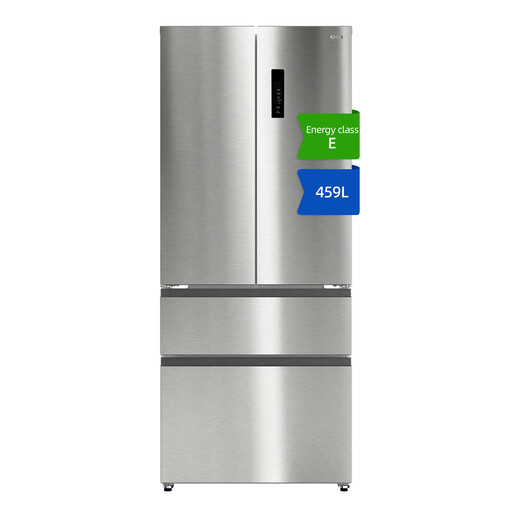
This four-door option is worth assessing if you make larger batches and have space for a wider freestanding fridge-freezer. Its total capacity is not a substitute for checking the usable freezer layout.
 No image available
For larger dough batches, check that your containers fit its freezer space and that the model can operate in the cottage’s intended location.
Set and check the freezer at around −18°C. That is the temperature advised for domestic freezers by the Food Standards Agency and recommended by Bosch UK; confirm the chosen appliance can maintain it where you plan to install it.
Cool warm dough before freezing it, then divide it into labelled portions. Smaller bags or containers are easier to arrange in the freezer than one large batch.
Choose one only if the exact model’s guidance covers the temperatures expected in that location, and check its fridge and freezer compartments separately. Beko states that the CFG4501 freezer compartment operates down to −15°C ambient temperature, but its low-ambient guidance cautions against relying on the fridge compartment there for chilled food.
Measure the internal cabinet aperture and match the existing sliding or fixed door-hinge system. Check the hinge type for a built-in replacement; compare the measurements with the exact model’s installation requirements rather than choosing by freezer capacity alone.