
24/7 Customer Support

Free returns

Same-day & Next-day Delivery

Quality Guaranteed

Unlock Your Welcome Offers: FREE Delivery | Up to 80% OFF | Free 30-day JoyPlus trial
Download the APP
As a 3D printing enthusiast in the UK, you know the appeal of creating objects with a flawless, high-sheen finish. PLA silk filament promises just that: turning everyday prints into eye-catching models with a luxurious, metallic lustre. However, the path to a perfect print is often littered with pitfalls that lead to wasted time and material.
Many makers invest in a spool of shiny PLA filament expecting spectacular results, only to be met with frustration. Two issues are particularly common:
Navigating the market requires looking past the marketing photos and understanding the core specifications that actually determine print quality and visual success.
To avoid disappointment, focus on a few non-negotiable technical details. These parameters are far more important than flashy packaging or exaggerated claims.
This is the most critical factor for preventing jams and ensuring consistent extrusion. The standard for most consumer printers in the UK is 1.75mm silk PLA. However, the diameter itself isn't the full story; the tolerance is what matters. Look for a filament with a stated dimensional accuracy of ±0.03mm or, even better, ±0.02mm. A wider tolerance can lead to under-extrusion (weak prints) or over-extrusion (clogs and blemishes), ruining the smooth finish you're aiming for.
A tangled spool is a guaranteed print failure, especially on long jobs. There is nothing more frustrating than returning to your printer after several hours to find a tangled mess and a half-finished object. Reputable manufacturers invest in automated, neat winding systems to prevent this. Look for descriptions that mention "tangle-free", "neatly wound" or "perfectly spooled." This small detail signals a higher level of quality control that often extends to the filament itself.
The term "silk" describes the finish, but the colour effect can vary dramatically. Understanding the different types helps you choose the right material for your project:
Instead of providing a generic list, we have matched specific types of PLA silk filament to the makers who will get the most from them.
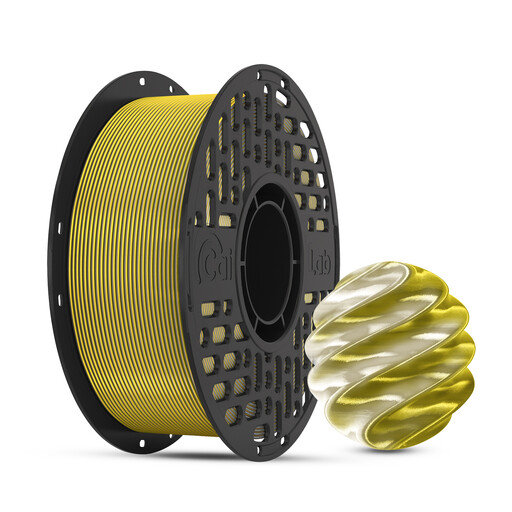
Why This Fits Their Persona: Perfect for Etsy sellers or market stall holders in the UK who create small decorative items, jewellery or personalised gifts. The consistent gold and silver sheen gives products a premium, high-value appearance that stands out in product photos.
The dual-extrusion process ensures the colour split is present throughout the filament, delivering a reliable two-tone effect even on smaller models, avoiding the "single colour" problem of gradient filaments.
Produces a dynamic, angle-dependent colour shift. The classic gold/silver combination has broad commercial appeal for decorative prints.
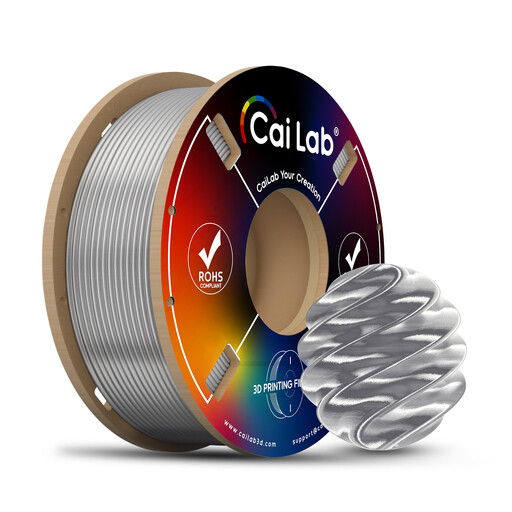
Why This Fits Their Persona: Ideal for UK cosplayers and prop makers who need a consistent metallic finish for armour, replica weapons or detailed accessories. A single, reliable colour ensures uniformity across multiple printed parts that need to be assembled.
By focusing on a single colour, this filament is formulated for better layer adhesion and reduced brittleness compared to more complex multi-colour variants. This makes it more suitable for parts that may be worn or handled.
Provides a uniform, high-gloss metallic sheen that requires minimal post-processing. Its formulation prioritises a balance of aesthetics and strength.
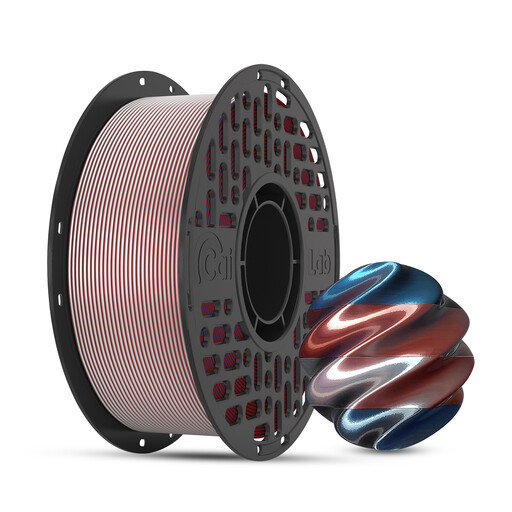
Why This Fits Their Persona: For the hobbyist focused on creating unique display pieces, fantasy miniatures or abstract art. The quad-colour blend of gold, copper, bronze and black creates a unique, unpredictable patina effect that makes every print one-of-a-kind.
This filament leans into the "gamble" of multicolour printing by offering a curated, thematic palette. It is designed for visual complexity, delivering a sophisticated, shifting appearance that basic rainbow filaments cannot match.
Creates an aged, metallic look straight from the printer. The four-colour blend provides a rich, complex finish that changes dramatically with the model's geometry.
We have compiled a complete, real-time list of products that fully satisfy these strict selection criteria and UK safety regulations.
While based on PLA, the additives in silk filaments change their behaviour. As a general rule, you may need to adjust your standard PLA settings. Start by increasing your nozzle temperature by 5-10°C (e.g., from 205°C to 215°C). This helps improve layer adhesion and reduces brittleness. It can also be beneficial to slightly reduce your print speed and cooling fan speed to give the layers more time to bond properly, enhancing both the sheen and the strength of the final print.
The most common cause of weak or brittle silk PLA prints is poor layer adhesion. This is the "brittleness trap" mentioned earlier. Besides increasing the print temperature, ensure your printer is well-calibrated. Under-extrusion is a major culprit, so check that your e-steps are calibrated and there are no partial clogs in the nozzle. Printing with a slightly wider line width (e.g., 0.45mm for a 0.4mm nozzle) can also force more material into the print and create stronger bonds between layers.
Probably not. Rainbow PLA filament has a long colour transition, sometimes taking many metres of filament to cycle through its full spectrum. If you are printing a small object like a keychain or a miniature figure, you might only see one or two colours. For showcasing the full gradient, these filaments are much better suited to large, continuous prints like vases, statues or large decorative panels. If you want multiple colours on a small object, a dual colour PLA filament is a more suitable choice.