
24/7 Customer Support

Free returns

Same-day & Next-day Delivery

Quality Guaranteed

Unlock Your Welcome Offers: FREE Delivery | Up to 80% OFF | Free 30-day JoyPlus trial
Download the APP
Choosing between oat milk, soya milk, almond milk and other plant-based milk alternatives is not simply a matter of taste. The right carton needs to suit your diet, storage space, coffee routine, cooking habits and budget. Marketing terms such as “barista”, “natural” and “low sugar” can also be misleading if you do not check the nutrition panel and ingredients list.
This guide explains the practical details to compare before buying dairy-free milk, including sweetness, allergens, protein, pack size and shelf life.
“Dairy-free” does not automatically mean free from every allergen. Oat drinks contain oats, which may be listed as cereals containing gluten. Soya drinks contain soya, while almond milk is unsuitable for people with nut allergies. Some soya beverages also contain milk ingredients.
For example, Vamino Soymilk Regular lists both soybean and milk, while Tropical Sun Soy Drink Original contains soya and milk. Always read the full ingredients and allergen statement rather than relying only on the front-of-pack description.
Oats naturally contribute sugars during processing, so an oat drink labelled “no added sugars” may still contain sugar. Alpro Oat Original contains 3.2g of sugars per 100ml, while Alpro Oat No Sugars lists 0.0g per 100ml. These are different formulations.
Flavoured and sweetened ready-to-drink soya products can contain considerably more sugar. Vitasoy Malted Soy Milk lists 5.0g of sugars per 100ml, and Yeo’s Pandan Flavoured Soy Bean Drink lists 7.9g. Check the “of which sugars” line for a realistic comparison.
Standard oat milk, almond milk and coconut drinks may work in tea or cereal but behave differently in coffee. Barista oat milk usually includes ingredients such as oil, acidity regulators or stabilisers to help it blend with coffee and create foam. Even then, results depend on temperature, steaming technique and the coffee itself.
A barista formulation is worth considering if you regularly prepare flat whites, cappuccinos or latte art. For occasional coffee, an ordinary long-life plant milk may be more economical.
Check the percentage of the main ingredient, added oils, sweeteners, stabilisers and fortification. Oat drinks in this selection use around 10% oats, while almond drinks may contain a relatively small percentage of almonds alongside water and fibre.
For households managing allergies, review the bold allergen declaration every time. Manufacturing details and recipes can change. Also note that a vegan milk alternative is not necessarily suitable for babies or young children as a complete milk substitute.
Comparing products per 100ml makes different pack sizes easier to assess. Look at:
For example, Alpro Almond No Sugars provides 20kcal and 0.5g protein per 100ml, whereas Oatly Whole provides 61kcal and 1.1g protein per 100ml. Neither is automatically right for everyone; the choice depends on how you use it.
Long-life plant milk is useful for student kitchens, family cupboards and households that do not finish an opened carton quickly. UHT cartons can usually be stored unopened in a cool, dry place, but they still need refrigeration after opening.
Opening guidance varies. Several Alpro products recommend using the drink within five days, while Oatly Barista advises consumption within seven days. Small ready-to-drink cartons, such as 250ml or 300ml packs, can reduce waste when you need a single serving, but usually cost more per litre.
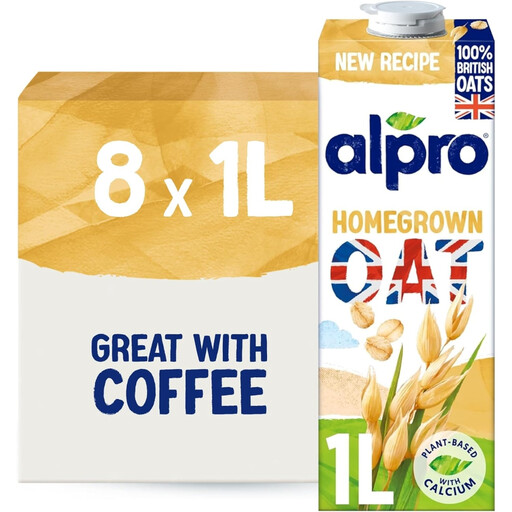
Why This Fits Their Persona: An eight-litre long-life pack suits shared houses and families that use oat milk for cereal, tea, smoothies and everyday cooking.
The long-life format reduces the need for frequent shopping. Its listed sugar content is 3.2g per 100ml, so buyers can compare it openly with no-sugar alternatives.
Eight 1-litre cartons; fortified with calcium, iodine, vitamins B2, B12 and D2.
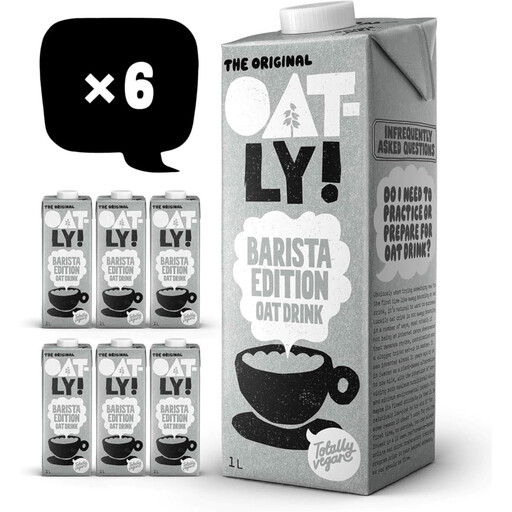
Why This Fits Their Persona: Designed for coffee enthusiasts who want a creamy oat drink for steamed milk, microfoam and hot or cold coffee at home.
It is specifically formulated for heating and frothing, rather than relying on a standard oat drink to perform like a barista product.
Six 1-litre cartons; contains calcium, vitamin D2, riboflavin, B12 and iodine.

Why This Fits Their Persona: Suitable for shoppers comparing sugar figures closely and wanting a neutral oat drink for cereal, coffee or cooking.
The nutrition panel lists 0.0g sugars per 100ml and no sweeteners, making the formulation easier to compare with standard oat drinks.
Eight 1-litre UHT cartons; provides 1.4g fibre and calcium per 100ml.

Why This Fits Their Persona: A practical choice for frequent coffee preparation, larger households and home baristas who want eight long-life cartons available.
Its barista positioning is supported by stated use for heating and frothing, while the label specifies no added sugars.
Eight 1-litre cartons; 43kcal and 3.0g sugars per 100ml.
We have compiled a complete, real-time list of products that fully satisfy these strict selection criteria and UK safety regulations.
Barista oat milk is designed for steaming and frothing, making it a practical option for cappuccinos, flat whites and lattes. Standard oat, soya or almond milk can also be used, but the foam texture may vary. Heat gently, shake the carton first and avoid boiling the drink.
Unopened UHT cartons can generally be stored in a cool, dry cupboard until the printed date. Once opened, refrigerate them and follow the pack instructions. In this selection, some products advise use within five days, while Oatly Barista states seven days. Do not rely on the unopened shelf-life guidance after opening.