
24/7 Customer Support

Free returns

Same-day & Next-day Delivery

Quality Guaranteed

Unlock Your Welcome Offers: FREE Delivery | Up to 80% OFF | Free 30-day JoyPlus trial
Download the APP
The world of plant based milk has expanded far beyond a single dusty carton in the supermarket aisle. Whether you are vegan, have a lactose intolerance or are simply looking to reduce your dairy consumption, the choices can be overwhelming. But with this variety comes a few common pitfalls that can lead to a disappointing purchase—from a watery coffee to a surprisingly sugary breakfast.
As a Joybuy Product Recommendation Officer, my role is to help you navigate the options and find a product that genuinely suits your needs. This guide will highlight the key traps to avoid and the essential factors to check before you add a dairy free milk to your basket.
To avoid these issues, focus on a few key parameters. This will ensure the vegan milk you choose performs as you expect, whether it's for your cereal, a smoothie or that perfect flat white.
Before anything else, check the ingredients list and nutritional table.
The intended use is crucial. A milk designed for cereal will not perform the same way in a coffee machine.
Check the ingredients list for the percentage of the primary component (e.g., Oat (10%), Almond (2.5%)). A higher percentage generally means a richer flavour and creamier texture. Also, look for fortification. Many plant milks are a great source of added nutrients.
Based on these practical criteria, here are a few recommendations matched to different needs and lifestyles.

Why This Fits Their Persona: For the UK coffee enthusiast who wants to replicate a café-quality experience at home, this oat milk is a reliable choice. Its ability to create a stable, creamy foam is ideal for lattes and cappuccinos, and the bulk-buy format is perfect for daily coffee drinkers.
It directly solves the "Curdled Coffee Catastrophe." As a dedicated barista oat milk, it is formulated with acidity regulators to remain smooth and integrated when mixed with hot coffee.
Consistently produces a rich, velvety microfoam suitable for latte art. It's a long life milk, making it easy to stock up.

Why This Fits Their Persona: Perfect for anyone in the UK closely monitoring their sugar and calorie intake. This almond milk is light, refreshing and versatile enough for cereals, low-sugar smoothies or simply drinking on its own, without any dietary compromise.
This is the definitive answer to the "Hidden Sugar" trap. With 0.0g of sugar per 100ml, it offers a clean, guilt-free profile, making it a leading choice for an unsweetened plant milk.
Extremely low in calories (20 kcal per 100ml) and fortified with vitamins B2, B12 and D. It is also naturally gluten-free.
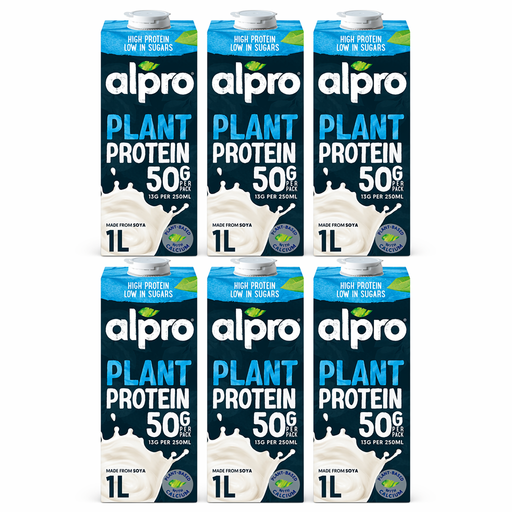
Why This Fits Their Persona: For active individuals, gym-goers or anyone looking to boost their protein intake on a plant-based diet. This soya milk is an excellent base for protein shakes or a great addition to high-protein porridge.
It counters the "Watered-Down" disappointment by being functionally dense. Instead of just being a milk alternative, it's a high-protein drink with 5.0g of protein per 100ml, far exceeding standard plant milks.
Delivers a substantial 50g of high-quality plant protein per litre. It is also fortified with calcium and essential B and D vitamins.
We have compiled a complete, real-time list of products that fully satisfy these strict selection criteria and UK safety regulations.
This common issue, known as curdling or splitting, happens when the proteins in the plant milk react to the heat and acidity of coffee. Standard plant milks are not always stable enough to withstand this change. To prevent it, choose a barista oat milk or soya milk, as these are specifically formulated with acidity regulators to remain smooth and creamy in hot drinks.
Not necessarily. Long life milk is treated with UHT (Ultra High Temperature) processing to make it shelf-stable. While this can affect some heat-sensitive vitamins, most reputable brands fortify their products with key nutrients like calcium, vitamin D and B12 after processing. This ensures you are still getting a nutritious product, with the added convenience of a longer storage time.