
24/7 Customer Support

Free returns

Same-day & Next-day Delivery

Quality Guaranteed

Unlock Your Welcome Offers: FREE Delivery | Up to 80% OFF | Free 30-day JoyPlus trial
Download the APP
A loose shelf, cracked plasterboard or a basin that shifts under pressure can often be traced back to one mistake: choosing a fixing for the wall you hoped to have rather than the wall actually in front of you.
As the Joybuy Product Recommendation Officer, I focus on separating useful specifications from vague marketing language. When buying plasterboard fixings, look beyond phrases such as “heavy duty” or “universal”. The fixing must suit the board thickness, cavity, screw size and expected load.
Traditional solid wall plugs are designed to expand inside brick, block or concrete. In hollow plasterboard, they may spin, pull through the board or provide little resistance. If you are working with a solid substrate, products such as Plasplugs RP 187 Solid Wall Super Grips are more appropriate; they are specified for brick and concrete and require a 6mm drill.
A large box is not automatically economical. A pack of 100 may suit a contractor fitting several battens or fixtures, but a homeowner hanging one mirror may need only six or ten fixings. Also check whether screws are included, whether the fixing is reusable and whether a pilot hole or special tool is needed.
The weight of an item is only part of the calculation. A shelf creates leverage as it projects from the wall, while a wall light or mirror may apply movement when adjusted or cleaned. Plasterboard condition, fixing spacing and the position of studs or noggins all affect the result. Do not rely on a product label alone for safety-critical or unusually heavy installations.
First identify whether the surface is:
For plasterboard, choose an anchor that expands, grips or threads into the board rather than a standard masonry plug. Multi-size plasterboard fixings can be useful when wall thickness varies. The Plasplugs multi-size pack includes fixings for 7mm, 12mm, 15mm, 17mm and 22mm walls, plus a depth gauge for selection.
Self-drilling products can save time, but “self-drill” does not mean every model installs identically. Some self-drill plasterboard fixings pierce the board and screw in with a screwdriver; others need a pilot hole.
For example, the Fixman Self-Drill Fixings 100pk has a sharp self-tapping thread, requires no pre-drilling or special setting tool, and is described as removable and reusable. By contrast, RAWLPLUG metal self-drill fixings require an 8mm pilot hole and must be used with the supplied screws.
Always check:
Nylon plasterboard fixings are light, corrosion-resistant options for many everyday interior jobs. RAWLPLUG Nylon Self-Drill Plasterboard Fixings accept panhead or countersunk screws, provide a flush finish and have a stated maximum fixture thickness of 12mm.
Metal plasterboard fixings may be preferable where a more rigid anchor is needed, including some double-board applications. However, metal does not remove the need to follow the stated hole size, screw specification or load guidance.
For shelving, wooden battens, wall lights and small mirrors, consider heavy-duty plasterboard fixings with a suitable expansion mechanism. The Plasplugs HCF110 uses a 10mm drilled hole, an expanding barrel and a No. 8 screw specified at 4.5mm. Avoid overtightening, which can damage the fixing or crush the board.
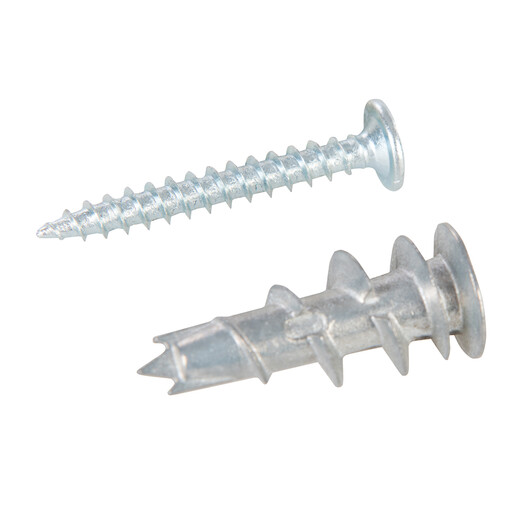
Why This Fits Their Persona: A practical option for DIY users tackling several light-to-medium indoor jobs around a home, flat or renovation project.
It avoids the assumption that installation needs a drill or specialist setting tool: the product is specified for screwdriver installation without pre-drilling.
100-pack quantity; anti-corrosion finish; self-tapping thread; described as removable and reusable.
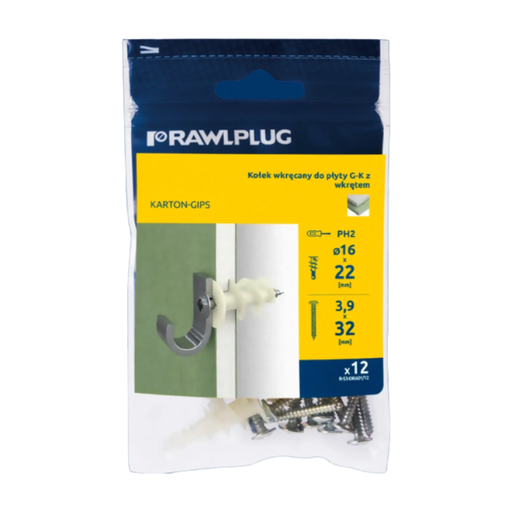
Why This Fits Their Persona: Suitable for homeowners and installers who want a clearly specified nylon fixing for repeated decorating or fixture changes.
The stated 12mm maximum fixture thickness and screw compatibility help prevent buying a fixing without checking the board and fixture depth.
Nylon construction; no drilling required; flush-fit panhead or countersunk screw options; removable and reusable.
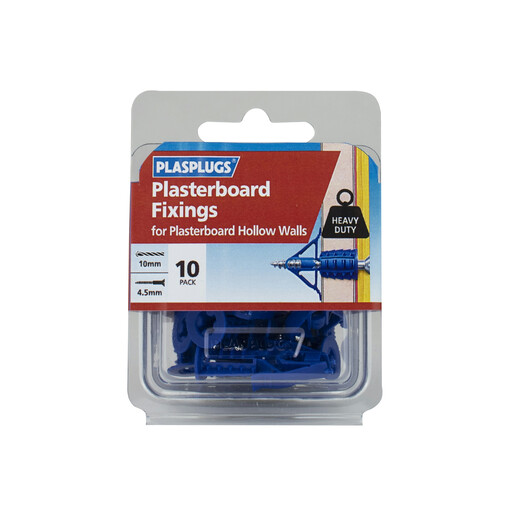
Why This Fits Their Persona: Intended for users securing medium-to-heavier indoor or outdoor items such as shelving, battens, wall lights and small mirrors.
It provides a defined 10mm hole and No. 8 screw specification, reducing uncertainty around installation size and compatibility.
Expanding barrel; integral screw thread; anti-rotate design; pack of 10; reusable fixing design.
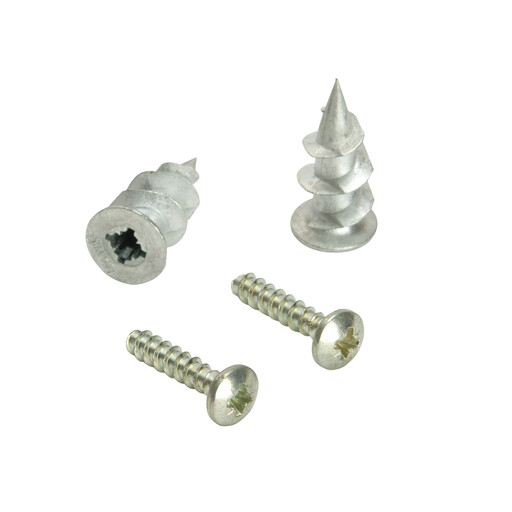
Why This Fits Their Persona: A larger quantity suits contractors, maintenance teams and renovators completing multiple board-mounted installations.
The product information clearly states the 8mm pilot-hole requirement, supplied-screw restriction and 12mm maximum fixture thickness.
All-metal construction; flush fit; suitable for double plasterboard; box of 100 for repeated work.
Bathroom fixtures need a product selected for the installation design, not simply a general wall plug. A wash basin fixing kit is made for the mounting points and hardware commonly used on basins. The RAWLPLUG 67 480 Basin Fixers Kit is described as suitable for the majority of wash basins.
For side-mounted toilets, use a dedicated WC fixing kit rather than adapting a general plasterboard anchor. The RAWLPLUG 67 488 Pan Side Fixing Kit is designed for adjustable bidet or WC fixing where the pan is mounted from the side. Check the pan design, wall construction and supplied hardware before installation.
We have compiled a complete, real-time list of products that fully satisfy these strict selection criteria and UK safety regulations.
Usually, no. Plasterboard anchors are designed for board or hollow-wall conditions. For brick or concrete, choose correctly sized solid wall plugs and a masonry drill bit, such as a fixing specified for a 6mm hole.
Material alone does not determine holding performance. The expansion design, board thickness, screw compatibility and load rating all matter. Metal fixings can suit certain double-board or more demanding applications, while nylon fixings may be suitable for lighter interior fixtures.
A fixing may remain usable for many years when correctly installed in sound, dry board and kept within its stated application. Movement, moisture, overloaded shelves, damaged plasterboard and repeated removal can reduce holding strength. Inspect fixings whenever a mounted item is taken down or repositioned.