
24/7 Customer Support

Free returns

Same-day & Next-day Delivery

Quality Guaranteed

Unlock Your Welcome Offers: FREE Delivery | Up to 80% OFF | Free 30-day JoyPlus trial
Download the APP
Loose shelves, pulled-out hooks and damaged plasterboard often start with one simple mistake: choosing a fixing based on appearance or price rather than the wall construction and load. Whether you are a DIY homeowner, electrician, plumber, kitchen installer or contractor, the right plasterboard fixings should match the board thickness, fixture weight and installation method.
This guide explains the practical specifications to check before buying, then matches several options to common UK user profiles.
A wall may look like plasterboard but contain timber studs, metal framing, masonry, insulation or a service void. Standard wall plugs for plasterboard are not automatically suitable for brick, concrete or aerated blockwork. Using the wrong fixing can result in poor grip, spinning plugs or surface damage.
Before drilling, identify the substrate where possible. A stud finder, careful tapping and existing drawings can help, but always take care around electrical cables and plumbing.
Terms such as heavy-duty plasterboard fixings describe a product category, not a guarantee that any object can be mounted safely. Load capacity depends on the board, the number and spacing of fixings, the fixture design and how far the load projects from the wall.
A radiator, wall cabinet or basin requires a more suitable mechanical fixing than a smoke alarm or lightweight picture. Check the manufacturer’s instructions and use additional support where the wall construction requires it.
A fixing may fit the wall but still be unsuitable for the fixture if the screw is too short or the board and bracket exceed its maximum fixture thickness. Self-drilling products may also require a specified screw, pilot hole or driver.
For reliable installation, compare the product’s drill size, screw size, fixing length and maximum fixture thickness with your project before placing an order.
For hollow partition walls, cavity wall fixings spread the load behind the board. Interset-style fixings create a larger bearing area and can be suitable for shelves, bathroom accessories, radiators and cabinets when the wall and load are appropriate.
Self-drill plasterboard fixings screw directly into the board, making them convenient for lighter fixtures and quick installation. Some nylon versions require no pre-drilling, while metal plasterboard fixings may require an 8mm pilot hole, depending on the product.
For timber or metal frames fixed to masonry, use dedicated frame fixings rather than ordinary plasterboard plugs. These are designed to pass through the frame and anchor into concrete, brick, stone or blockwork.
Metal plasterboard fixings can offer a firm, flush installation and are suitable for some double-board applications. They are generally selected when a more substantial board fixing is needed, but the supplied screw and stated pilot-hole requirement must be followed.
Nylon plasterboard fixings are lightweight and convenient. Some designs offer insulation against accidental electrical contact and can be removed and reused, which is useful when decorating or repositioning fittings.
General-purpose plugs are intended for regular-duty work in solid materials such as concrete, brick, breeze block and stone. Do not assume that a red general-purpose plug is an equivalent replacement for a cavity fixing.
M4 and M5 cavity fixings are common sizes, but the exact choice depends on the fixture and manufacturer guidance. For example:
For one-off household jobs, a pack of 6 or 10 may be sufficient. A plasterboard fixings trade pack of 50 or 100 is more practical for repeated installations, maintenance work or multiple rooms.
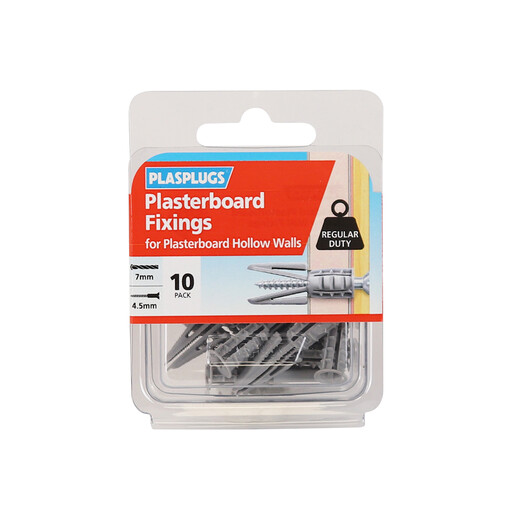
Why This Fits Their Persona: A practical starting pack for UK DIY jobs such as curtain tie-backs, lightweight hooks and smoke alarms.
Its stated general-use purpose helps avoid using a cavity fixing for a light-duty application, while the 7mm drill size and No.8 screw specification clarify compatibility.
Designed for general plasterboard use; supplied as a pack of 10 with clearly stated drill and screw sizes.
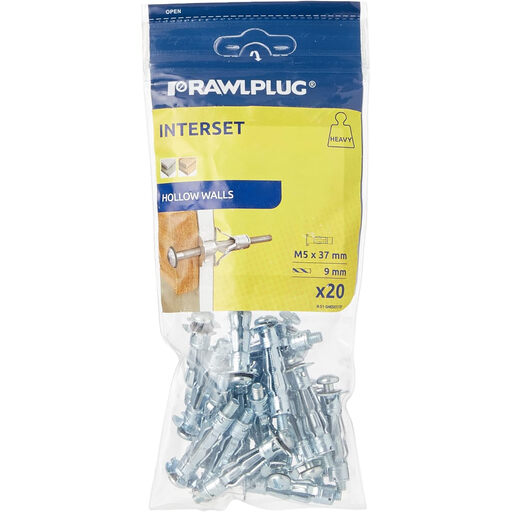
Why This Fits Their Persona: Suitable for users who want a reusable cavity-fixing system for shelves, bathroom accessories, radiators or kitchen cabinets, subject to load and wall construction.
The stated 10mm drill size, M5 x 40mm dimensions and 20mm fixing thickness make selection less guesswork than relying on a generic “heavy-duty” label.
Supplied with screws; the screw and fixing can be removed and reused; trade pack of 20.
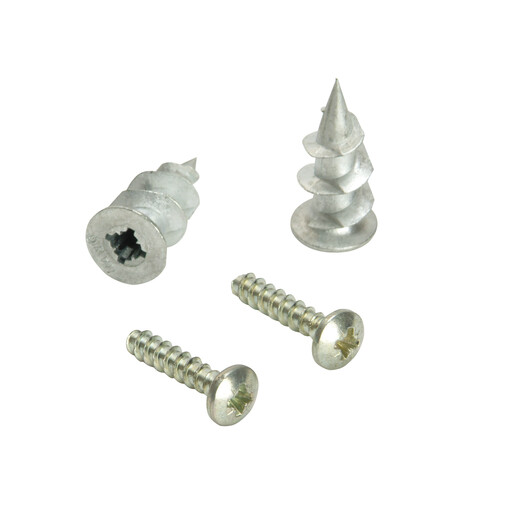
Why This Fits Their Persona: A useful option for installers handling repeated plasterboard work, including double-board applications where the specified fixing method is followed.
It states the need for an 8mm pilot hole and use with the supplied screws, helping prevent the common mistake of treating self-drilling as universally drill-free.
All-metal construction; flush-fit design; supplied in a 25-pack; listed for double plasterboard and certain lightweight or aerated concrete blocks.
For wash basins, select a dedicated kit such as the RAWLPLUG 67 480 Basin Fixers Kit, which is described as suitable for the majority of wash basins. For timber or metal door and window frames fixed to masonry, consider RAWLPLUG Frame Fixings & Screws 8 x 120mm Pack of 16, checking the maximum fixture thickness and substrate first.
We have compiled a complete, real-time list of products that fully satisfy these strict selection criteria and UK safety regulations.
Usually, no. Standard plugs designed for brick or concrete rely on expansion inside a solid material. Plasterboard requires a fixing designed for a hollow board, such as a self-drill, cavity or interset fixing. If you locate a timber stud, a suitable wood screw may be more appropriate.
Both materials have different designs and stated applications. Metal options may be selected for certain board configurations, while nylon self-drill fixings are often convenient for lighter fixtures and allow removal and reuse. Always follow the product’s load guidance, maximum fixture thickness and screw requirements rather than choosing by material alone.
There is no universal lifespan. Indoor conditions, moisture, vibration, corrosion, board damage and repeated removal all affect performance. Inspect fixings supporting shelves, cabinets or bathroom fittings periodically. Replace any fixing that spins, loosens, shows corrosion or has damaged the surrounding board.