
24/7 Customer Support

Free returns

Same-day & Next-day Delivery

Quality Guaranteed

Unlock Your Welcome Offers: FREE Delivery | Up to 80% OFF | Free 30-day JoyPlus trial
Download the APP
By Joybuy Product Recommendation Officer
Plastic storage boxes can make a noticeable difference in a busy UK home, garage or office. They protect seasonal belongings, reduce clutter and help you use vertical space more effectively. However, choosing by litre capacity or a low price alone can lead to awkward, unstable or short-lived storage.
The useful question is not simply “Which box is largest?” It is “Which box suits the space, contents and handling routine?”
A 60-litre box may sound spacious, but its external measurements could prevent it fitting beneath a bed, through a loft hatch or onto existing shelving. Compare height, width and length, then measure the storage location, including doorways and access routes.
For example, a low under-bed storage box needs a suitable height, while a garage container may need enough clearance for a car door or walkway.
A loose cover may keep out some dust but can shift when boxes are moved or stacked. Look for a clip-on, snap-fit or clip-lock lid that is securely attached on all sides. If the contents are stored in a garage, loft or shed, remember that a plastic lid is not automatically airtight or waterproof.
For items that need additional security, consider lockable storage boxes with holes or built-in clips that accept a padlock or cable tie.
Large storage boxes are easy to overfill with books, tools or files. This makes them difficult to lift and may put unnecessary pressure on the base, lid or handles. Check the stated load guidance, distribute weight evenly and avoid creating tall, unstable stacks.
A box with wheels can be useful for bulky garage items, while smaller nestable storage boxes may be more practical when empty boxes need to be stored away.
Storage capacity is usually shown in litres, but internal dimensions determine what will actually fit. Use these broad guidelines:
For documents, measure folders rather than relying on the litre figure. Some clear plastic storage boxes are designed around A4 files, while others are wider or deeper for household goods.
Polypropylene, commonly abbreviated to PP, is widely used for reusable storage containers. Useful construction features include reinforced bases, rounded corners, thicker walls and ribs that help the box retain its shape.
Several products in this range use recycled plastic, while other models use virgin polypropylene. Material choice should be considered alongside the intended environment. Keep plastic boxes away from open flames, direct high heat and prolonged sunlight, as heat can deform plastic.
A thicker body does not mean a box can be overloaded. Always follow the product’s weight and stacking guidance.
Stable stackable storage boxes should have a lid and base designed to sit securely together. Flat or recessed lids can help prevent sliding, but stacks should remain level and moderate in height.
For frequent access, clear or translucent boxes make it easier to identify contents without opening every container. For long-term storage, a secure lid helps limit dust and contact with pests, but contents should still be clean and dry before packing.
Handles are important when boxes are moved regularly. Very large boxes may be more manageable with wheels, although wheels require a clear, reasonably level surface.
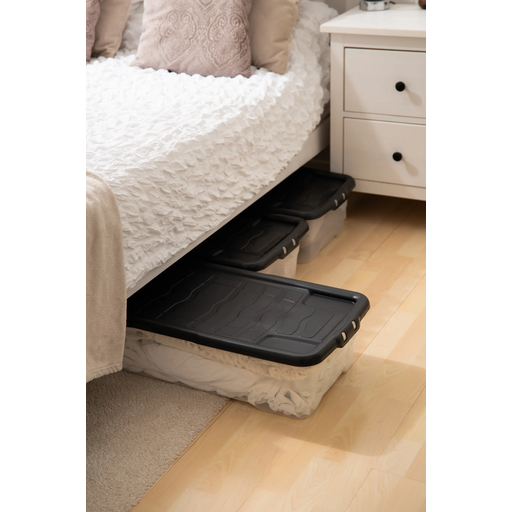
Why This Fits Their Persona: A practical starting point for tenants, students and households tackling bedroom or cupboard clutter. Its 30-litre capacity and stated dimensions of H17 × W40 × L60cm make it suited to lower storage areas.
The clear body helps avoid forgotten contents, while the clip-on lid is more secure than a loose cover. Check the height carefully before ordering for under-bed use.
30-litre capacity; clear box with black clip-on lid; stackable construction; made from recycled plastic.

Why This Fits Their Persona: Suitable for people building a consistent storage system across a home office, cupboard, loft or garage. The three matching boxes provide a uniform format for labelled categories.
The transparent polypropylene body makes contents visible, while clip-lock lids and a reinforced base address common problems with dust and unstable stacking.
Pack of three; 33-litre capacity per box; clear polypropylene; clip-lock lids; flat lid and reinforced base for stacking.

Why This Fits Their Persona: Designed for larger garage, loft, shed and workshop items such as tools, decorations and workplace supplies. Built-in wheels are useful when a fully loaded trunk needs repositioning.
The 145-litre format avoids forcing bulky items into several small boxes. Locking points allow a padlock or cable tie, but the trunk still needs a dry, stable storage position.
145-litre capacity; built-in wheels; clip-on lid; lockable with a padlock or cable tie; recycled plastic construction.
Before buying, group items by how often they are used. Keep frequently accessed supplies in smaller boxes at reachable height and reserve large storage boxes for seasonal or occasional belongings.
For loft storage, use clearly labelled containers and avoid placing heavy boxes where they could fall when the hatch is opened. In garages and sheds, raise boxes from damp floors where possible and do not store hazardous chemicals, flammable liquids or leaking items inside plastic containers.
A transparent box is useful for toys, craft supplies and office materials. Opaque or dark boxes can be preferable for light-sensitive contents, but labels become more important. For collections such as vinyl records, check the internal dimensions and keep items upright rather than relying only on external capacity.
If you need a larger coordinated solution for moving or household storage, browse the removals boxes large range.
We have compiled a complete, real-time list of products that fully satisfy these strict selection criteria and UK safety regulations.
They can be suitable for loft storage when placed on a stable, dry surface and kept away from heat sources. Check the manufacturer’s temperature guidance, avoid overloading and ensure the lid is fully secured. Plastic boxes do not replace proper loft ventilation or moisture control.
Lifespan depends on material, loading, sunlight, temperature and how the box is handled. Strong polypropylene boxes with reinforced bases can be reused, but dragging them across rough surfaces, overloading them or exposing them to heat may cause damage. Inspect lids, clips, handles and corners before continued use.
Clear boxes can save time because you can identify contents without opening them. They are particularly useful for seasonal clothing, paperwork, craft materials and children’s toys. If the boxes will contain items that are sensitive to light, use suitable labels and consider whether an opaque container would be more appropriate.