
24/7 Customer Support

Free returns

Same-day & Next-day Delivery

Quality Guaranteed

Unlock Your Welcome Offers: FREE Delivery | Up to 80% OFF | Free 30-day JoyPlus trial
Download the APP
Plastic storage boxes can make a small flat, busy family home, student room or garage much easier to manage. However, a low price or impressive litre figure does not always mean a box will suit your space. The wrong dimensions, weak lid or unsuitable material can leave you with cracked corners, unstable stacks and contents that are difficult to find.
This guide explains what to check before buying plastic storage boxes, followed by practical recommendations for different UK households and storage needs.
A box described as “large” may still be too narrow for coats, folders or hobby equipment. Conversely, a box with generous capacity may not fit beneath a bed, inside a wardrobe or on existing shelving.
Always compare:
For under-bed storage, a low-profile design is more important than the total litre capacity. A 30-litre box measuring approximately 17cm high may be more practical than a taller box with a larger stated capacity.
Clear plastic storage boxes vary from fully transparent to translucent. Some allow you to identify contents quickly, while others still require labels or opening to see what is inside. If you are storing seasonal clothing, paperwork or children’s toys, visibility can save time and reduce unnecessary rummaging.
Check product images and descriptions carefully. A solid-colour lid may also obscure part of the contents, even when the main container is clear.
A clip-on or snap-fit lid helps keep dust and household debris away, but it does not automatically make a box airtight, waterproof or suitable for outdoor exposure. For lofts, sheds and garages, check whether the product is intended for dry storage and follow the care instructions.
For valuable documents, textiles and electrical items, consider moisture control separately. Do not assume that a plastic box alone will prevent condensation or damp damage.
Polypropylene, commonly labelled PP, is widely used for reusable storage containers because it is lightweight and suitable for everyday household use. Thicker walls, reinforced corners, ribbed panels and a flat base can help a container stay stable when loaded.
Look for practical details such as:
“Heavy-duty” should still be treated as a product description rather than a universal load rating. Follow the manufacturer’s stated weight and stacking guidance, and distribute heavy items evenly.
Match the box to its contents instead of filling every container to maximum capacity.
Measure doorways, loft access points and shelving before ordering larger containers.
A secure lid protects contents from dust and makes boxes easier to move. For stackable storage boxes, check whether the lid has a recessed top or locating points that stop boxes sliding.
Do not build a tall stack simply because the boxes fit together. Keep heavier boxes at the bottom, place the stack on a level surface and follow any maximum stacking guidance. Avoid using storage boxes as seats or steps.
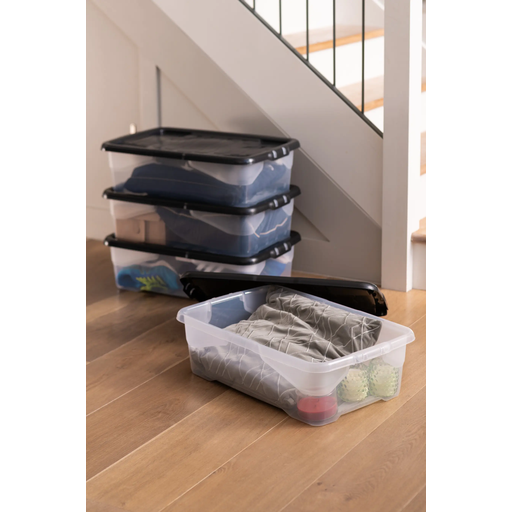
Why This Fits Their Persona: A four-box set gives renters, students and families a consistent way to organise clothing, bedding, shoes or toys without buying several different sizes.
The clear tubs make contents easier to identify, while included lids help reduce dust exposure. The 30-litre format is more manageable for cupboards and under-bed storage than oversized trunks.
Four 30-litre boxes, stackable design, clear bodies and recycled plastic construction.
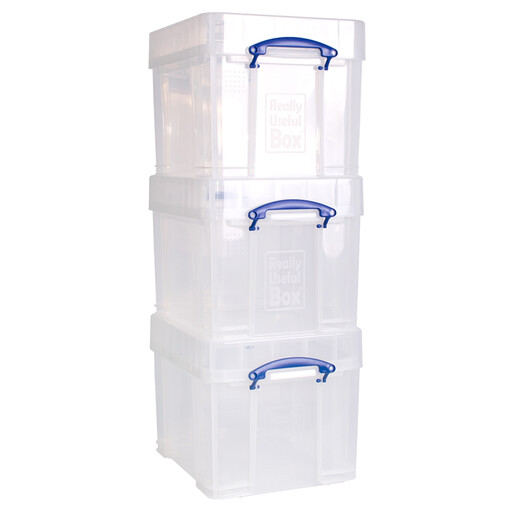
Why This Fits Their Persona: Suitable for home-office users, collectors and hobbyists who want visible storage with a more structured lid and reinforced base.
The product specifies internal dimensions for storing vinyl records and includes locking handles, reducing uncertainty around fit and lid closure.
35-litre capacity, transparent polypropylene, reinforced base and stackable design with or without the lid.

Why This Fits Their Persona: Garage owners, workshop users and families storing camping equipment or seasonal decorations may benefit from the high capacity and wheeled format.
The 145-litre capacity is clearly stated, and built-in wheels address the problem of moving a large loaded box. Locking points allow a padlock or cable tie to be added.
145-litre capacity, clip-on lid, built-in wheels and recycled plastic construction.
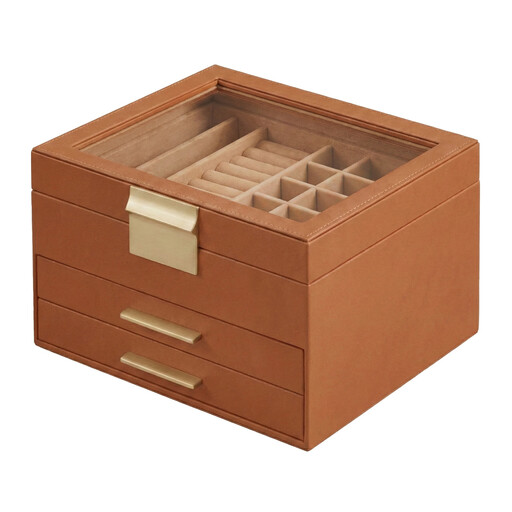
Why This Fits Their Persona: A dresser-based jewellery organiser suits users who need separate spaces for rings, earrings, necklaces and other small accessories.
The listed three-layer arrangement and two drawers provide defined storage areas, while the glass lid allows the contents to be viewed without opening the box.
Three layers, two drawers, glass lid and velvet lining, with stated dimensions of approximately 20.3 x 23.1 x 13.5cm.
Before filling your new home organisation boxes:
If you need smaller compartments rather than general tubs, jewellery storage boxes or document-sized containers may be more suitable. For related storage products, browse the enclosure box range.
We have compiled a complete, real-time list of products that fully satisfy these strict selection criteria and UK safety regulations.
They can be suitable for dry storage, provided the product is intended for the environment and is kept away from extreme heat, open flames and prolonged direct sunlight. Plastic boxes are not automatically moisture-proof, so avoid storing damp textiles or sensitive documents without additional protection.
Lifespan depends on plastic thickness, loading, sunlight exposure, temperature and handling. Boxes with reinforced bases and corners can be more suitable for repeated use, but they should not be overloaded or dragged across rough floors. Replace any container or lid that becomes cracked, warped or unstable.
Clear boxes may reduce the need for labels, but translucent plastic, dark lids and poor lighting can still make contents difficult to identify. A simple label on the front edge is useful for stacked boxes, especially when storing seasonal clothing, paperwork or children’s items.