
24/7 Customer Support

Free returns

Same-day & Next-day Delivery

Quality Guaranteed

Unlock Your Welcome Offers: FREE Delivery | Up to 80% OFF | Free 30-day JoyPlus trial
Download the APP
Plastic storage boxes can make a small flat, busy family home, office or garage noticeably easier to manage. However, choosing by appearance alone can lead to wasted space, broken lids and boxes that are awkward to lift once filled.
This guide explains the practical specifications to check before buying, with suitable options for clothing, paperwork, craft materials, tools, records and jewellery.
A box labelled “large” may still be unsuitable for a wardrobe, loft shelf or under-bed space. Capacity is usually measured in litres, but the external height, width and length determine whether it will physically fit.
Measure the storage area first, including door openings, shelf depth and the clearance needed to remove the box. For under-bed storage, height is particularly important. A box that fits beneath the bed but has no room to slide out may be difficult to use regularly.
Loose covers can shift when boxes are moved, allowing dust into the contents. For clothes, documents and seasonal items, look for clip-on or snap-fit lids. Locking handles can also make a box easier to transport.
A lid is not automatically airtight or waterproof, so avoid assuming that a plastic storage box is suitable for damp garages, outdoor sheds or areas prone to condensation. Store contents in a dry location unless the product information specifically supports another use.
A tall tower of boxes may save floor space but can become unstable if the base is overloaded or the stack is too high. Reinforced bases, shaped lids and anti-slip features can improve stability, but they do not remove the need to distribute weight evenly.
Do not use storage boxes as steps or seats. Check the manufacturer’s instructions, keep heavy items low down and inspect clips, lids and corners for damage before stacking.
For general household organisation boxes, 30–42 litres can provide a useful balance between capacity and portability. These sizes may suit bedding, toys, shoes, paperwork or hobby supplies. Larger storage boxes, such as 50-litre or 84-litre models, are more suitable for bulky clothing, blankets, tools and larger collections, but they become heavier when full.
Low-profile boxes can work well beneath beds or on shallow shelves. For wardrobes and lofts, compare both external and internal dimensions, as thick walls and reinforced corners reduce usable space slightly.
Polypropylene (PP) is commonly used for durable plastic storage containers because it is lightweight and resistant to everyday knocks. Look for practical construction details such as:
Some products use recycled plastic, while others use virgin polypropylene. The more important selection point is whether the material and structure suit the expected load and environment.
Storage boxes with lids are more suitable for long-term storage than open tubs, particularly where dust is a concern. Check whether the lid clips on securely and whether the box is designed to stack with the lid fitted.
Clear plastic storage boxes reduce the need to open several containers when searching for an item. For small contents, dividers, trays or labelled sections may be more useful than a deeper box.

Why This Fits Their Persona: The four-box set suits students, renters and office users who need compact storage for stationery, documents or craft supplies without committing to oversized containers.
Its 4-litre capacity and low-profile format reduce the risk of buying boxes that are too deep for desks, cabinets or shelves.
Transparent polypropylene boxes with secure snap-on lids; stackable with or without lids.
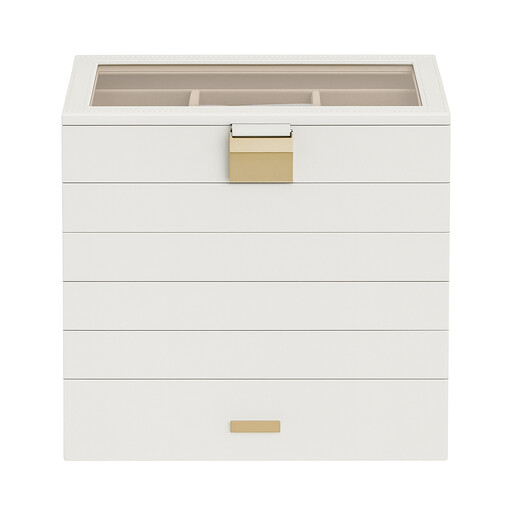
Why This Fits Their Persona: Jewellery owners wanting a dedicated dresser or wardrobe organiser can separate rings, earrings, watches and necklaces in one vertical unit.
The clear dustproof lid and separate stackable trays avoid the common problem of mixed accessories becoming difficult to find.
Six tiers, soft lining and clear lid; dimensions are 17 x 28 x 25.3 cm.
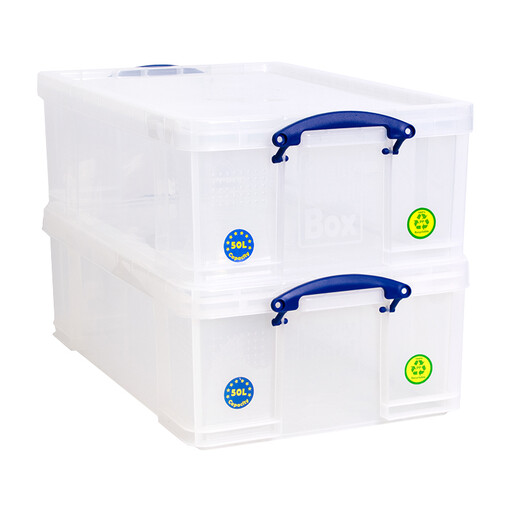
Why This Fits Their Persona: Families, crafters and garage users needing space for clothing, files, tools or hobby materials may benefit from the larger capacity.
The reinforced base and locking clips address sagging and loose lids, while transparent walls reduce unnecessary opening and searching.
Two 50-litre boxes with locking lids, integrated handles and stackable construction.
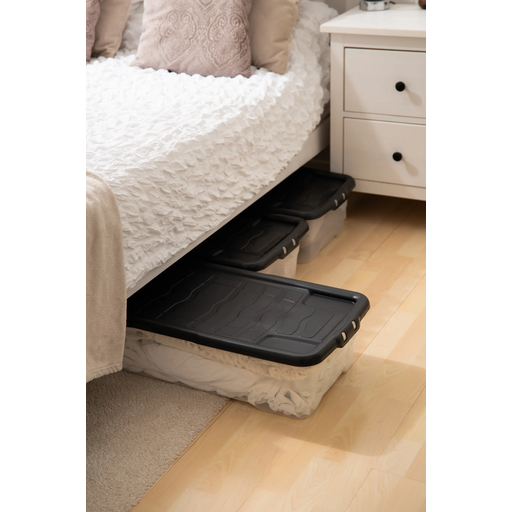
Why This Fits Their Persona: Renters and homeowners with limited cupboard or bedroom space can use its 30-litre capacity for linen, shoes and seasonal belongings.
Its stated 17 x 40 x 60 cm dimensions make it easier to compare with under-bed clearance before purchase.
Clear body, clip-on black lid, stackable format and recycled plastic construction.
We have compiled a complete, real-time list of products that fully satisfy these strict selection criteria and UK safety regulations.
Some polypropylene boxes are designed to tolerate a range of temperatures, but suitability depends on the specific product. Keep boxes away from open flames, direct heat and prolonged sunlight. In a loft or garage, use a secure, dry surface and avoid storing items where condensation can build up.
Measure the clear height beneath the bed frame rather than relying on the advertised capacity. Low-profile under-bed storage boxes are generally easier to slide out, but allow extra clearance for the lid and handles. Check the full external dimensions before ordering.
Do not overload them, distribute weight evenly and keep heavier boxes at the bottom. Secure every lid before stacking, avoid dragging boxes across rough floors and clean them with a damp cloth. Replace any box with cracked corners, damaged clips or a distorted lid.