
24/7 Customer Support

Free returns

Same-day & Next-day Delivery

Quality Guaranteed

Unlock Your Welcome Offers: FREE Delivery | Up to 80% OFF | Free 30-day JoyPlus trial
Download the APP
Plastic storage boxes can make a cramped flat, busy family home, garage or home office easier to manage. However, choosing by capacity alone can lead to wasted money, awkward stacking and damaged contents. A box that looks spacious online may not fit your shelving, while a low-cost container may have a lid that flexes or clips that become unreliable with regular use.
This guide explains what to check before buying plastic storage boxes, including clear storage boxes, stackable storage boxes, storage boxes with lids and larger garage storage boxes.
A listed capacity such as 30L, 48L or 65L describes the approximate internal volume, but the shape matters just as much. Sloping sides, thick walls and lid mechanisms can reduce the usable area. If you are storing A4 folders, vinyl records, shoes or under-bed items, check the dimensions as well as the litre capacity.
Measure the space where the box will sit, allowing room to lift the lid and carry the container. This is particularly important for loft shelves, wardrobes and narrow cupboards.
Some storage boxes have loose-fitting covers, while others use clip-on or lift-lock handles. A secure closure can help reduce exposure to household dust and keep contents contained during movement. It does not make a box suitable for outdoor weather, food storage or hazardous liquids unless the manufacturer specifically states this.
Check that the lid is included, how it attaches and whether the box can be lifted safely when full. A lid should not be treated as a carrying handle unless the product design specifically supports this.
A large box encourages overfilling. Books, tools and files can become heavy well before the container reaches its stated volume. Overloading may strain the base, clips or shelving, and tall stacks can become unstable.
Look for a reinforced base, stable lid recesses and clear safety instructions. Keep heavier items in lower boxes, distribute weight evenly and avoid using storage containers as steps or stools.
Many lidded plastic storage containers use polypropylene, a practical material that is lightweight, wipe-clean and suitable for everyday household use. Some Really Useful Boxes in the range are made in the UK from polypropylene, while Strata storage boxes use recycled plastic according to their product descriptions.
Plastic is generally more suitable than fabric for garages, workshops and areas where items need protection from dust or occasional handling. Fabric cube organisers are better suited to lightweight clothes, toys and soft furnishings indoors. They can fold flat when not in use, but they are not a replacement for rigid heavy-duty storage boxes.
Choose capacity according to the items being stored:
For specialist storage, internal dimensions are particularly important. A 35L box with an XL lid is listed as suitable for upright LP storage, while a 48L model is designed to accommodate A4 and lever-arch files.
Clear storage boxes let you identify contents without opening several containers. Translucent designs offer a similar benefit, although labels may still be useful in dim cupboards or lofts.
For vertical organisation, compare stackable storage boxes rather than simply buying containers that appear flat. Reinforced bases and recessed lids can improve stability, but every stack should remain level and within the manufacturer’s guidance. If empty storage boxes need to take up less room, a nestable design can be useful: some large containers stack when full and fit inside one another when empty.
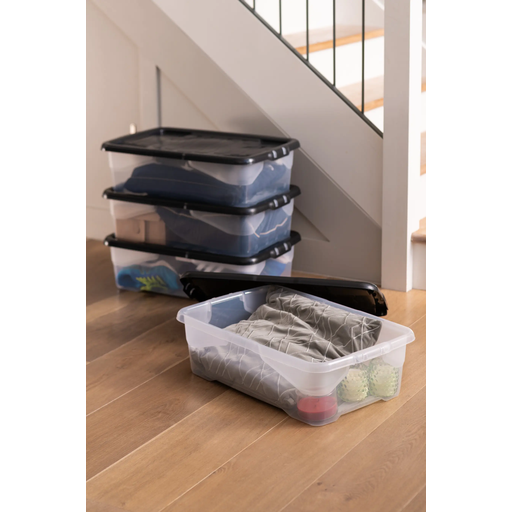
Why This Fits Their Persona: Four matching 30-litre containers offer a straightforward starting point for bedrooms, cupboards and under-bed storage without mixing different sizes.
The clear tubs make contents visible, while included lids avoid the common mistake of buying boxes first and compatible covers later.
30L capacity, recycled plastic construction, clip-on lids and dimensions of 60 x 40 x 32cm.
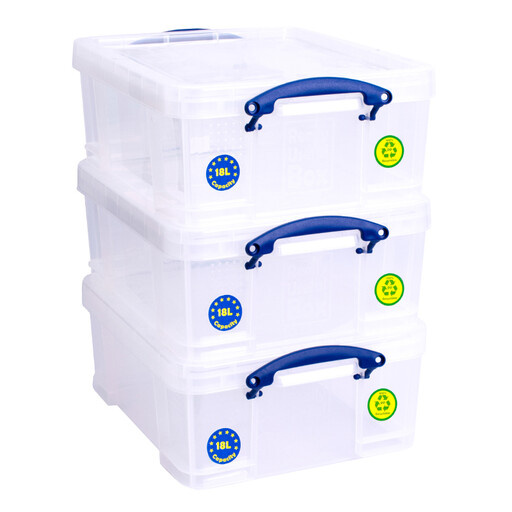
Why This Fits Their Persona: Suitable for shoppers who want consistent, transparent boxes for an office, craft room, media collection or household shelving system.
The listed 48 x 39 x 20cm dimensions make cupboard planning easier, and clip-lock handles provide a defined closure rather than a loose cover.
Three 18L polypropylene boxes, clear sides, secure lids and stackable construction; each is listed to hold up to 44 DVDs or 93 CDs.
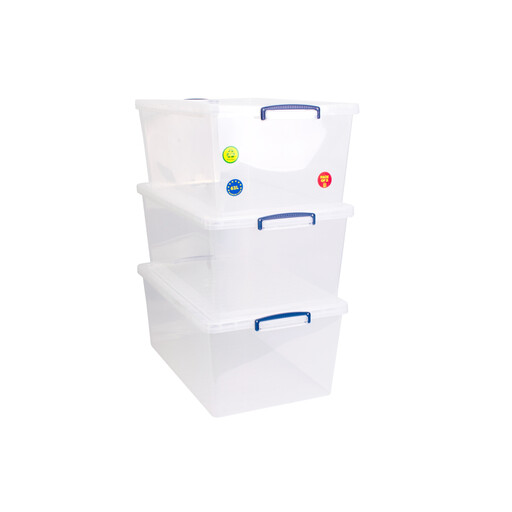
Why This Fits Their Persona: A practical choice for lofts, garages and workshops where bulky bedding, camping equipment, seasonal clothing or DIY supplies need larger-volume storage.
The 62L capacity is paired with a stated 25kg maximum per box, helping buyers think about load limits instead of filling by volume alone.
Each box measures approximately 69.5 x 44 x 28.7cm, has integrated handles and can be stacked when full or nested when empty.
We have compiled a complete, real-time list of products that fully satisfy these strict selection criteria and UK safety regulations.
Create a simple location-based system rather than mixing unrelated items. For example, keep cleaning supplies together, seasonal clothing in larger containers and craft materials in smaller clear boxes. Add a label to the short side if boxes will sit on shelving, because the lid may not remain visible.
For travel, rigid containers are not always convenient. Travel packing cubes made from lightweight nylon can separate clean clothes, laundry, shoes and toiletries inside a suitcase. The 10-piece sets listed include mesh packing cubes, a shoe bag, laundry bags and smaller organisers. They fold away when not in use, but should not be confused with lidded plastic storage containers for garages or lofts.
Fabric cube organisers are another indoor option for open shelving. The JOYFURNOS sets measure approximately 30–33cm per side and are designed for cube units. Check the shelf dimensions before ordering and keep heavier contents within the stated 5kg capacity per organiser.
They can be useful in a garage for clean, dry household goods, tools and hobby supplies. Choose sturdy polypropylene boxes with secure lids, keep them away from direct heat and do not store flammable liquids, hazardous chemicals or unsuitable materials inside them. Place heavier boxes low down and keep stacks stable.
Lifespan depends on material thickness, loading, temperature, sunlight and handling. Avoid overloading, dragging boxes across rough floors or leaving them beside heat sources. Inspect lids, clips and corners periodically, and replace any container that becomes cracked, warped or deformed.
A large box may offer more capacity per container, but it is not automatically better value. Consider the cost per usable litre, the number of boxes required, delivery charges and whether you can safely lift the contents. Several medium storage boxes may be easier to carry and organise than one heavily loaded container.