
24/7 Customer Support

Free returns

Same-day & Next-day Delivery

Quality Guaranteed

Unlock Your Welcome Offers: FREE Delivery | Up to 80% OFF | Free 30-day JoyPlus trial
Download the APP
Plastic storage boxes can make a loft, garage, spare room or office easier to manage, but choosing the wrong design can create more problems than it solves. A box that is too large may become impossible to lift, while a lid that does not close securely can leave clothing, tools and paperwork exposed to dust and damp.
Before buying, look beyond capacity figures and promotional wording. The most useful storage box is one that matches the space, contents and handling requirements of your household.
A box advertised as 60 litres may sound spacious, but its external dimensions determine whether it fits beneath shelving, through a loft hatch or inside a cupboard. Large storage boxes can also be difficult to carry when filled.
Measure the available floor and shelf space first. Check height, width and length, then allow room to remove the lid or access handles. For awkward spaces, several medium stackable storage boxes may be more practical than one oversized container.
Plastic type, wall thickness and base construction all affect performance. A lightweight container may suit clothes or soft furnishings, but tools, books and equipment require more support. Check whether the product uses polypropylene or another specified material, and look for features such as a reinforced base, impact resistance and secure corners.
Do not confuse a bold colour or industrial appearance with a stated load capacity. If a maximum load is not provided, avoid treating the box as suitable for exceptionally heavy contents.
A lid can reduce dust and keep contents enclosed, but this does not automatically make a box waterproof or suitable for outdoor exposure. Loft storage boxes may experience temperature changes, while garages and sheds can be damp. Store sensitive items in sealed bags inside the box where appropriate, and keep containers raised from potentially wet floors.
For valuable tools or workplace stock, consider lockable storage boxes with holes for a padlock or cable tie. This offers a practical deterrent, but it is not the same as a certified security container.
Capacity is usually measured in litres, but internal shape matters just as much. A deep container may hold bulky blankets, toys or tools, while a longer design can accommodate files, equipment and other items that do not fit comfortably in square boxes.
For everyday household storage:
Always consider the filled weight. A large box may be suitable for storing items in one location but unsuitable for lifting up a ladder or carrying through a loft.
Polypropylene is commonly used for durable household storage because it is lightweight and resistant to everyday impacts. Some products specify recycled plastic, while others use recyclable or virgin polypropylene. These details help explain the construction, but they do not replace sensible loading and handling.
A flat or reinforced base helps reduce sagging when the box is loaded. For loft storage boxes and garage storage boxes, a stated temperature range can also be useful. The 50-litre clear boxes listed below specify resistance from -15°C to +80°C, although contents should still be protected from condensation and prolonged damp.
Avoid placing plastic boxes near open flames, heaters or other high-heat sources. Do not use a damaged or deformed container for heavy storage.
Storage boxes with lids help contain dust and make stacked items easier to organise. Locking handles or integrated clips can keep lids in position during storage and transport. Stackable storage boxes should have a stable lid recess or shaped base so that the boxes sit securely rather than sliding.
Do not stack higher than the product guidance allows. Place heavier boxes at the bottom, distribute contents evenly and avoid using a box as a step. If you regularly reorganise a garage, workshop or stockroom, wheeled storage trunks can reduce the need to lift a full container.
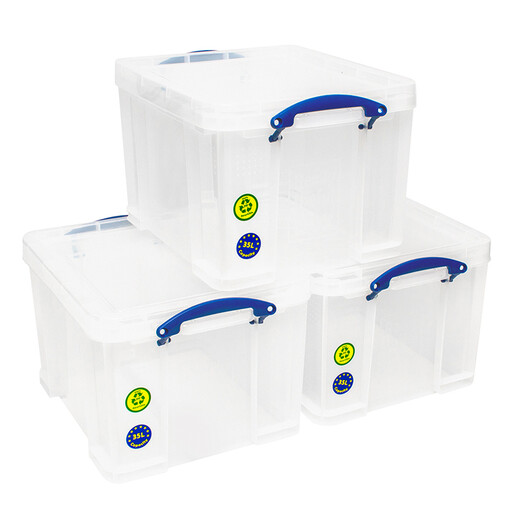
Why This Fits Their Persona: A three-box set gives renters, families and first-time organisers several containers for clothing, toys, office supplies or general household items without committing to one oversized trunk.
Clear polypropylene walls make contents visible, while secure lids and reinforced bases address the common problems of rummaging and sagging.
Three 35-litre boxes; clear construction; stackable design; made from recyclable polypropylene in the UK.
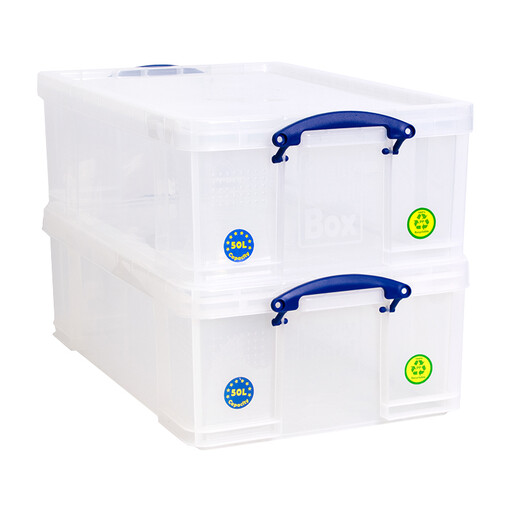
Why This Fits Their Persona: Homeowners and collectors who want a coordinated, visible system for folders, seasonal clothing, hobby materials or equipment can use the matching twin pack across cupboards, lofts and shelving units.
The transparent body removes the need to label every container, and integrated locking clips provide a more secure closure than a loose cover.
Two 50-litre boxes; dimensions of 230H x 710W x 440D mm; reinforced base; stated temperature resistance from -15°C to +80°C.

Why This Fits Their Persona: DIY enthusiasts, workshop users and small businesses needing to move bulky tools, seasonal stock or equipment around a garage, shed or work area may benefit from the high capacity and built-in wheels.
Built-in wheels address the lifting problem associated with very large containers, while lid holes allow a padlock or cable tie to be added.
145-litre capacity; built-in wheels; clip-on lid; made from recycled plastic; dimensions of H45 x W52 x L94cm.
We have compiled a complete, real-time list of products that fully satisfy these strict selection criteria and UK safety regulations.
Use clear plastic storage boxes for items that are frequently accessed, such as children’s toys, craft supplies or office materials. Opaque heavy-duty boxes may be preferable for tools and garage storage where appearance is less important.
For kitchens, compact organisers can make better use of worktop and cupboard space than deep general-purpose containers. A sink tidy with separate compartments and a removable drip tray is designed for cloths, brushes and washing-up liquid. In bathrooms, open shelving or a two-tier shower caddy allows water to drain rather than collecting inside a closed box.
For lofts and garages, group items by season or activity and label the short-facing side of each box. Keep a clear walkway, avoid unstable towers and secure shelving units to the wall where the manufacturer supplies an anti-tip device.
They can be suitable when the product’s material and temperature guidance match the space. Use boxes with secure lids, avoid overloading them and protect contents from condensation. Do not assume a standard plastic container is waterproof.
Follow the manufacturer’s instructions and keep the tower stable. As a practical rule, place heavier containers at the bottom, keep the stack on a level surface and stop if boxes begin to flex or shift. Never use stacked boxes as steps.
A padlock or cable tie can help prevent casual access, but it does not provide the protection of a tested security safe. For tools, documents or stock, combine a lockable box with a secure room, suitable shelving and sensible access control.