
24/7 Customer Support

Free returns

Same-day & Next-day Delivery

Quality Guaranteed

Unlock Your Welcome Offers: FREE Delivery | Up to 80% OFF | Free 30-day JoyPlus trial
Download the APP
Buying plastic storage boxes with lids seems straightforward until a box arrives too shallow, the lid does not clip securely, or the stated capacity fails to fit the items you intended to store. UK homes often need flexible storage for wardrobes, lofts, cupboards, garages and home offices, but marketing descriptions can make different products appear more similar than they are.
The right choice depends on more than litre capacity. Before buying, check the box dimensions, lid mechanism, material, stackability and intended location.
A 30-litre box may suit folded clothing but be unsuitable for long tools, ring binders or vinyl records. Capacity describes volume, not usable space. External measurements also include the walls and lid, so the internal dimensions may be smaller.
Measure the shelf, cupboard or under-bed clearance first. For example, low-profile clear storage boxes are more suitable for paperwork or craft materials, while deeper containers are more practical for bedding, toys and garage equipment.
A loose-fitting lid may reduce dust but can detach when a box is moved. For items that will be stored for months in a loft, garage or storeroom, look for storage boxes with clip-lock lids or integrated locking handles.
A clip-on or snap-fit lid is useful for keeping contents contained during transport and everyday handling. However, it should not automatically be treated as waterproof or airtight unless the product specification clearly says so. Avoid storing liquids, hazardous substances or heat-sensitive materials unless the box is specifically designed for that purpose.
“Stackable” does not mean that boxes can be piled indefinitely. A tall, uneven tower can become unstable, especially on an imperfect garage floor or when heavy contents are placed in the upper boxes.
Check whether the lid has a recessed stacking surface and whether the base is reinforced. Distribute weight evenly, keep heavier boxes lower down and follow any stated stacking guidance. This is particularly important when using large plastic storage boxes in workshops, lofts or small-business stockrooms.
Use the box’s capacity as a starting point, then compare the measurements with your storage area and belongings.
Remember that a fully loaded box can become difficult to carry. A smaller box may be more practical for books, tools or dense paperwork, even when a larger container offers more volume.
Polypropylene is commonly used for reusable storage containers because it is lightweight, washable and suitable for repeated household use. Look for useful construction details such as:
Do not confuse a durable plastic box with a load-bearing platform. Never use storage boxes as steps or stools, and keep them away from open flames and direct heat.
Clip-lock lids, snap-fit closures and integrated handles each offer different practical benefits. A lid with external locking handles can help during transport, while a simple clip-on lid may be quicker for frequent access.
For documents, crafts and office supplies, easy opening may matter more than maximum closure strength. For loft storage, seasonal clothing or garage equipment, a secure lid and stable stacking design are usually higher priorities.
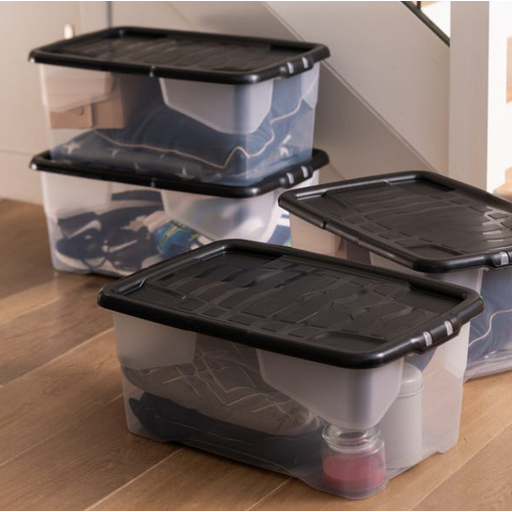
Why This Fits Their Persona: Four matching 42-litre boxes give renters, students and households a straightforward way to create a consistent storage system across wardrobes, cupboards, utility rooms or garages.
The clear/translucent body helps identify contents, while solid clip-on lids reduce the risk of loose lids during normal storage. Its 60 x 40 x 40cm dimensions are stated clearly for planning shelf space.
Pack of four; stackable construction; made from recycled plastic; suitable for clothing, toys, paperwork and general belongings.
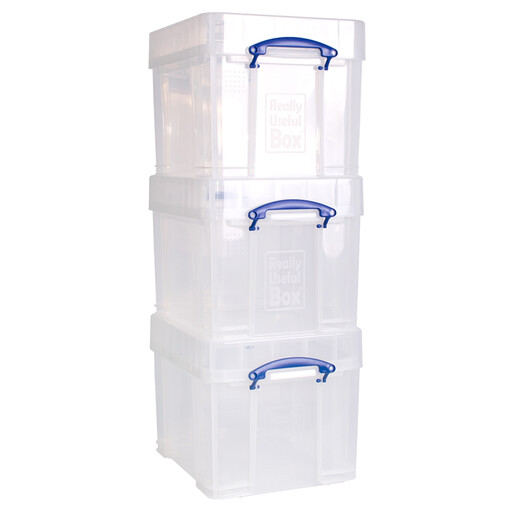
Why This Fits Their Persona: Record collectors, crafters and organised home-office users may appreciate the stated internal dimensions and reinforced design for structured, upright storage.
The XL snap-fit lid has locking handles, and the flat reinforced base is intended to support stability when loaded. The listing also gives a recommended maximum stacking height of four to five boxes, depending on load weight.
35-litre capacity per box; pack of three; clear polypropylene; suitable for up to 100 LPs per box according to the product description.

Why This Fits Their Persona: Garage users, workshop owners, small businesses and households storing blankets, tools or bulky seasonal items may need high-volume containers with a consistent footprint.
The product specifies reinforced corners, a honeycomb-patterned base and recessed lids for stacking. Two locking handles per lid help keep contents contained during storage.
84-litre capacity per box; pack of three; clear polypropylene; dimensions of 71 x 44 x 38cm per box.
We have compiled a complete, real-time list of products that fully satisfy these strict selection criteria and UK safety regulations.
Before filling your boxes, group contents by type and label the outside if the material is not fully transparent. Leave enough room for the lid to sit flat, particularly with clip-lock designs. Place boxes on a dry, stable surface and avoid dragging them across rough concrete.
For garage storage boxes and loft containers, keep heavier items low and check the clips periodically for cracks or deformation. Clean plastic with a damp cloth or mild soapy water; avoid abrasive products and solvents that may mark the surface.
They can be, provided the height and length match the available clearance. Low-profile boxes are generally more suitable than deep containers. Measure from the floor to the underside of the bed frame, allowing space to pull the box out without catching the lid.
Lifespan depends on material, loading, temperature, handling and exposure to sunlight. Polypropylene boxes designed for repeated use can remain practical for a long time when they are not overloaded, dragged across abrasive surfaces or exposed to direct heat. Replace any box or lid that becomes cracked, warped or difficult to secure.
Clear or translucent walls make it easier to identify contents without opening each container, which can save time in offices, craft rooms and seasonal storage areas. Opaque options may suit spaces where appearance matters more, but they usually require clearer labelling and more frequent opening to locate items.