
24/7 Customer Support

Free returns

Same-day & Next-day Delivery

Quality Guaranteed

Unlock Your Welcome Offers: FREE Delivery | Up to 80% OFF | Free 30-day JoyPlus trial
Download the APP
Plastic storage boxes can make a loft, cupboard, bedroom or garage easier to manage—but only if the box suits the load, location and items inside. A low-priced container may look suitable online yet prove awkward when the lid will not clip securely, the base flexes under weight or the dimensions do not fit your shelf.
This guide explains the specifications worth checking before you buy, followed by our top recommendations for different household needs.
A box labelled “large” may hold plenty of volume but still be unsuitable for your storage area. Check height, width and depth, including the lid, before ordering. This is particularly important for wardrobes, loft shelving, car boots and underbed spaces.
Large plastic storage boxes are useful for duvets, toys and seasonal clothing, but their weight can become difficult to carry when full. A smaller box may be more practical for books, paperwork or craft supplies.
Clear plastic helps you identify contents quickly, but visibility does not automatically mean the box is sealed against moisture or pests. Look for storage boxes with lids that clip firmly on all sides. A secure lid can help reduce exposure to dust and spills, but these products should not be treated as completely waterproof unless the listing specifically confirms this.
For documents, photographs and vinyl records, keep items clean and dry before storing them. Avoid placing boxes directly on damp garage floors or against walls where condensation may occur.
Stackable storage boxes need a stable, level surface. A flat, reinforced base and a lid designed to support another box can improve stability, but stacking too high may still create a tipping risk.
Also check how loaded boxes are lifted. Integrated handles are useful, yet heavy boxes should be supported underneath rather than carried by the lid clips alone. Never use a plastic storage box as a step or seat.
Choose capacity according to the items you intend to store:
Do not rely on litre capacity alone. Compare the internal dimensions with the item. For example, upright records require suitable width and depth, while underbed storage boxes need a low profile.
Polypropylene (PP) is commonly used for reusable plastic storage boxes because it is relatively light and can be formed into reinforced bases, corners and handles. The product listing should identify the material clearly. Some heavy-duty storage boxes use recycled plastic, while others use virgin polypropylene.
Look for:
Plastic can deform when exposed to open flames or high heat. Follow the manufacturer’s temperature and load guidance, and do not store flammable liquids or hazardous chemicals in ordinary household boxes.
Stackable storage boxes are designed to sit securely on top of one another when full. Nestable storage boxes fit inside each other when empty, which is useful when you need to store spare containers.
For garages and workshops, storage boxes with wheels can reduce the need to lift very large loads. Wheels are most useful on level surfaces and do not remove the need to observe the stated load limit.
Underbed storage boxes should be measured against the clearance beneath your bed frame. A box that fits lengthways may still be too tall once the lid is attached.

Why This Fits Their Persona: A four-box pack provides a straightforward way to organise desks, drawers, shelves and craft areas without committing to oversized containers.
The low-profile format makes dimensions easier to manage, while snap-on lids and transparent polypropylene address poor visibility and unsecured closures.
4-litre capacity per box; stackable with or without lids; designed for A4 paper, files and craft supplies.
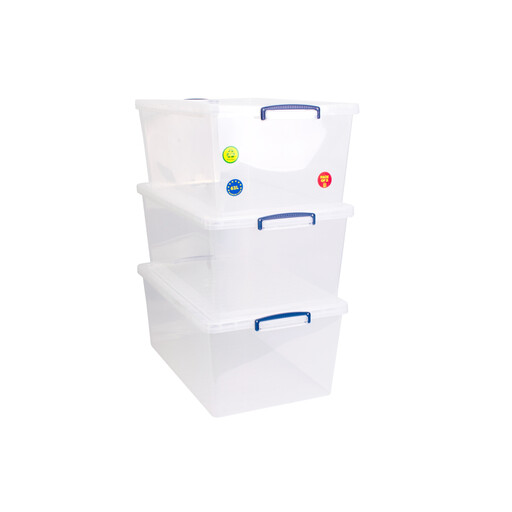
Why This Fits Their Persona: Suitable for households wanting a consistent, visible storage system for bedding, winter clothing, camping equipment or larger DIY supplies.
The stated 25kg maximum per box helps set a clear loading boundary, while the nestable design avoids wasting space when containers are empty.
62 litres per box; clear sides; clip-on lids; stackable when full and nestable when empty.
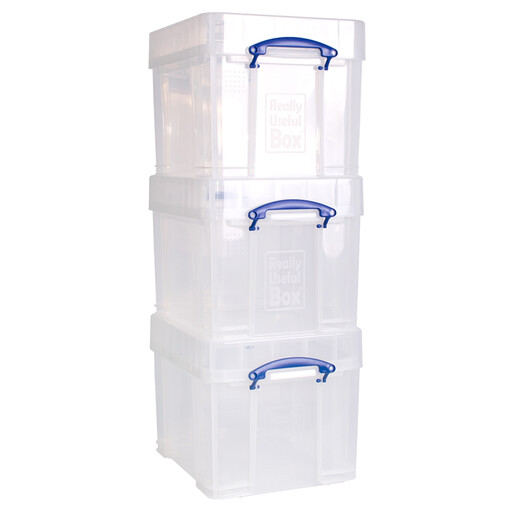
Why This Fits Their Persona: A practical fit for record collectors, office users and garage organisers who need a stable box with a defined internal format.
The internal dimensions are listed as 37 × 31 × 31cm, and the reinforced flat base is intended to support upright storage rather than leaving contents to slump.
35 litres per box; XL snap-fit lid; stated capacity of up to 100 LPs per box; stackable with or without lids.

Why This Fits Their Persona: The large wheeled trunk is suited to garages, sheds and workshops where bulky tools, decorations or equipment need to be moved across level surfaces.
Built-in wheels reduce repeated lifting, while the clip-on lid and holes for a padlock or cable tie provide practical closure and security options.
145-litre capacity; integrated wheels; recycled plastic construction; lid compatible with a padlock or cable tie.
We have compiled a complete, real-time list of products that fully satisfy these strict selection criteria and UK safety regulations.
They can be suitable when the material, temperature guidance and dimensions match the location. Polypropylene storage boxes are commonly used for household organisation, but they should be kept away from direct heat and stored on a stable, dry surface. In a garage, raised shelving can help reduce contact with damp floors.
Lifespan depends on loading, handling, sunlight, temperature and how often the box is moved. A reinforced box with a secure lid can remain useful through repeated household storage, but dragging it across rough flooring, overloading it or exposing it to heat may cause cracking or deformation.
A pack can provide a consistent system and may reduce the cost per box, but compare total capacity, dimensions and lid design rather than quantity alone. Three small boxes may be more useful than one oversized container if you need to separate clothing, documents and tools.