
24/7 Customer Support

Free returns

Same-day & Next-day Delivery

Quality Guaranteed

Unlock Your Welcome Offers: FREE Delivery | Up to 80% OFF | Free 30-day JoyPlus trial
Download the APP
Plastic storage boxes can make a loft, garage, cupboard or home office easier to manage, but choosing by appearance alone can lead to wasted space, broken lids and difficult-to-move containers. UK homes often need storage that can cope with seasonal clothing, paperwork, toys, tools and hobby equipment—each requiring different dimensions and protection.
Before buying, consider these common pitfalls.
A box may hold 50 or 60 litres, yet still be unsuitable for a particular shelf, loft hatch or cupboard. Capacity does not show whether a container is long and shallow, tall and narrow, or wide and deep.
Measure the available space first, including:
For loft storage boxes and garage storage boxes, external measurements matter more than the advertised litre figure alone.
Stackable storage boxes are designed to sit on one another, but the safe height depends on the box construction, weight distribution and surface underneath. A box filled with books or tools places more strain on its base than one holding cushions.
Look for a reinforced base, a flat lid and a stable shape. Keep heavier containers at the bottom, avoid uneven floors and follow any stated stacking guidance. Do not use a loaded box as a step.
A clip-lock lid can help keep contents enclosed and reduce dust exposure, but it does not automatically make a container waterproof. Some lids are designed for everyday household storage, while others use silicone seals for dry food storage.
Check whether the product description specifically mentions:
For food storage jars, use only products intended for food. Do not assume that a general-purpose plastic box is suitable for flour, pasta or other ingredients.
Choose the smallest practical size for the items you store. Smaller clear storage boxes are often easier to lift and organise, while large storage boxes reduce the number of containers needed for bulky belongings.
A 19-litre box can suit A4 paperwork, craft materials and office supplies. Medium 33–35-litre boxes are useful for clothing, toys, towels and equipment. Larger 50–84-litre boxes can accommodate bulky items, while a 145-litre wheeled storage trunk is more appropriate for substantial loads that need occasional movement.
Internal dimensions are especially important for:
Polypropylene is commonly used for durable household storage because it is lightweight and can be formed into rigid, reusable containers. Check for reinforced bases, strong corners and impact-resistant construction where available.
For garages, sheds and workshops, also check the stated temperature range. One 50-litre range listed here is specified for temperatures from -15°C to +80°C, although storage conditions, direct sunlight and the load inside can still affect long-term use.
Recycled plastic can be a practical material choice, but sustainability wording should not distract from the functional details: capacity, lid security, dimensions and intended environment.
A box that is difficult to move may become inconvenient once full. Integrated handles can assist with carrying, but loaded containers should still be supported from the base rather than lifted by the lid or clips alone.
For heavier contents, consider a storage trunk with wheels. A lockable lid may also be useful in shared garages, sheds or workplace storage, although a padlock or cable tie is normally an additional accessory rather than part of the box.
For kitchen organisation, transparent storage jars with airtight silicone gaskets can make dry ingredients easier to identify. They are not substitutes for plastic storage boxes intended for lofts, garages or general household items.
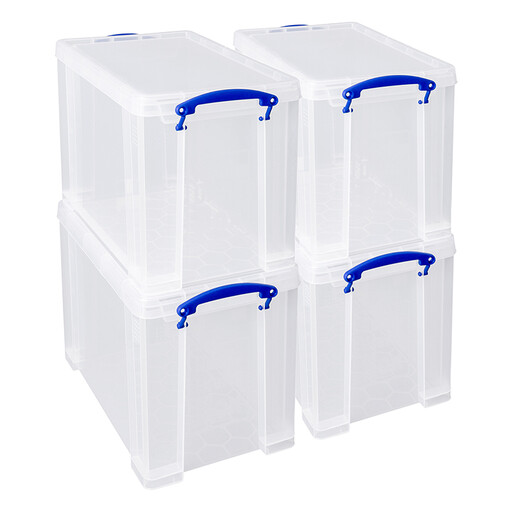
Why This Fits Their Persona: A four-box pack gives renters, students and first-time organisers several matching containers for cupboards, desks and shelves without committing to oversized storage.
The transparent polypropylene body makes contents visible, while clip-lock lids and stackable construction address the problems of hidden items and wasted vertical space.
Four 19-litre boxes; external dimensions of 395 x 255 x 290mm per box; suitable for A4 files, crafts and office supplies.
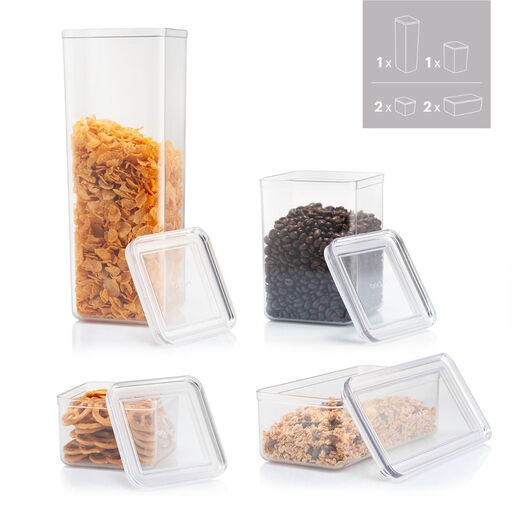
Why This Fits Their Persona: Suitable for households that want coordinated pantry storage for coffee, pasta, flour and nuts, with contents visible on open shelves or inside cupboards.
The set uses transparent lids and airtight silicone gaskets, so it is more specific to dry food organisation than a general-purpose storage tub.
Six jars with a combined 6.8-litre capacity; dishwasher-safe components, with top-rack use recommended.

Why This Fits Their Persona: A practical match for DIY users, families and businesses storing tools, decorations or bulky equipment in garages, sheds, lofts and workshops.
The 145-litre format and built-in wheels address the difficulty of moving large loads, while the clip-on lid and lockable holes provide additional closure options.
145-litre capacity; built-in wheels; recycled plastic construction; dimensions of 45 x 52 x 94cm.
We have compiled a complete, real-time list of products that fully satisfy these strict selection criteria and UK safety regulations.
For a consistent home organisation system, consider matching box sizes across different areas:
They can be, provided the product is suitable for the expected temperature range and the loft is dry and stable. Keep boxes away from direct heat, roof leaks and excessive weight. Clear lids or labels can make seasonal items easier to locate.
Lifespan depends on material, loading, sunlight, temperature changes and handling. Avoid overloading, dragging boxes across rough surfaces or stacking beyond a stable height. Replace any container with a cracked body, damaged lid or clips that no longer close securely.
Not necessarily. A fitted or clip-lock lid can reduce dust and help contain contents, but only use a box for moisture-sensitive items when the product information clearly states the relevant protection. For important documents, photographs and clothing, dry storage conditions remain essential.