
24/7 Customer Support

Free returns

Same-day & Next-day Delivery

Quality Guaranteed

Unlock Your Welcome Offers: FREE Delivery | Up to 80% OFF | Free 30-day JoyPlus trial
Download the APP
Plastic storage boxes can make a noticeable difference in a busy UK home, whether you are clearing a rented flat, storing children’s toys, organising documents or making better use of a garage. However, attractive photos and large capacity figures do not always tell the full story.
Before buying, look beyond the headline price and check the box dimensions, lid design, material and intended load. The right choice depends on where the box will go, what it will hold and how often you need to access it.
A box labelled 65L or 80L storage box may hold plenty, but its outside measurements can make it unsuitable for a cupboard, loft shelf or under-stairs area. Measure the available height, width and depth first, allowing room to lift the lid and move the box.
For underbed storage, compare the height carefully. A box that is too tall may not slide beneath the bed, even if its length and width appear suitable.
A loose-fitting lid may keep belongings covered but can allow dust to enter when stored in a garage or loft. Look for storage boxes with lids that use clip-on, snap-on or locking handles. These designs help keep the lid in position during handling.
A secure lid is not the same as an airtight or waterproof seal. Avoid assuming that a standard plastic box will protect contents from flooding, condensation or damp. Store clothing, bedding and paperwork clean and completely dry, and use additional protective bags where moisture is a concern.
“Stackable” does not mean suitable for unlimited weight or height. Heavy items can deform the lower box, while uneven floors may make a tall stack unstable. Check the supplier’s guidance, distribute weight evenly and keep frequently used items at a comfortable lifting height.
Boxes with reinforced ribs, flat lids or anti-slip bases can offer a more stable arrangement, but the actual load limit still matters.
Most household organisation boxes use polypropylene or recycled plastic. A thicker body, rounded corners and reinforcing ribs can help the container resist everyday knocks and reduce flexing when carried.
For durable plastic storage containers, check whether the product description states the material and any structural features. The thick clear plastic ranges listed here specify 2.5mm PP plastic, rounded corners, three-dimensional reinforcing ribs and an anti-slip base. These are useful features for wardrobes, balconies, car boots and storage rooms.
Plastic should still be kept away from open flames, high heat and prolonged direct sunlight. Do not use a domestic storage box for hazardous chemicals or flammable liquids unless the product is specifically designed for that purpose.
Clear plastic storage boxes allow you to identify contents without opening every container. This is particularly useful for seasonal clothing, craft supplies, children’s toys and office materials.
Opaque lids can reduce visibility, so label the front or top of each box if the contents cannot be seen. Built-in handles are also worth considering when boxes will be moved regularly. They can make lifting more manageable, but loaded containers should still be supported from underneath.
Choose capacity according to the items you are storing:
Do not fill a large container simply because space is available. A box that is too heavy becomes difficult to carry and may place extra stress on the handles or base.
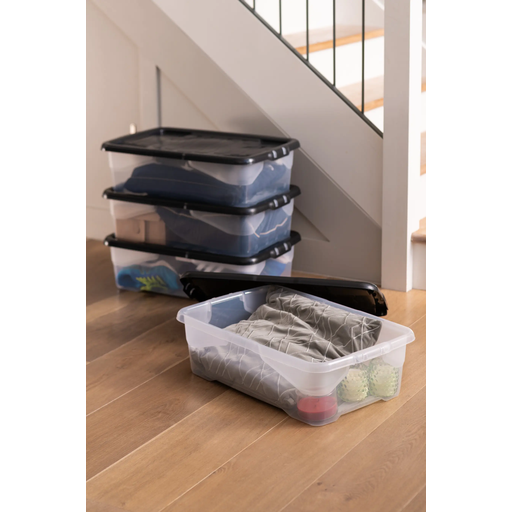
Why This Fits Their Persona: Four matching 30-litre boxes provide a straightforward starting point for renters, students and households organising several small areas at once.
The clear tubs make contents visible, while included lids avoid the need to buy covers separately. Check the stated 32 x 40 x 60cm dimensions before choosing it for underbed use.
Pack of four; clear tubs; included lids; stackable design; made from recycled plastic.
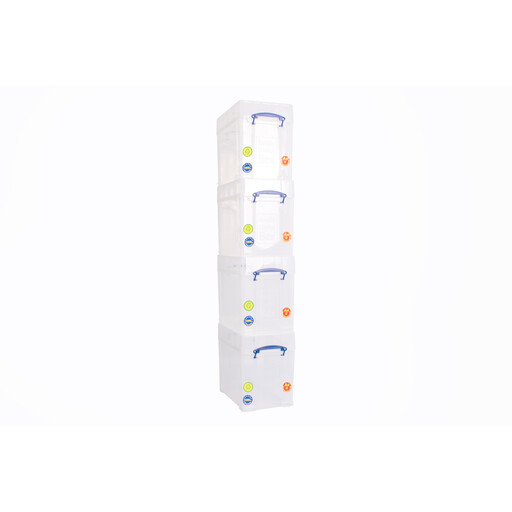
Why This Fits Their Persona: Suitable for shoppers who value a defined footprint, secure closure and clear identification for home offices, collections or careful household organisation.
The product details provide internal and external measurements, so buyers can plan shelving space rather than relying on the 19-litre label alone.
100% polypropylene; XL lid with lift-lock handles; clear finish; four 19L boxes; stated UK manufacture.

Why This Fits Their Persona: A practical option for garage owners and households storing bulky bedding, coats, decorations or larger household items.
Its 80-litre capacity is clearly stated alongside 37 x 40 x 80cm dimensions. This helps buyers judge both volume and the available storage footprint.
80-litre capacity; clip-on lid; clear body with black lid; stackable design; recycled plastic construction.
Group belongings by frequency of use rather than by room alone. Keep everyday items in smaller containers at eye level, and place seasonal belongings in larger boxes on higher shelves. Label each box with its contents and storage date.
For clothing and bedding, wash and dry items before packing. Avoid compressing delicate materials too tightly, and leave enough room to lift the contents without pulling against the lid. In garages and sheds, raise boxes off damp floors and avoid placing them beside heaters or windows with strong direct sunlight.
If you are comparing several household organisation boxes, choose compatible dimensions where possible. Uniform footprints make stacks easier to plan and reduce wasted shelf space.
We have compiled a complete, real-time list of products that fully satisfy these strict selection criteria and UK safety regulations.
They can be suitable when kept dry, stable and away from direct heat. Check the product warnings before use. Plastic boxes do not automatically prevent condensation, so dry contents thoroughly and avoid storing sensitive paperwork or fabrics in damp conditions without additional protection.
Clear boxes make it easier to identify contents and can reduce unnecessary opening. Opaque options may be preferable for items that need less light exposure. In either case, labels remain useful, particularly when boxes are stacked.
Lifespan depends on material thickness, loading, temperature, sunlight and handling. Avoid exceeding the recommended load, dragging boxes across rough floors or stacking them unevenly. Inspect lids, clips and corners periodically, and replace any box that shows cracking or distortion.