
24/7 Customer Support

Free returns

Same-day & Next-day Delivery

Quality Guaranteed

Unlock Your Welcome Offers: FREE Delivery | Up to 80% OFF | Free 30-day JoyPlus trial
Download the APP
Plastic storage boxes with lids can quickly organise a loft, wardrobe, garage or home office, but the wrong design may waste space and money. A box that looks spacious online may have a shallow usable interior, while a lid described as “secure” may only rest on top without clips.
This guide explains the practical details to check before buying, followed by our top recommendations for different UK household and workplace needs.
A 50-litre label does not tell you the internal dimensions or shape. Thick walls, sloping sides and reinforced bases can reduce the space available for bulky items. Before purchasing, measure the items you intend to store and compare them with the stated internal dimensions where available.
This is particularly important for wardrobe storage boxes, A4 documents, vinyl records and tools, which may require a specific length or depth rather than simply a high litre capacity.
Loose-fitting lids can allow dust into stored clothing, paperwork and craft materials. Storage boxes with clip-on lids or locking handles generally provide a more reliable closure than a lid that simply rests on the rim. However, a clip-on lid should not automatically be treated as airtight or waterproof.
For lofts, garages and sheds, look for a firm closure and store the boxes on a dry, stable surface. Avoid storing liquids, hazardous chemicals or damp items unless the product instructions specifically allow it.
Stackable storage boxes help make use of vertical space, but a tall stack can become unstable if the boxes are overloaded or placed on an uneven floor. Check whether the lids have locating recesses or whether the box bases are reinforced for stacking.
In a garage or workshop, also consider the weight of tools and equipment. Large storage boxes may hold more volume than a domestic shelf or loft board can safely support.
Choose the size according to the contents and storage location:
Measure doorways, shelving, wardrobe interiors and boot spaces before ordering. Remember to allow room to lift the lid or remove the box from a stack.
Polypropylene (PP) is widely used for lidded plastic storage containers because it is lightweight, washable and suitable for repeated household use. Recycled plastic can help reduce reliance on newly produced material, while recyclable polypropylene may be accepted through some local recycling schemes. Check your council’s current guidance rather than assuming the box can go in a household kerbside collection.
Useful construction details include:
A thicker body may provide additional rigidity, but it can also make a box heavier and reduce its internal capacity.
Storage boxes with clip-on lids are useful when contents need protection from everyday dust or accidental spills. Locking handles can also make carrying more controlled, but always support a loaded box from underneath rather than lifting it by the lid clips alone.
For stable stacking, check that the box and lid are designed to align. Follow the manufacturer’s stacking guidance and avoid creating a top-heavy tower. Keep children away from unstable stacks and never use a storage box as a step.
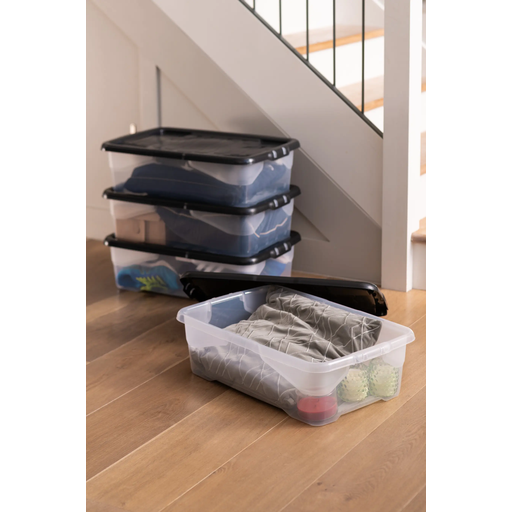
Why This Fits Their Persona: A four-box set gives renters, students and first-time organisers a consistent way to sort clothing, shoes, bed linen and general household items.
The clear tubs make contents visible, while included lids reduce exposure to everyday dust. Its 30-litre size is easier to handle than extra-large containers.
Pack of four; recycled plastic construction; clear body; stackable format; dimensions of 32 × 40 × 60 cm.
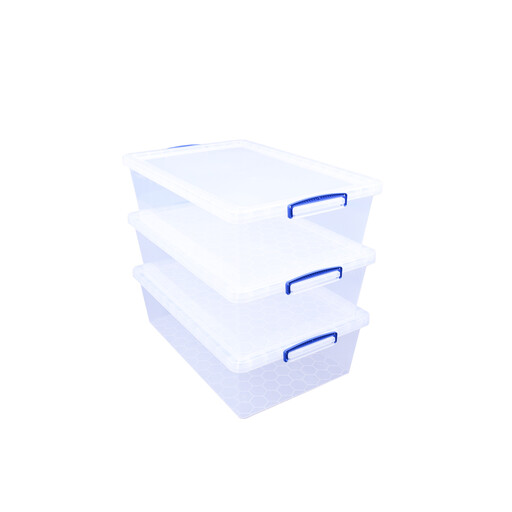
Why This Fits Their Persona: Suitable for homeowners and office users who want one coordinated system for cupboards, lofts, garages or archived paperwork.
The stated external dimensions and nestable design make space planning clearer when boxes are empty. Clip-lock handles provide a defined closing mechanism.
43 litres per box; pack of three; clear polypropylene; nestable when empty and stackable when full.
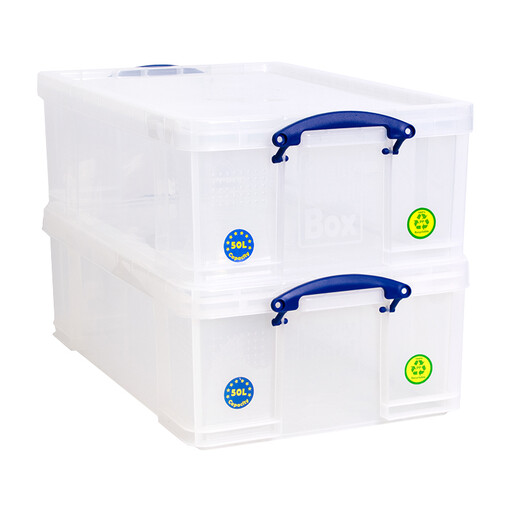
Why This Fits Their Persona: A practical choice for DIY users, crafters, garages, workshops and small businesses storing larger tools, files, toys or stock.
The reinforced base is intended to reduce sagging, while integrated clips secure the lid. Buyers can check the generous 710 × 440 × 230 mm dimensions before committing shelf space.
Two 50-litre boxes; transparent polypropylene; stackable design; reinforced base; integrated lid clips.
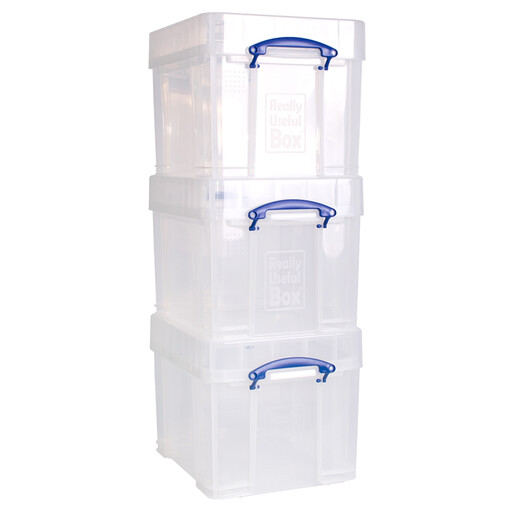
Why This Fits Their Persona: The internal proportions suit vinyl records, hobby materials and other items that need to remain upright, visible and easy to carry.
The stated internal dimensions help collectors assess fit, while the XL lid and locking handles offer a more defined closure than an unfastened cover.
35 litres per box; pack of three; clear polypropylene; reinforced base; stackable with or without the lid.
Fill boxes evenly rather than concentrating heavy items at one end. Keep stored contents clean and dry, especially in lofts, garages and sheds. Wipe plastic surfaces with a damp cloth or mild soapy water, following the product instructions. Avoid abrasive cleaners, solvents, open flames and prolonged direct sunlight, which may damage or deform plastic.
When stacking, place the heaviest containers at the bottom and keep the tower low enough to remain stable. Label the short ends if boxes are stored on shelving, even when the plastic is clear; this makes identification easier when visibility is limited.
We have compiled a complete, real-time list of products that fully satisfy these strict selection criteria and UK safety regulations.
They can be suitable for clean, dry loft storage when placed on a stable surface and kept away from heat, leaks and direct sunlight. Check the temperature and stacking guidance supplied with the product. A lidded box helps reduce dust but should not automatically be considered moisture-proof.
Lifespan depends on plastic thickness, loading, handling, sunlight and temperature. Avoid overloading, dragging boxes across rough floors or lifting full containers by their lids. Inspect clips, corners and bases periodically, and replace any box that is cracked, deformed or no longer closes securely.
A storage box multipack can reduce the cost per container and create a uniform system, but compare the total capacity, dimensions and lid design rather than pack quantity alone. Four small boxes may offer less useful space than two large storage boxes, while smaller units can be easier to carry and fit into cupboards.