
24/7 Customer Support

Free returns

Same-day & Next-day Delivery

Quality Guaranteed

Unlock Your Welcome Offers: FREE Delivery | Up to 80% OFF | Free 30-day JoyPlus trial
Download the APP
A play kitchen is more than just a toy; it’s a miniature world where creativity, learning and fun come together. For many children, it’s the heart of the playroom, a place to mimic the grown-ups they admire, host imaginary dinner parties and develop crucial life skills. But with so many options available, choosing the right one can feel overwhelming. Do you go for a classic wooden design or a modern plastic one with all the bells and whistles?
As the Joybuy Product Recommendation Officer, my role is to help you navigate these choices. This guide offers practical advice and highlights a few standout models to help you find a children's toy kitchen that will inspire hours of imaginative play.
Before diving into specific products, let's consider a few key factors. Thinking about these points will help you narrow down the options and select a kitchen that fits your home, budget and your child's play style.
The material of a pretend play kitchen significantly influences its look, feel and longevity.
Consider what kind of play experience you want to encourage. A kids kitchen with sounds can be highly engaging for children who enjoy realistic feedback. The sizzle of a pan or the ding of an oven can make pretend play feel more real. On the other hand, a simpler, sound-free kitchen leaves more to the imagination, empowering children to create their own sound effects and scenarios. This can foster greater creativity and problem-solving skills during role play.
Finally, think about the practicalities. Measure your available space before you buy. If you're short on room, a small play kitchen or a compact tabletop model can be an excellent solution. Also, check what's included. A kitchen playset with accessories—like pots, pans and utensils—offers great value and means your little chef can start cooking straight away. Buying a kitchen that comes well-equipped can save you the time and expense of sourcing these items separately.
Based on design, features and play value, here are a few recommendations to help you find the perfect fit for your budding chef.
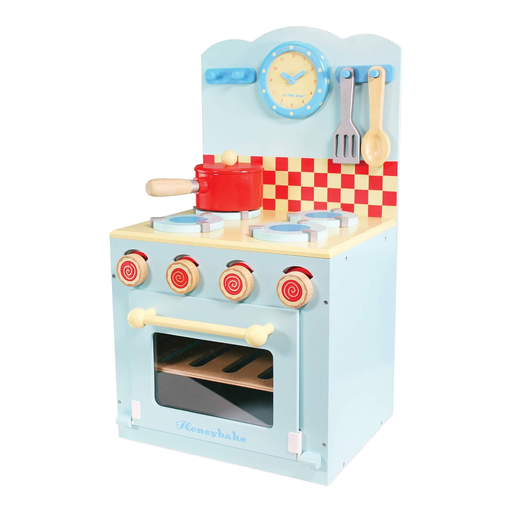
Why It Stands Out: This charming wooden play kitchen from Le Toy Van’s Honeybake collection combines classic design with sustainable craftsmanship. Made from FSC-certified rubberwood and finished with non-toxic paints, it’s a toy built with both children and the planet in mind. The design features rustic dials, an opening oven door and a clock with moving hands, all perfectly scaled for little hands.
Pros:
Who is it for: Families who value traditional, eco-friendly toys and a beautiful aesthetic. It’s an ideal toddler kitchen set for encouraging pure, unplugged imagination.

Why It Stands Out: For those seeking a feature-packed, modern experience, the Smoby Bon Appétit kitchen delivers. This kids kitchen with sounds features a hotplate that makes realistic sizzling noises, an espresso machine with pods and a full suite of appliances including an oven and refrigerator. It comes with 23 accessories, making it a comprehensive playset straight out of the box.
Pros:
Who is it for: Children who thrive on sensory feedback and realistic play. It’s a fantastic all-in-one option for parents looking for a complete kitchen playset with accessories that provides instant fun.

Why It Stands Out: This Miele-branded mini kitchen from Theo Klein is the perfect solution for smaller spaces. Its clever tabletop design provides all the core functions of a pretend play kitchen—a sink and a hob—without taking up valuable floor space. The realistic Miele branding adds a touch of authenticity that little ones love.
Pros:
Who is it for: Families living in flats or smaller homes, or anyone looking for a starter small play kitchen. Its portability and easy storage make it a practical and engaging choice.
A pretend play kitchen is only half the fun without ingredients. To complete the experience and inspire countless new recipes, you’ll need a pantry full of delicious-looking items.
To stock your new kitchen, explore our wide selection of play food, from sliceable wooden vegetables and fruits to colourful felt cakes and breads.
1. What age is a play kitchen for? Most play kitchens are designed for children aged 3 and up, primarily due to the inclusion of small parts that could be a choking hazard. Always check the manufacturer's recommended age on the packaging. Simpler toddler kitchen set models without small accessories may be suitable for slightly younger children, but direct adult supervision is essential.
2. Are wooden play kitchens better than plastic ones? Neither material is inherently "better"; the choice depends on your family's priorities. A wooden play kitchen is often favoured for its durability, classic aesthetic and use of sustainable materials. Plastic kitchens, in contrast, are typically lighter, may be more affordable and often include electronic features like lights and sounds.
3. What should I look for in a kitchen playset with accessories? A good set provides value and variety. Look for a mix of cookware (pots, pans), utensils (spatulas, spoons) and tableware (plates, cups). Some sets also include pretend food. Check that the accessories are made from the same child-safe, durable materials as the main kitchen unit to ensure a cohesive and safe play experience.