
24/7 Customer Support

Free returns

Same-day & Next-day Delivery

Quality Guaranteed

Unlock Your Welcome Offers: FREE Delivery | Up to 80% OFF | Free 30-day JoyPlus trial
Download the APP
Buying pliers and hand tools can seem straightforward until a cheap pair slips on a fitting, damages cable insulation or becomes uncomfortable after a few repeated cuts. For UK electricians, plumbers, mechanics, jewellery makers and DIY users, the right choice depends less on appearance and more on jaw design, working capacity and material quality.
This guide explains the practical specifications to check before buying, highlights common purchasing traps and matches suitable tools to different working needs.
Combination pliers are useful for gripping, twisting and occasional cutting, but they are not a substitute for wire strippers, tile nippers or oil filter pliers. Using the wrong jaw profile can damage the workpiece, increase hand strain or make a job unnecessarily slow.
For example, a hose clamp requires controlled compression rather than the aggressive gripping teeth found on water pump pliers. Similarly, electrical cable should be stripped with a tool designed for its size and insulation type, rather than cut with ordinary side cutters.
Product names can be vague. “Heavy duty”, “universal” and “professional” do not tell you whether a tool fits your cable, hose, filter or fastener. Always check measurable details such as:
A tool that is too small may not open far enough, while an oversized tool can be awkward in confined areas.
Steel type is relevant, but it is not the only consideration. Look for details about heat treatment, jaw hardness, corrosion-resistant finishes and handle construction. A hard cutting edge may perform well on suitable wire, but it can be damaged if used on hardened steel or materials above its stated capacity.
Storage and maintenance also affect service life. Wipe tools dry after use, keep pivot points lightly lubricated and avoid leaving steel tools in damp garages, sheds or unheated vans.
The jaw shape should match the job. Long-nose pliers reach into narrow spaces, side cutters are intended for cutting and water pump pliers grip round, flat, square and hexagonal objects. For plumbing tools, compare both the closed-jaw setting and maximum opening.
The WORKPRO 2 Pack Water Pump Pliers provides 180mm and 250mm options, with maximum openings listed as 33mm and 43mm. This gives users a smaller tool for fittings and a longer option for larger maintenance tasks.
For electrical work, check whether a stripper supports solid or stranded copper and aluminium wire and whether it handles both flat and round cable. The C.K. Automatic Wire Stripper Pro lists stripping capacity from 0.2–6.0mm² for copper or aluminium wire, with a micro-adjustment range extending to 0.05–8mm².
Cutting capacity must be read alongside the material being cut. A tool rated for soft wire is not automatically suitable for piano wire, hardened cable or metal chain. Never exceed the stated diameter.
The WORKPRO Mini Bolt Cutter is specified for materials up to 2.3mm in diameter, using CR-MO steel jaws with heat-treated cutting edges. This makes it a compact option for suitable wires, chains and metal components, but it should not be treated as a replacement for larger bolt cutters when higher capacity is required.
For repetitive work, handle design can be as important as jaw strength. Look for non-slip materials such as TPR or resin, spring-assisted opening for precision work and a locking mechanism where the tool may need to remain clamped.
For electrical tasks, use tools only on isolated circuits and follow appropriate workplace procedures. BS 7671 relates to electrical installation requirements, but the presence of a wire stripper does not make live working safe. Use suitable PPE and confirm that cables are de-energised before handling them.
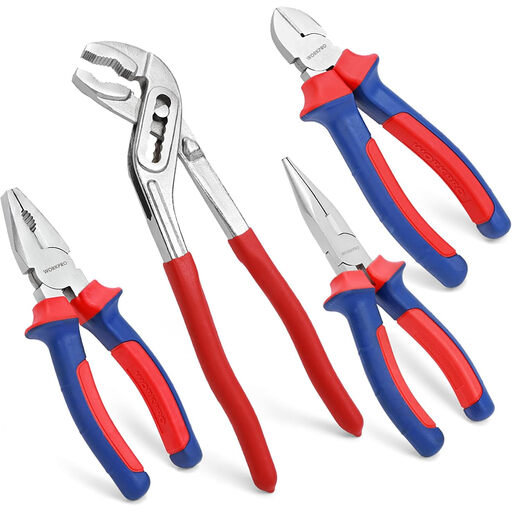
Why This Fits Their Persona: A practical starting point for UK households, renters and DIY users who need several common plier types without buying each tool separately.
The four-piece selection avoids relying on one unsuitable general-purpose tool for every repair.
Includes combination, long-nose, side-cutting and water pump pliers, with PP and TPR resin handles.
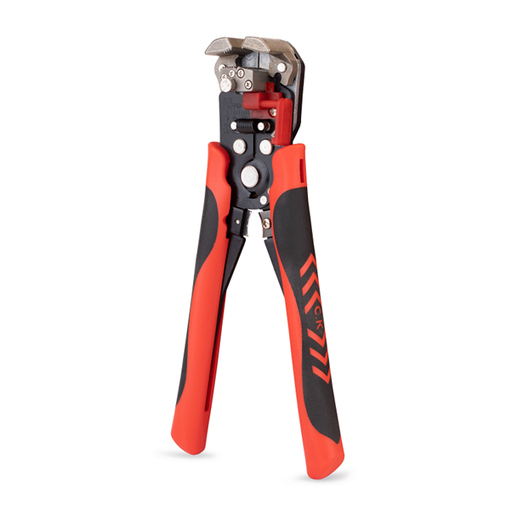
Why This Fits Their Persona: Suitable for electricians and maintenance workers who regularly strip different cable sizes and value repeatable operation.
Its automatic size adjustment and micro-adjustment feature provide stated capacity information rather than vague “universal” wording.
Hardened steel blades, two-component handles and support for stranded or solid copper and aluminium wire.
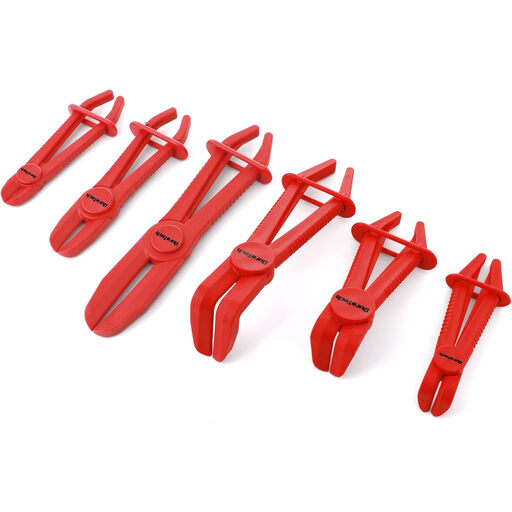
Why This Fits Their Persona: A focused option for mechanics and automotive technicians working on flexible fuel, coolant, brake and radiator hoses.
Six stated sizes and both straight and angled designs make the application clearer than a single generic clamp tool.
PA6 reinforced nylon construction, locking buckles and stated suitability for flexible—not hard or high-pressure—lines.
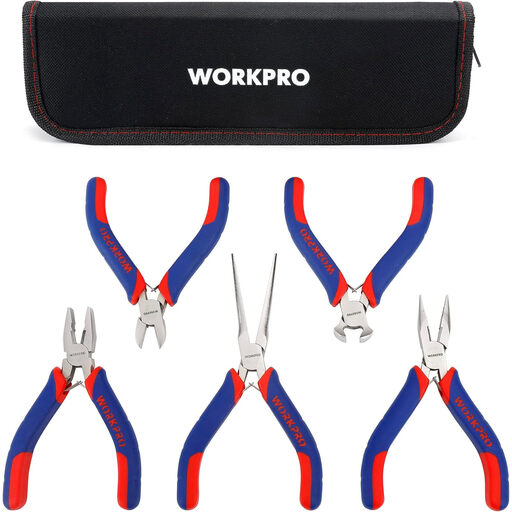
Why This Fits Their Persona: Designed for small components, electronics repair, model building and jewellery work where access and control matter more than maximum leverage.
The five dedicated shapes reduce the need to force large household pliers into delicate tasks.
Includes side, combination, front, flat-nose and needle-nose pliers, with HRC55-65 hardened jaws and a storage pouch.
We have compiled a complete, real-time list of products that fully satisfy these strict selection criteria and UK safety regulations.
The right tool depends on the material and access involved:
No. Automatic wire strippers still have defined cable ranges and insulation types. Check whether the tool supports flat twin and earth, round cable, solid conductors or stranded wire. The C.K. Automatic Cable & Wire Stripper is designed for PVC-insulated flat twin and earth cables up to 12mm wide and conductor cross-sections from 0.75–2.5mm².
Remove dirt and moisture after use, wipe metal surfaces dry and apply a small amount of suitable oil to pivots or adjustment mechanisms. Store tools in a dry toolbox or pouch. Inspect cutting edges, jaws, handles and locking parts before each use, replacing tools that are cracked, heavily worn or misaligned.
It may cover occasional gripping, cutting and maintenance, but professional tasks often require specialist tools with clearly stated capacities. Electricians may need wire strippers and cable cutters, mechanics may need hose clamp and oil filter pliers, while tilers benefit from dedicated tile nippers. Select tools according to the work rather than simply the number of pieces in a set.