
24/7 Customer Support

Free returns

Same-day & Next-day Delivery

Quality Guaranteed

Unlock Your Welcome Offers: FREE Delivery | Up to 80% OFF | Free 30-day JoyPlus trial
Download the APP
A pliers set can save space, time and repeated trips to the hardware shop, but only if each tool suits the work you actually do. A four-piece household set may cover general repairs, while jewellery making, leathercraft and electronics require smaller or specialist jaws.
The main buying risks are not always obvious from product photographs. A polished finish can look impressive without indicating how the steel was treated, and a large number of pieces may include tools that rarely match your projects. Before comparing products, consider these common pitfalls.
A set containing many tools is not automatically more useful. If you mainly tighten fittings, grip wire and cut cable, a compact household pliers set with the right jaw types may be more practical than a large assortment of specialist tools.
Check exactly what is included. Combination pliers, long nose pliers, side cutters and water pump pliers cover different jobs and should not be treated as interchangeable.
Unpadded handles can become uncomfortable during repetitive work, while short handles may require more hand force. For occasional household repairs this may be manageable, but longer DIY sessions, plumbing tasks or workshop work call for a secure grip and suitable leverage.
Look for non-slip handle materials, a comfortable shape and a pivot that opens and closes smoothly. These features do not remove the need for sensible technique, but they can make controlled use easier.
Side cutters are designed for cutting suitable wire and similar materials within their capacity. They are not a substitute for bolt cutters, cable shears or heavy-duty cutting equipment. Using the wrong tool can damage the cutting edges or create flying fragments.
Always check the intended application, avoid exceeding the tool’s capacity and wear safety glasses when cutting.
For regular DIY hand tools, drop-forged alloy steel and heat treatment are useful details to look for because they describe how the tool body is formed and hardened. A polished or plated surface may also help with cleaning and resistance to surface corrosion, but it does not make a tool immune to rust.
For small precision work, hardened jaws can help maintain a defined gripping or cutting edge. The WORKPRO mini precision set, for example, specifies jaws hardened to HRC55–65 and uses an Ni-Fe coating. Treat this as a product specification rather than a guarantee that the tools are suitable for every material.
Length affects leverage, access and portability:
Bi-material PP and TPR or rubber handles can provide a more secure grip than smooth metal handles. Double spring strips are particularly useful for repeated precision work, as they help the jaws return after each squeeze.
After use, wipe metal surfaces with a dry cloth, remove debris from the jaws and store the tools somewhere dry. Light oil on pivot points can help maintain smooth movement. Leather punch heads may also benefit from occasional light oiling, while cutting edges should be kept clean and protected from unsuitable materials.
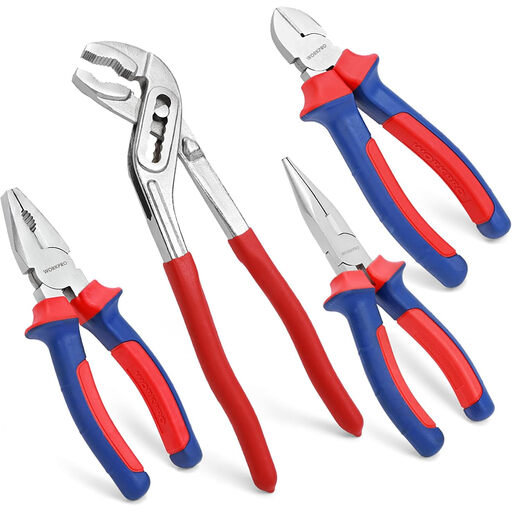
Why This Fits Their Persona: A straightforward option for UK homeowners, renters and DIY starters who want core tools for household maintenance without selecting each type separately.
The contents are clearly defined: 160mm combination, long nose and side-cutting pliers plus 244mm water pump pliers, rather than relying on an unclear piece count.
Drop-forged, heat-treated alloy steel; PP and TPR resin handles with a non-slip texture; useful coverage for household, electrical and plumbing tasks.
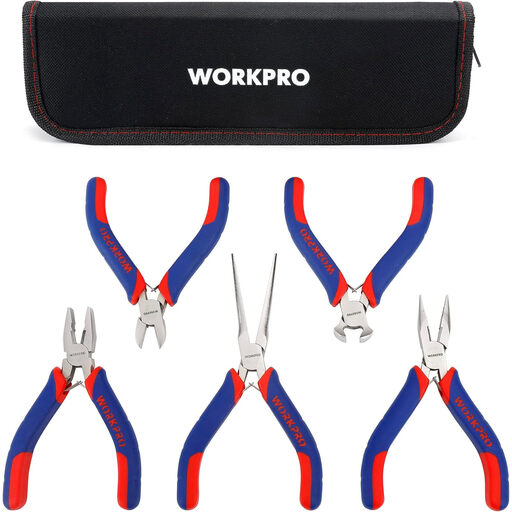
Why This Fits Their Persona: Suited to jewellery makers, electronics repairers, model builders and crafters who prioritise controlled handling and organised storage for small work.
The set identifies each tool and its size, including 108mm side cutters, flat-nose, needle-nose and combination pliers, so buyers can match the jaws to precise tasks.
HRC55–65 hardened jaws, double spring strips, bi-material rubber handles and a 600D nylon zip pouch.
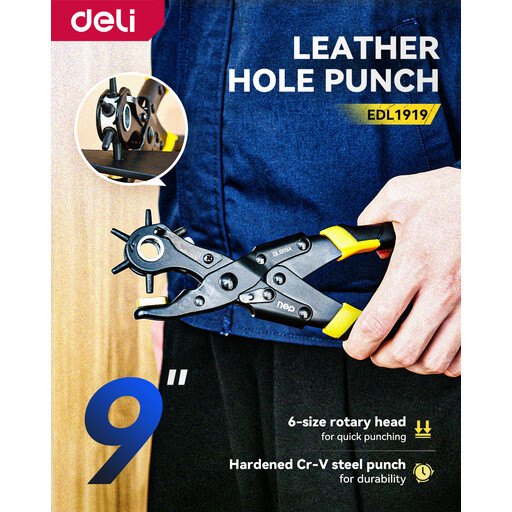
Why This Fits Their Persona: Designed for leatherworkers, repairers and crafters who repeatedly make round holes in leather, fabric, plastic or canvas rather than needing general gripping tools.
It provides six stated punch sizes—2mm, 2.5mm, 3mm, 3.5mm, 4mm and 4.5mm—so the required hole diameter can be selected rather than guessed.
High-hardness plated steel construction, padded non-slip grips, double-lever operation and a brass pad with a thickened safety design.
Use the tool intended for the material and task. Keep fingers clear of closing jaws, support leather or other workpieces on a stable suitable surface, and inspect pivots, handles and cutting edges before use.
Cutting tools can eject fragments, so safety glasses are sensible. Do not use ordinary pliers on live electrical circuits; electrical work should be isolated and handled with appropriate equipment and competence. Keep tools away from children and do not continue using any item that is cracked, loose or visibly damaged.
We have compiled a complete, real-time list of products that fully satisfy these strict selection criteria and UK safety regulations.
For general repairs, look for combination pliers, long nose pliers, side cutters and water pump pliers. These cover gripping, reaching, cutting suitable wire and handling larger fittings. Add specialist tools only when your projects require them.
Lifespan depends on frequency of use, material choice, force applied and storage. Wipe tools after use, keep them dry, oil pivots occasionally and avoid cutting materials beyond the stated capacity. Correct tool selection usually matters as much as the steel specification.
Small jaws can offer better access and control around wire, beads and model components. However, mini precision pliers are not intended for heavy gripping or high-force cutting. Choose jaw shape—flat-nose, needle-nose, side cutter or front cutter—according to the particular jewellery-making task.