
24/7 Customer Support

Free returns

Same-day & Next-day Delivery

Quality Guaranteed

Unlock Your Welcome Offers: FREE Delivery | Up to 80% OFF | Free 30-day JoyPlus trial
Download the APP
Instant photography is appealing because it turns a phone image or camera moment into something tangible. However, buying the wrong film, format or printer can quickly make the hobby more expensive than expected. Before choosing between Polaroid instant cameras, film and photo printers, check how the system works, what each refill costs and whether it suits the way you actually take pictures.
Film formats are not interchangeable. Polaroid Go film is made for the compact Polaroid Go camera, while Polaroid i-Type film fits modern full-size cameras such as the Polaroid Now, Polaroid Now Gen 3, Polaroid Flip and I-2. Older cameras may require Polaroid 600 film because the cartridge includes a battery.
Always check the camera and film compatibility list before ordering. A lower-priced pack is not good value if it cannot be loaded into your camera.
A single eight-shot film pack may look affordable, but parties, holidays and family events can use several packs quickly. Compare the total number of exposures, not just the number of cartridges. Twin-packs and five-packs can reduce the frequency of reordering, although film still has a use-by date and should be stored appropriately.
For phone printing, also distinguish between printer cartridges and ordinary paper. The Polaroid Hi-Print system uses all-in-one cartridges containing both the paper and printing components.
Instant film has a changing, analogue appearance. Colour, contrast and development can vary with lighting, temperature and handling. Polaroid colour film typically takes around 10–15 minutes to develop, so it is not the same as a photo appearing immediately on a screen.
For more predictable results from a smartphone image, a portable photo printer may be more suitable. The Polaroid Hi-Print uses dye-sublimation technology and produces small prints in under 60 seconds, while retaining a physical, peel-and-stick format.
Full-size Polaroid film has a frame measuring approximately 107 × 88 mm, with an image area around 79 × 79 mm. It suits cameras such as the Polaroid Now Gen 3 and Polaroid Flip, producing the familiar large white-frame photograph.
Polaroid Go film is considerably smaller and is designed specifically for the pocket-sized Go camera. Its compact dimensions are convenient for travel, journals and small displays, but it will not fit full-size cameras.
The Polaroid Hi-Print 2x3 system produces prints measuring approximately 54 × 86 mm. These are close to business-card size and include a sticky backing, making them practical for scrapbooks, notebooks and smooth surfaces. The Hi-Print 4x6 system is designed for larger postcard-style prints measuring 102 × 152 mm.
For casual use, look for straightforward controls, a built-in flash and a rechargeable battery. The Polaroid Now Generation 3 has a two-lens autofocus system, self-timer, double-exposure mode, tripod mount and USB-C charging. It works with both i-Type and 600 film.
The Polaroid Flip adds an LED display for film count and battery status, Bluetooth connectivity and app-based controls. Its lens system uses four focus zones from close subjects to infinity. The folding design also helps protect the lens when the camera is stored in a bag.
Hi-Print cartridges are made for a specific printer size, so confirm whether your device uses 2x3 or 4x6 supplies. The 2x3 20-sheet cartridge is suitable for occasional use, while 60-sheet packs are more practical for frequent journalling, events or creative projects.
The supplied product information states that the Hi-Print printer uses 30% recycled materials, while compatible 2x3 cartridges use 99% recycled materials. These figures describe material content, not a guarantee of overall environmental impact. For responsible use, avoid wasting test prints and follow local recycling guidance for packaging and spent cartridges.

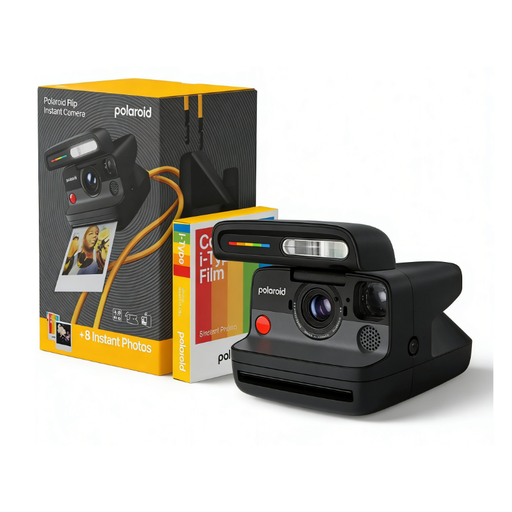
Why This Fits Their Persona: It includes a colour i-Type film pack, so first-time buyers can start taking full-size photos without sourcing a separate film pack immediately.
The box makes the camera-and-film requirement clear, while compatibility with i-Type and 600 film gives buyers more refill options.
Two-lens autofocus, USB-C rechargeable battery, self-timer and included eight-shot colour film.
Why This Fits Their Persona: Its folding body, scene analysis and app connectivity suit photographers who want more control while travelling or shooting social occasions.
The on-camera display shows battery and film status, helping reduce the risk of unexpectedly running out during a shoot.
Four focus zones, Bluetooth app control, tripod mount and compatibility with i-Type and 600 film.

Why This Fits Their Persona: Smartphone users, scrapbookers and party hosts can print repeatedly without using analogue camera film for every image.
The bundle includes 40 sheets, so the initial purchase does not leave you with a printer but no consumables.
Bluetooth printing, 54 × 86 mm peel-and-stick photos, USB-C charging and iOS and Android support.
For refill planning, the Polaroid Hi-Print 2x3 Cartridge 60 Sheets provides 60 prints, while the 20-sheet cartridge suits occasional printing. Full-size camera users can compare Polaroid Colour Film i-Type 2 Pack and larger 40-shot Polaroid film packs. Go owners should choose the dedicated Polaroid Go Film 2 Pack or 48-shot six-pack rather than full-size film.
We have compiled a complete, real-time list of products that fully satisfy these strict selection criteria and UK safety regulations.
Most colour i-Type and Go film takes approximately 10–15 minutes to develop under normal conditions. Keep the photograph flat and shielded from direct light while it develops. Do not shake, bend or press the image.
No. i-Type film is battery-free and draws power from compatible modern cameras. Vintage cameras generally require Polaroid 600 film, which contains the battery needed by those devices. Check the exact camera model before buying.
The answer depends on the refill price and how often you print. A printer lets you select and edit smartphone images before using paper, which can reduce unwanted shots. However, it requires dedicated cartridges. Compare the cost per sheet of each refill, including whether the pack contains 20, 40, 60 or 80 prints, before making a purchase.