
24/7 Customer Support

Free returns

Same-day & Next-day Delivery

Quality Guaranteed

Unlock Your Welcome Offers: FREE Delivery | Up to 80% OFF | Free 30-day JoyPlus trial
Download the APP
Choosing police toys for kids can be more complicated than it first appears. A flashing police car toy may look exciting online, yet need frequent battery changes. A large ride-on police car may offer impressive features, but require storage space, charging time and a suitable outdoor surface.
Parents, grandparents and gift buyers can avoid costly mistakes by checking three things before ordering: the child’s age and ability, the type of play the toy supports and the practical requirements behind the headline features.
A toy marked for ages 3+ may still contain small accessories that require close supervision. Building sets with figures, handcuffs, tools or other miniature parts are generally more suitable for older children who can follow instructions and keep pieces away from younger siblings.
For toddlers, look for chunky components, easy-grasp shapes and simple movement. For children aged 6 or 7, a police building blocks set or more detailed police vehicle toy may provide a more suitable challenge.
Lights, sirens and music can increase play appeal, but they also add running requirements. Check whether the product uses AA or AAA batteries, whether they are included and whether a rechargeable battery needs several hours to charge.
A ride-on police car typically needs more planning than a push-along vehicle. For example, the listed HOMCOM and AIYAPLAY models use a 12V rechargeable battery, require assembly and offer up to approximately 45 minutes of riding time depending on use. That may suit garden play, but not a small flat with limited storage.
A ride-on vehicle can be over one metre long, while a LEGO City police train may need a sizeable play area once its track is assembled. Measure doorways, storage cupboards and the intended play space before purchase.
For compact homes, a police motorcycle toy, small police car toy or police role-play toys may be easier to store and use regularly.
Use the manufacturer’s recommended age as a starting point, then consider the child’s coordination and maturity. Products such as the LEGO DUPLO Town 10471 Blue Police Motorcycle are designed for children from age 2 and use larger pieces. By contrast, the Playmobil 5673 City Action Police Cruiser is suitable from age 4 and includes small accessories, while several LEGO City sets are intended for age 6 or 7 and carry small-part warnings.
For children under 3, avoid products containing small detachable parts or strong magnets. The XINQIYUAN magnetic police building blocks set specifically warns about small strong magnets and recommends adult supervision. Store magnetic pieces securely and stop using any tile if it becomes cracked or exposes its magnet.
For building sets, check piece size, connection method and storage. A set with a dedicated bag can help prevent lost parts. For ride-on toys, examine the maximum load, seat dimensions, wheel size, speed range and whether adult remote control is provided.
The listed HOMCOM ride-on police car supports up to 30 kg, has a single seat, adjustable speed from 3–5 km/h and includes a remote control. The AIYAPLAY version also supports a maximum load of 30 kg, with a stated speed range of 3–7 km/h. These figures are more useful for planning than vague descriptions such as “powerful” or “realistic”.
A battery-powered police vehicle toy should be matched with the child’s usual play location. The Playmobil police cruiser requires 2 x AA batteries, which are not included. The VTech Toot-Toot Drivers police car uses 2 x AAA batteries, supplied with the product. The LEGO City Police Boat Chase and LEGO City Police Prisoner Transport Van do not require batteries.
For ride-on models, allow the stated charging period and use only the supplied or compatible charger. Operate them on appropriate flat surfaces, follow the seat-belt guidance and keep the adult remote control available when required.
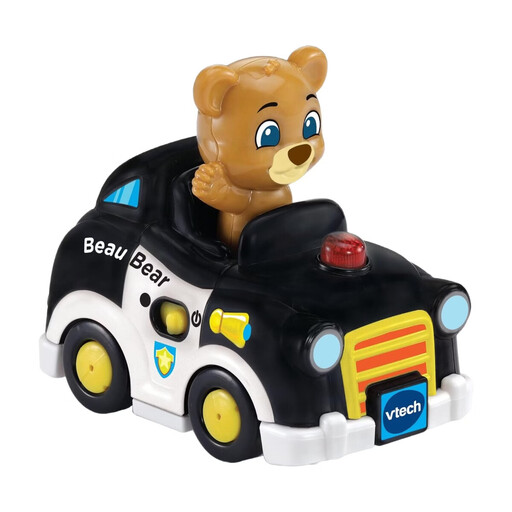
Why This Fits Their Persona: A compact first police car toy for younger children, suitable from 12 months to 5 years and easy to push across indoor floors.
Its compact format avoids the storage demands of a ride-on vehicle, while the stated battery type and included batteries make setup more straightforward.
Push-and-play operation, light-up button, sounds and SmartPoint compatibility. Suitable for younger children than many detailed police sets.
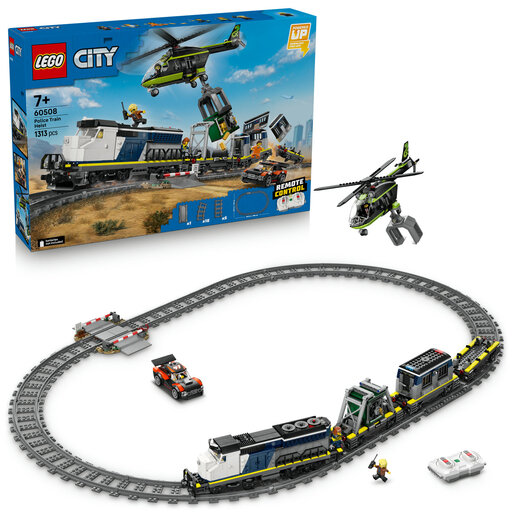
Why This Fits Their Persona: A substantial gift for children aged 7+ who enjoy construction, moving vehicles and longer-form storytelling.
The 1,313-piece contents, motorised locomotive, track and six minifigures provide clearly stated play components rather than relying only on lights or sound.
Includes a remote-controlled train, oval track, helicopter with grabbing claw and prison cell. No separate toy batteries are listed.
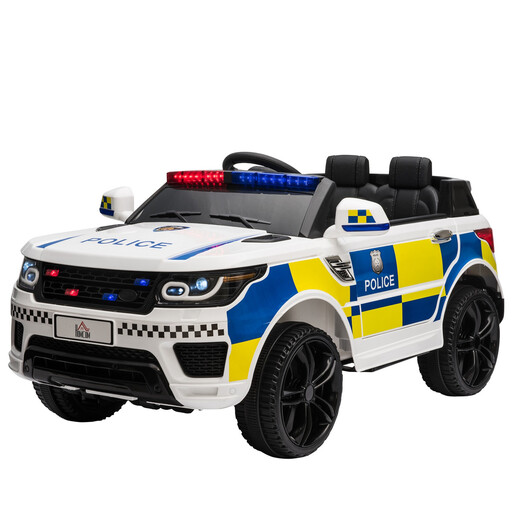
Why This Fits Their Persona: Suits families with garden or park access who want an active ride-on police car for children aged 3–6.
The listing specifies speed, load capacity, single-seat design, remote control, seat belt and dimensions, helping buyers assess whether it fits their child and home.
Dual control, flashing lights, siren, USB/AUX/Bluetooth music options, suspension and a foldable pull handle with auxiliary wheels.
We have compiled a complete, real-time list of products that fully satisfy these strict selection criteria and UK safety regulations.
Choose chunky, easy-to-hold products such as LEGO DUPLO or a simple three-wheel ride-on bike. Avoid sets with small figures, weapons, handcuffs or loose accessories. Always follow the product’s age grading and supervise play where recommended.
Their main ongoing requirements are electricity for charging and occasional battery replacement over time. Check the listed charging duration, expected run time, charger specifications and storage conditions. Models with lights, sirens and music may use power more quickly than a basic ride-on vehicle.
Lifespan depends on construction, frequency of use and storage. Keep electronic toys dry, remove batteries if they will be stored for a long period and inspect ride-on vehicles, wheels and chargers regularly. For building sets, use the supplied storage solution to reduce missing pieces and keep small parts away from younger children.